
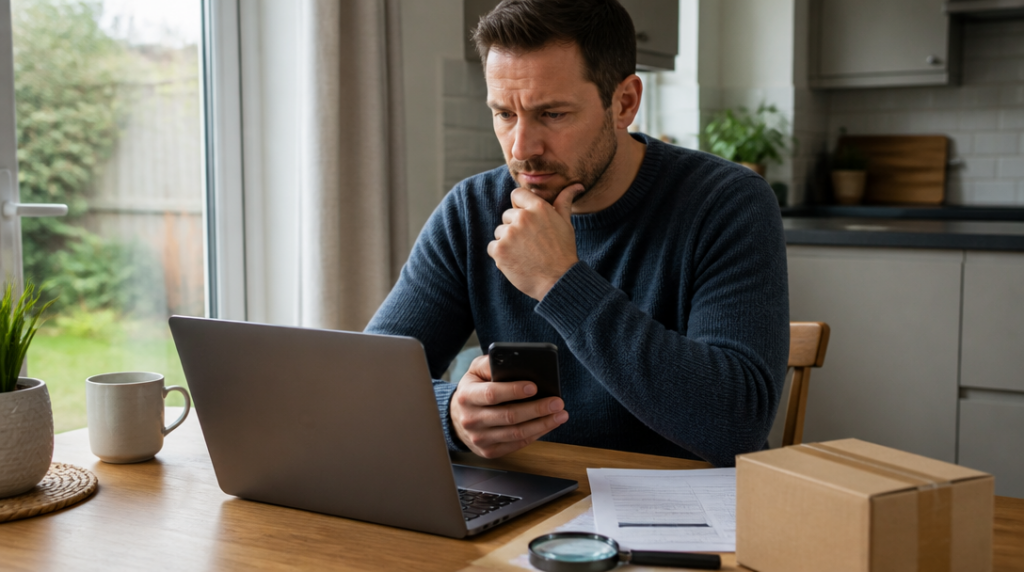
Aisha was ready to order a £180 office chair. The product page showed hundreds of glowing reviews, many praising the same features in almost identical language: excellent support, perfect comfort, fast delivery. Then she noticed that several reviews mentioned a colour the chair did not come in. Others described parts that were missing from the product photographs.
She searched elsewhere and found a much less flattering picture. Customers complained about damaged deliveries, difficult returns and a seat that became uncomfortable after a few weeks. Aisha bought a different chair instead. The first page had not merely failed to help her; it had nearly persuaded her to make an expensive mistake.
That is why adding a section on reviews, ratings and consumer rights in the UK is such a strong idea. It offers two clear benefits: it helps people make safer choices before they buy, and it explains what businesses and platforms are expected to do when information has been manipulated.
Reviews are not harmless decoration
Many shoppers treat star ratings as a shortcut. A product with 4.8 stars feels safer than one with 3.9, even if the difference comes from a relatively small number of reviews. People also scan the comments for practical details: whether shoes run small, whether a hotel room is noisy, whether a phone charger overheats or whether a sofa really fits through a narrow doorway.
That shortcut can be useful, but it is easy to exploit. A well-written fake review does not need to make extravagant claims. It only needs to sound like an ordinary customer describing an ordinary experience. One government experiment found that convincing fake reviews increased the likelihood of purchase by 3.1%. Poorly written fake reviews had the opposite effect, reducing the likelihood of purchase by 5.3%.
The difference is revealing. Shoppers are not simply responding to praise. They are judging whether the praise sounds human. A short comment such as “Lovely product” may be ignored, while a detailed account of delivery, packaging and everyday use can create trust, even if the writer has never bought the item.
Consumers are not especially well equipped to detect this. Research in the UK found that 41% of people find fake reviews difficult to identify, while only 17% consider the task easy. That leaves a large gap between the confidence people place in ratings and their ability to test whether those ratings deserve confidence.
A useful consumer-rights section can narrow that gap without pretending that every suspicious review is obvious. It can teach readers to look for patterns rather than hunt for one magical warning sign. Repeated phrases, a sudden flood of reviews, vague praise with no product details, reviews posted before an item was available and comments that describe a different product all deserve caution. None proves fraud on its own. Together, they may tell a different story from the star rating at the top of the page.
The law now puts responsibility on more than the shopper
From 6 April 2025, UK law under the Digital Markets, Competition and Consumers Act 2024 made it illegal to create, commission, publish or host fake consumer reviews. The change matters because responsibility no longer rests only with the person who clicks “buy” and hopes for the best. Those who manufacture false praise, arrange for it to be posted or knowingly provide a home for it can all fall within the problem the law is designed to address.
That does not mean every negative review is genuine or every positive review is suspicious. It means the systems surrounding reviews should be capable of dealing with obvious manipulation. Platforms need to think about how reviews are submitted, how unusual activity is detected and whether businesses are attempting to influence the picture customers see.
The Competition and Markets Authority began investigating five companies in March 2026 over suspected breaches of online review rules. An investigation is not a finding of wrongdoing, but its existence sends a practical message: review practices are now receiving serious regulatory attention rather than being treated as a minor issue in online merchandising.
Amazon Europe Core SARL also committed on 6 June 2025 to strengthen its systems against fake reviews and catalogue abuse. Such changes are significant because large marketplaces sit between millions of sellers and customers. Their design decisions can determine whether a misleading rating is quickly buried, prominently displayed or quietly removed.
The public should not have to understand the technical machinery behind a review platform. Still, people deserve to know that a high rating is not being manufactured in the background while they are comparing prices on a phone.
A fake review can be only a few sentences long, but its commercial effect can last much longer.
Why independent checks matter
A platform’s own promises are useful, but they are not the whole answer. Businesses have a financial interest in looking attractive, and platforms earn money from the activity taking place on them. That is why independent scrutiny, transparent rules and accessible complaints processes matter alongside automated detection.
One major review platform said it removed 4.5 million fake reviews in 2024, with automated detection models identifying 90% of them. The figures show both the scale of the problem and the value of technology. Automated systems can notice patterns that a human moderator would struggle to spot across millions of posts: clusters of accounts, unusual timing, repeated language or activity connected to known networks.
Automation is not infallible. A genuine customer may write in a style that resembles other users, post several reviews after a shopping trip or use a new account because they rarely leave feedback. A platform that removes reviews without a clear process can create a different kind of unfairness. People should have some way to challenge an incorrect removal, while businesses should not be able to hide legitimate criticism simply by reporting it repeatedly.
The best approach is layered. Software can flag unusual behaviour, trained reviewers can examine context, and clear rules can explain why content was removed or retained. Readers do not need a technical lecture every time they open a product page, but they do benefit from signs that the system is actively checking the material rather than displaying every submission without question.
Consumer rights begin before the payment screen
Consumer protection is often discussed as if it starts when a parcel arrives damaged. In reality, it begins earlier, when a person is deciding whether the product, service or trader deserves their money. Misleading reviews can distort that decision before the customer has any chance to use formal complaint channels.
That makes reviews part of consumer information, not merely online conversation. A customer comparing two tradespeople, booking accommodation or choosing a health-related product may be influenced by ratings that appear to confirm quality. If the underlying praise is fabricated, the buyer is making a decision with a distorted view of the market.
A practical guide should therefore explain what to do when the experience does not match the promises. Save the order confirmation, product description, photographs, messages and relevant reviews. Write to the trader clearly and keep a record of the response. If the problem concerns a review platform, report the specific content and describe the evidence rather than simply calling it “fake”. Screenshots can be useful when a listing or review later changes.
Readers should also be encouraged to separate two questions: “Was the review genuine?” and “Was my purchase acceptable?” A review may be authentic while the product still fails to meet expectations. Conversely, a suspicious review may alert a customer to investigate further, but it does not automatically prove that a trader has broken every consumer rule.
That distinction keeps advice calm and useful. People need a route through the problem, not a promise that every dispute will be settled instantly.
What responsible businesses should do
Honest businesses gain from a cleaner review environment because fabricated praise can push them below competitors that are willing to manipulate ratings. The solution is not to ask only satisfied customers for five stars or to offer rewards that quietly favour positive feedback. Businesses should invite genuine feedback in a consistent way and make it clear that customers are free to be honest.
They should also avoid editing criticism into something flattering, hiding unfavourable comments or commissioning reviews from people who have not used the product. If a customer posts an unfair claim, the proper response is evidence and a measured explanation, not pressure to remove it.
Clear responses can be more persuasive than a spotless rating. A trader who acknowledges a delivery problem, explains what changed and answers a specific complaint often appears more credible than one surrounded by hundreds of vague compliments.
For readers, this is the lasting value of a dedicated UK section on reviews and consumer rights. It can turn a confusing online signal into something people know how to question. A rating is a clue, not a guarantee; a review is evidence of one person’s experience, not a substitute for checking the seller, the terms and the product itself.