
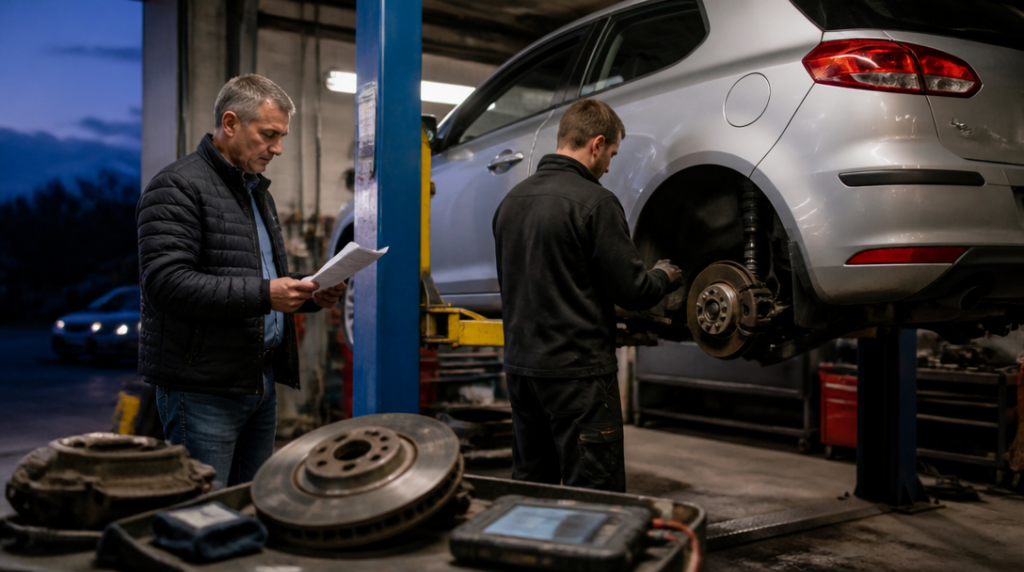
The first question is not “How much is a service?”
If your car went into a UK garage tomorrow, would you expect to pay £140, £300, or more than £600? There is no single average that answers the question, because “car service” covers several different jobs and repair bills belong to an entirely different category.
The figures are still useful. They show the rough scale of the expense, provided you do not treat one headline number as a promise.
A full service averaged £298.60 in offers made between 1 September and 30 November 2025. That is a striking figure beside other recent averages, which put a full service at £179.75 for bookings made during 2024 and 2025.
Neither number is necessarily wrong. They may reflect different garages, locations, vehicle types, booking methods and definitions of “full service”. An average is not a quote. It is a line drawn through a messy collection of prices.
Servicing is cheaper when the work is smaller
An interim service averaged £140.71 in the same 2024–2025 booking data. That price is closer to what many drivers imagine when they hear “service”, especially if the car is relatively young and the work is limited to routine checks, fluids and filters.
A major service averaged £237.24. The gap between that and the £179.75 full-service figure is not large enough to make the labels especially reassuring. Different garages package their work differently, and manufacturers may set their own service schedules.
That is why comparing the name of the service alone can be misleading. One garage’s full service may include more replacement items than another’s. A cheap booking may cover inspections but exclude parts that the car’s maintenance schedule calls for.
The strongest warning sign is a quote that says little about what will actually be done. Ask for the work to be specified, not merely labelled.
Another set of market figures, based on prices from 1 April to 31 May 2026, put a full service at £187 or more and a major service at £227 or more. The wording matters: “from” is an entry price, not an expected final bill. It tells you where the pricing starts, not where your particular car will finish.
Location and car type can change the answer
A service price for a small petrol hatchback should not be compared casually with the price for a large diesel SUV, a premium model or a car requiring specialist equipment. Labour rates also vary between regions and between independent garages, dealer workshops and national chains.
The same job can therefore produce very different quotes without either garage behaving dishonestly. A driver in a city centre may face higher labour costs, while a rural garage may have fewer competing businesses. A main dealer may charge more but use manufacturer-specific procedures, whereas an independent garage may offer a lower labour rate.
That does not make the most expensive option automatically better. It does mean that a price comparison needs more than two numbers placed side by side.
Even a routine service can uncover work that was not part of the original booking. Worn tyres, low brake-pad material or a weak battery may be spotted during inspection. The discovery is useful, but it also turns a predictable expense into a decision about whether to authorise additional work immediately.
Repairs are where the budget gets tested
The average unexpected repair bill reached £650 in 2025. That figure explains why a modest service price can create a false sense of security. The costly part of motoring is often not the scheduled visit but the fault that appears without warning.
A clutch replacement averaged £753, while replacing a timing belt averaged £600. An overheating-engine repair averaged £665. Each of those bills is large enough to disrupt a monthly budget, especially when the car is needed for work or family commitments.
These averages also hide a crucial difference between a repair and a replacement. A clutch job may involve related components, and an overheating engine may have anything from a relatively contained fault to serious damage. The first diagnosis does not always reveal the full cost.
This is where online price guides can become more comforting than useful. They offer a neat figure for a job that may not be neat at all. A garage can quote accurately only after identifying the failed part and understanding what else it may have damaged.
The ordinary repairs are not especially ordinary anymore
The smaller figures are easier to absorb, but they still add up. Average prices for common repairs included £237 for brake discs, £189 for a battery, £133 for brake pads and £94 for a tyre.
None of these amounts is catastrophic on its own. Two tyres, discs on more than one axle or a battery fitted alongside another repair can quickly turn a manageable visit into a four-figure period of car ownership. The bill does not care that each individual item looked “average”.
Tyres are a particularly good example of why the headline price needs context. A £94 average says nothing about the tyre’s size, brand, performance rating or whether a matching pair is needed. Choosing purely by price may be tempting, but a tyre is not an interchangeable household consumable.
Batteries also expose a common omission. The replacement itself may be one cost, while fitting or registering the battery on some modern vehicles may add complexity. That requirement is not universal, so it should be checked rather than assumed.
Why the cheapest quote can be the wrong comparison
A low advertised service price may exclude diagnostic work, replacement parts, manufacturer-specific items or additional labour. The garage may still be offering exactly what it advertised. The problem is that the customer may have assumed the advert meant something broader.
The sensible comparison is between written descriptions of the work. Does the price include oil and the correct filter? Are checks listed? Are parts included? Will the garage contact you before carrying out extra work? These questions are less glamorous than searching for the lowest number, but they are far more likely to prevent an unpleasant surprise.
You should also ask whether the quote is fixed or subject to inspection. A fixed price can provide certainty, but it may apply only to the stated service. A quote subject to inspection may be more honest about the condition of an older vehicle, though it leaves the final amount open.
I find garage invoices slightly like restaurant menus: the large price at the top catches your eye, while the small additions decide what you actually pay. With cars, those additions are usually not optional extras in the usual sense. They are parts that have failed or worn out.
What drivers should do with the averages
Use the figures as planning markers. Around £140 suggests the scale of an interim service; roughly £180 to £300 shows how widely full-service pricing can move; and £600 to £750 is a realistic warning for several major unexpected repairs.
Do not use them as evidence that your garage is overcharging simply because its quote is higher. Check what is included, whether the vehicle needs a more extensive service, and whether the repair involves related parts or specialist labour.
A service history can make the conversation easier because it shows what has already been replaced and when. Without that information, a garage may reasonably recommend checks or maintenance that another workshop would treat as already completed.
For an older car, the more difficult question is not whether a repair is expensive. It is whether the repair makes sense alongside the car’s condition, likely future maintenance and current value. A £753 clutch bill can be painful on a reliable car with years of useful life left, yet hard to justify on a vehicle already accumulating faults.
The UK’s average servicing and repair costs are high enough to demand preparation, but too inconsistent to support a single magic number. The useful figure is the one attached to a clearly described job on your particular car, before the keys are handed over and the inspection begins.