
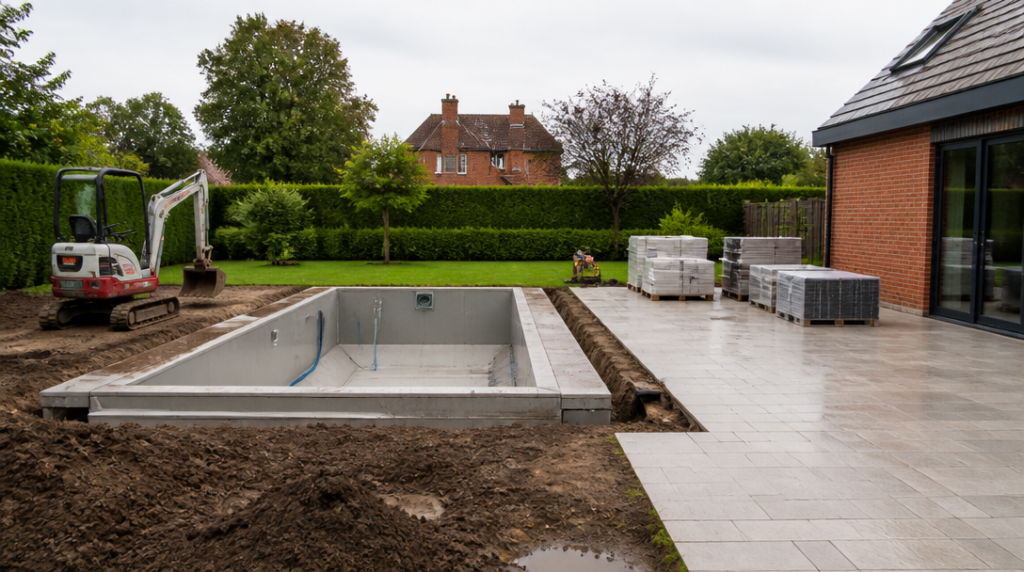
A swimming pool in the UK can cost as much as a family car, a house extension or even a small flat: installation prices in 2026 range from roughly £3,000 to £100,000, with a typical project costing about £45,000 including installation. That range is enormous because “a swimming pool” can mean anything from a modest above-ground setup to a fully excavated, heated concrete pool with elaborate landscaping and a specialist cover.
For homeowners considering an in-ground pool, the headline price is only the beginning. The shape and construction method matter, but so do soil conditions, access for machinery, drainage, heating and the amount of garden that needs rebuilding afterwards. A quotation that looks attractively low can change quickly once the dig begins.
The £45,000 middle ground is not a standard package
The typical figure of around £45,000 is useful as a planning guide, not a fixed market price. It generally points towards a properly installed domestic pool rather than a simple temporary structure, but the exact specification can vary dramatically.
At the lower end, a small or above-ground pool may be possible for a few thousand pounds, especially where the installation is uncomplicated and the surrounding work is limited. That is a very different project from an in-ground pool with filtration, heating, lighting, paving and a safety cover. At the upper end, complex sites and high-specification finishes can push the total towards £100,000.
An 8-by-4-metre in-ground pool is a useful size for comparing materials. A lined pool of this size typically costs about £30,000 to £55,000 including VAT. A fibreglass version is more likely to fall between £50,000 and £75,000, while a concrete pool can reach approximately £75,000 to £130,000.
Those figures are not simply three prices for the same product. Each construction method brings different design possibilities, installation requirements and finishing options. A liner pool may offer a more controlled budget, while fibreglass shells are manufactured in advance and can be installed relatively quickly. Concrete allows the greatest freedom over shape and dimensions, but that flexibility usually comes with a higher price and a longer build.
Excavation is where the garden starts charging you
Groundworks commonly add between £8,000 and £25,000. The difference is driven by soil, depth, access and the practical difficulty of removing excavated material from the site.
A garden with clear side access may allow a digger to reach the pool area directly. A property surrounded by narrow passages, walls or neighbouring buildings may require smaller machinery, additional labour or more time. Spoil also has to go somewhere. If lorries cannot get close to the excavation, moving soil from the back garden can become a surprisingly labour-intensive job.
Ground conditions create another layer of uncertainty. Ordinary soil is one thing; dense clay, rock, groundwater or unstable ground is another. The pool may need extra drainage, reinforcement, pumping or structural work before construction can continue. These are not cosmetic upgrades. They are responses to what the site physically demands.
This is why a serious quotation should explain the assumptions behind the groundworks rather than presenting one unexplained allowance. Ask whether excavation, spoil removal, drainage, concrete, backfilling and reinstatement are included. A pool can look affordable on paper until each of those items appears as a separate variation.
Fibreglass is quicker; concrete buys freedom
Fibreglass pools are delivered as a manufactured shell. Once the excavation and base are ready, the shell can be positioned and connected to the filtration system without waiting for the pool structure to be built and cured on site. Installation commonly takes around four to eight weeks, depending on the wider project and site conditions.
The main limitation is choice. The manufacturer’s available shapes and sizes determine what can be installed, and transporting a large shell to the property may itself require careful planning. Access needs to be checked before the design is finalised, particularly if the shell must be lifted over a house or carried through a restricted route.
Concrete pools take longer, commonly around eight to sixteen weeks. They can be designed around the garden rather than selected from a catalogue, which makes them suitable for unusual sites, custom depths, integrated steps and distinctive shapes. That freedom comes at a cost: more construction stages, more specialist labour and a longer period during which the garden is a building site.
A lined pool sits between these options in terms of price and construction approach. Its finish can help control the initial budget, although the liner is a component that may eventually need replacement. The right choice depends on the planned shape, the site, the desired finish and how much value you place on speed versus customisation. The cheapest initial option is not automatically the cheapest over the pool’s full life.
Heating and covers decide whether the pool gets used
The pool itself is only part of the decision. In the UK, outdoor water is unlikely to remain inviting for much of the year without heating, and heating can become one of the largest ongoing costs. Running an outdoor heated pool typically costs around £1,000 to £3,000 a year, depending on the season, water temperature, pool size, insulation, cover and energy system.
A good cover is not a decorative extra. It reduces heat loss and evaporation, keeps debris out and can reduce the workload on the filtration and heating equipment. Without one, the pool may need more energy and chemicals simply to maintain the same condition. A solid safety cover, automatic system or low-profile enclosure will raise the installation cost, but it can make regular use more practical.
Heating options vary. Heat pumps are commonly considered for efficiency, although they work best when matched with sensible insulation and a suitable cover. Gas or other systems may provide faster heating in some circumstances, but their running costs and installation requirements need to be assessed carefully. The installer should explain the expected operating pattern rather than quoting a heating system in isolation.
Filtration, pumps, dosing equipment, lighting, steps and controls also affect the budget. These items are easy to overlook because they are less visually impressive than the pool finish. They are also the parts that determine whether maintenance feels straightforward or becomes a weekly chore. Personally, I would rather spend money on dependable filtration and a proper cover than on decorative features that only look impressive in a brochure.
The patio, fence and access route belong in the budget
Many homeowners focus so closely on the pool that they forget the surrounding garden. Excavation can damage lawns, paving, planting, walls and drainage routes. Once the pool is finished, the area may need new paving, retaining walls, steps, planting or fencing before it feels like part of the property again.
Safety requirements and the layout of the garden may influence the design. Gates, barriers and covers can all affect how the pool is accessed and secured. A pool positioned too close to a boundary may also create practical complications, while a pool placed far from the house may require a larger area of paving and a longer route for services.
Access should be discussed at the first survey, not after the contract is signed. The installer needs to know where machinery can go, how materials will arrive and whether a crane or specialist lifting arrangement could be needed. Even when the pool installation itself is straightforward, restoring a confined garden can add weeks and a substantial sum to the project.
A useful quotation separates the pool structure from site preparation, plant equipment, heating, cover, electrical work, landscaping and VAT. It should also make clear what happens if rock, groundwater or poor ground is discovered. Allowances for uncertain work are not necessarily a warning sign; hiding those uncertainties is.
For budgeting purposes, begin with the type and size of pool you actually want, then add a realistic groundworks allowance and the equipment required for comfortable use. An 8-by-4-metre lined pool may sit around £30,000 to £55,000 including VAT, but a fibreglass or concrete specification can move the figure substantially higher before the final paving and landscaping are finished. The garden may be the part of the project that decides the price.