
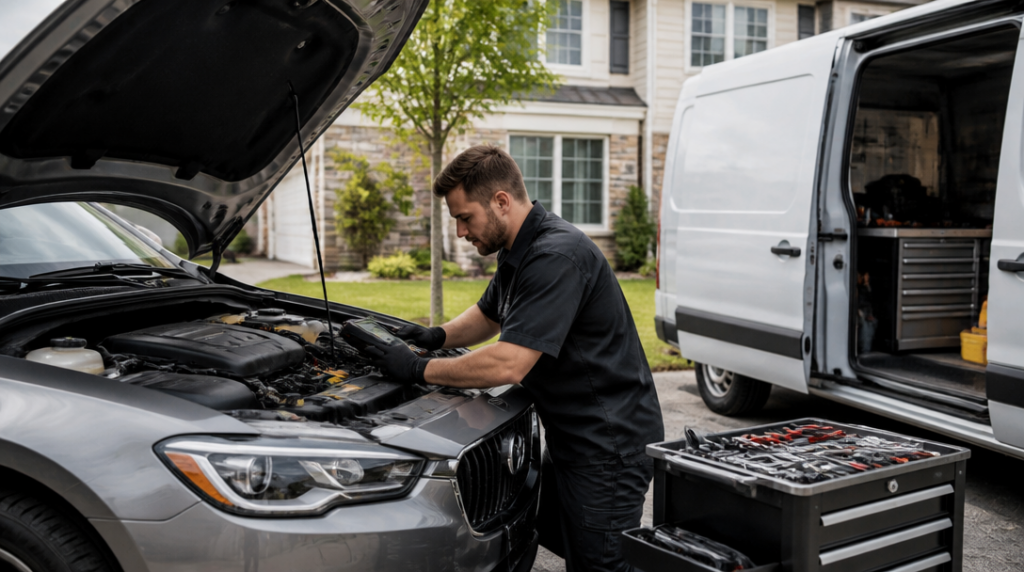
Your car refuses to start outside the office, and the last thing you want is to pay for a tow before anyone has even looked under the hood. A mobile mechanic may be able to come to you, diagnose the fault, and complete the repair right there in the parking space.
That convenience has a price, but it is often more transparent than drivers expect. In the United States, mobile mechanics commonly charge between $80 and $170 per hour in 2026, with a typical working rate of about $110 per hour. A separate diagnostic or travel charge may add another $50 to $150, although many mechanics subtract that fee from the final repair bill.
The number on the invoice depends on more than the hourly rate. The vehicle, the fault, the parts, the location, and even the surface beneath the car can all change the final cost.
The first bill may arrive before the toolbox opens
A mobile mechanic is charging for more than the minutes spent turning a wrench. The service includes travel, scheduling, equipment, and the time spent reaching a vehicle that may be stranded miles from the mechanic’s usual work area.
That is why a call-out fee is common. Some businesses treat it as a flat travel charge, while others label it a diagnostic visit. Expect roughly $50 to $150 for this first step. A mechanic may inspect the battery, scan the vehicle’s computer, test electrical connections, or identify a mechanical failure before quoting the repair.
The fee should be explained before the appointment. Ask whether it covers diagnosis only, whether travel is included, and whether the amount will be credited toward parts and labor. That one conversation can prevent the awkward moment when a modest repair suddenly comes with an unexpected service charge.
A complete mobile service averages around $150 to $200 per job, although real-world totals range from about $80 for a simple task to $1,000 for a complicated repair. The wide range makes sense: replacing a battery is a very different job from troubleshooting an intermittent electrical problem or replacing several major components.
Some mechanics charge a minimum labor period even when the repair takes only a short time. Others use fixed prices for common jobs. Neither approach is automatically better. A fixed quote can make budgeting easier, while an hourly rate may be fairer for a repair whose difficulty is impossible to predict in advance.
Why a Houston repair can cost less than a dealer visit
Location affects the bill, and Houston offers a useful example. Mobile mechanics there generally charge around $80 to $120 per hour, compared with roughly $120 to $180 per hour at dealerships. That gap does not mean every mobile repair will be cheaper, because parts, diagnostic work, and travel can narrow it, but labor alone may favor the independent service.
Typical Houston estimates put brake pad replacement at about $200 to $350 per axle. A battery replacement often falls between $180 and $300, while a starter replacement may cost approximately $300 to $500. These figures are useful for a quick reality check, not a promise. A luxury vehicle, an awkwardly mounted component, or corrosion around fasteners can push a job above the usual range.
The vehicle’s design matters more than many owners realize. A compact sedan with an accessible battery can be straightforward. A newer vehicle with a tightly packed engine bay, electronic safety systems, or a battery that requires programming may take longer and need more expensive parts. European vehicles often carry a higher labor rate as well, partly because they may require specialized tools and brand-specific diagnostic equipment.
One Austin mobile service lists a $100 diagnostic visit, a $125 hourly rate for standard work, and $175 per hour for European vehicles. It also lists a $50 travel fee. That kind of published price structure is helpful because it shows exactly how a business separates diagnosis, travel, and labor instead of blending everything into a vague estimate.
Repairs that suit the driveway, and repairs that do not
Mobile service is particularly well suited to jobs that involve accessible components and do not require a lift. Battery replacement, starter and alternator work, brake repairs, belts, sensors, ignition components, and some cooling-system repairs are often practical on-site. A mechanic can also handle inspections, routine maintenance, fault-code scans, and no-start troubleshooting without moving the vehicle.
Brake work is a good example. If the problem is worn pads and the calipers and rotors are in reasonable condition, the repair may be completed in a driveway or parking space. The mechanic still needs firm, level ground and enough room to work safely, but a full workshop is not always necessary.
A dead battery is even simpler. A technician can test the battery and charging system, install a replacement, and check that the vehicle starts correctly. That is far more useful than a jump-start that gets the car running for five minutes but leaves the original problem untouched.
The limits become clearer with major engine or transmission work. A repair requiring a vehicle lift, extensive disassembly, welding, machine work, or a controlled indoor environment may be a poor fit for mobile service. A mobile mechanic may diagnose the issue on-site and then arrange transport to a workshop, but the initial visit can still save time by preventing an unnecessary tow to the wrong place.
Weather and working conditions matter too. Heavy rain, extreme heat, poor lighting, loose gravel, and cramped underground garages can make an otherwise manageable job unsafe. I would rather see a mechanic postpone a repair than watch someone balance a floor jack on uneven ground beside moving traffic. Convenience is not worth gambling with basic safety.
How to get a quote that means something
Describe the symptoms before asking for a price. “The car is broken” tells a mechanic almost nothing. Mention whether the engine cranks, whether the dashboard lights appear, whether the vehicle stalled while driving, and whether any warning lights came on. Include the make, model, year, engine, location, and recent repairs.
A short video or photo can help with visible problems, especially damaged belts, leaking hoses, warning lights, or a flat tire. It cannot replace a proper diagnosis, but it may help the mechanic bring the right tools and likely parts on the first visit.
Ask for the estimate in separate pieces: diagnostic or call-out fee, travel charge, labor rate, expected labor time, parts, shop supplies, taxes, and any programming or disposal fees. A trustworthy estimate should also explain what happens if the mechanic finds an additional problem after disassembly.
Parts deserve special attention. A low quote may use aftermarket or remanufactured components, while a higher quote may include original-equipment parts. Neither choice is automatically wrong, but the customer should know what is being installed and what warranty comes with it. For a battery, starter, alternator, or brake component, ask whether the part includes a replacement warranty and whether labor is covered if it fails.
Also confirm payment terms and cancellation rules. Some mechanics charge for arriving at the location even if the customer declines the repair. Others waive part of the diagnostic fee when the job proceeds. These policies are ordinary business details, yet they can make a noticeable difference on a small repair.
The cheapest quote is not always the cheapest repair
A mobile mechanic can save money by eliminating a tow, reducing workshop overhead, and allowing the customer to avoid taking time off for a drop-off and pickup. Those savings are real, especially for a vehicle that is already stuck at home.
Still, compare estimates by scope rather than by the largest number. A $250 brake quote may not include both axles, premium parts, a diagnostic inspection, or tax. A $400 starter quote may include everything, while a cheaper offer covers labor only. Two prices are comparable only when they describe the same repair.
Check the mechanic’s communication before booking. Does the business answer direct questions? Does it explain the diagnostic process? Will it provide a written estimate before replacing expensive parts? Clear answers are a better sign than a dramatically low hourly rate.
For urgent repairs, speed may be the deciding factor. Paying a reasonable call-out fee to get a vehicle running in a parking lot can be cheaper than losing a workday, arranging a ride, and paying for a tow. For a major repair, a mobile diagnosis followed by a second estimate from a specialist may be the smarter route.
The best on-site repair is not simply the one with the lowest advertised rate. It is the one that matches the vehicle, the fault, and the working conditions without turning a small breakdown into a larger bill.