
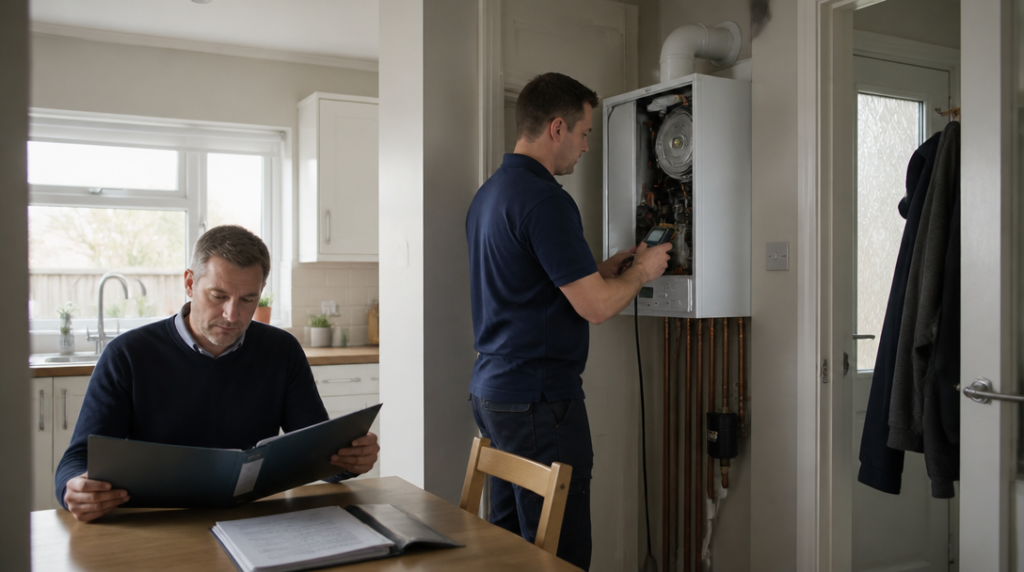
Picture a landlord called Martin, standing in a hallway with a folder full of receipts, tenancy agreements and one mysterious instruction manual for a boiler that appears to have been installed during the reign of Queen Victoria. His tenant asks for the latest gas safety record. Martin searches the folder, then the kitchen drawer, then briefly considers blaming the cat.
The cat, naturally, has no comment. Martin’s real problem is simpler: a landlord gas safety check is not complete merely because someone once looked at the boiler. The inspection must be carried out on time, by the right person, and recorded properly.
What a landlord gas safety certificate actually covers
People often say “gas safety certificate” as if it were a single document attached to the boiler. In practice, the record relates to the gas appliances and relevant flues covered by the inspection at the property. That may include a boiler, gas cooker, fire or other gas appliance provided for use by tenants.
The inspection is designed to establish whether those appliances and flues are safe to use. It is not a general home inspection, a service contract or a polite annual reminder that the boiler exists. A boiler can be running perfectly and still require its scheduled safety check.
The inspection must be carried out by a gas engineer registered with the Gas Safe Register. A landlord should check the engineer’s registration before booking the appointment, rather than relying on a van, a confident handshake or a website featuring an impressive photograph of a wrench.
The annual deadline
The gas safety check must be completed no later than 12 months after the previous check. The deadline follows the date of the last inspection, so landlords need a reliable system for tracking it rather than depending on memory and a calendar notification labelled “boiler thing”.
A landlord can arrange the next check up to two months before the deadline. This early window does not move the date on which the following check is due. In other words, a check carried out within those two months can preserve the original annual schedule instead of gradually dragging the inspection date earlier each year.
That detail matters for practical reasons. A landlord who books early in November does not necessarily want the next inspection creeping into September, then July, then a time of year when everyone is distracted by something else. The permitted early window makes planning easier without resetting the timetable.
What the safety record must contain
The completed record needs to identify the property and explain what was inspected. It must include the property address and the date of the check, along with a description and location of each appliance and flue covered by the inspection.
It must also identify the engineer and include the engineer’s registration number. Any defects discovered during the check must be recorded as well. A vague note saying “looked at boiler” is not a useful safety record, even if the boiler was looked at with considerable professional seriousness.
The record should make it clear what equipment was examined and what condition it was found in. If a fault is identified, the paperwork should not quietly turn that fault into a decorative footnote. The landlord needs to understand what has been reported and what action is required.
The document may be called a certificate in everyday conversation, but the important point is its content. A glossy title cannot compensate for missing details about the appliances, flues, engineer or defects.
Giving the record to tenants
Timing matters after the inspection too. A new tenant must receive the current gas safety record before moving into the property. Handing it over several days after the keys have changed hands does not meet that timing requirement.
Existing tenants must receive the record within 28 days of the check. This gives landlords a clear administrative task after every inspection: obtain the completed record, check that it is legible and complete, and make sure the tenant receives it within the required period.
This is one reason not to leave the appointment until the final possible day. If an engineer visits on the deadline but the landlord then struggles to obtain or send the paperwork, the inspection may have happened on time while the wider process remains poorly managed.
A sensible landlord treats delivery as part of the job, not as an optional encore. Keep a note of when the record was sent and how it was provided. That small piece of organisation is far less exciting than dealing with a dispute later, which is precisely why it tends to work.
How long the record must be kept
Landlords must keep the gas safety record for at least two years. That applies even after a later inspection has taken place; the earlier record should not be discarded simply because a newer piece of paper has arrived.
There is a specific rule for checks carried out during the two-month early window. In that situation, the record must be kept until the next two gas safety checks have been completed. The retention period therefore depends on how the inspection schedule has been managed, not just on an arbitrary filing date.
Digital storage can make this easier, provided the records remain accessible, readable and safely backed up. A folder with clear filenames is more useful than a desktop crowded with files called “gas certificate final”, “gas certificate final 2” and “gas certificate final really final”.
Paper records are fine too. The medium is less important than being able to produce the correct document for the correct property and inspection date.
What if the engineer finds a problem?
The record must include defects found during the inspection. That information deserves prompt attention, particularly if the defect affects the safe operation of an appliance or flue.
The landlord should read the engineer’s findings carefully and clarify anything that is unclear. Do not assume that a signature at the bottom means every appliance passed without qualification. The record may contain observations or faults that require follow-up work.
An appliance that needs repair should not be treated as a nuisance to be hidden behind a fresh coat of paint. Gas safety is a particularly poor area for creative paperwork. If the engineer identifies a problem, the landlord needs to understand the finding and arrange whatever action is necessary.
Tenants should also know whom to contact if they notice unusual smells, strange noises or other signs that an appliance may not be operating normally. The annual check is important, but it is not a magical force field that lasts until the next anniversary.
Common administrative mistakes
The most common mistakes are rarely dramatic. A landlord books the inspection a little too late, uses an engineer who is not properly registered, forgets to send the record to a new tenant before move-in or files the document under the wrong property.
Another error is assuming that a service visit automatically counts as the required safety check. Servicing and safety inspections may be different tasks. The paperwork should clearly show that the relevant gas safety check was carried out and should contain the required details.
Landlords with several properties face a particular risk of confusion. A spreadsheet or property management system can help track inspection dates, tenant delivery dates and document retention. It does not need to be elaborate. It does need to be accurate.
The safest routine is pleasantly dull: book the check before the deadline, use a Gas Safe registered engineer, inspect the completed record, send it to the tenant at the right time and store it where it can be found. Dull systems have an excellent record in preventing exciting problems.
A practical landlord timeline
Before the annual deadline, check the date of the last inspection and arrange the next one. Booking within the two-month early period can help preserve the original due date, which is useful for keeping several properties on a manageable schedule.
At the appointment, make sure the engineer has access to the relevant appliances and flues. Afterward, review the record for the property address, inspection date, appliance and flue descriptions and locations, engineer details, registration number and any recorded defects.
If a new tenant is moving in, provide the current record before the tenancy begins. For an existing tenant, send it within 28 days of the check. Then retain the record for at least two years, or, where the permitted early inspection rule applies, until the following two checks have been completed.
Martin eventually finds his missing document behind the toaster. It is for the wrong property, from the wrong year, and has a coffee stain shaped rather impressively like a small country. The lesson is not to keep paperwork near breakfast; it is to keep a clear, current record for every home and every inspection.