
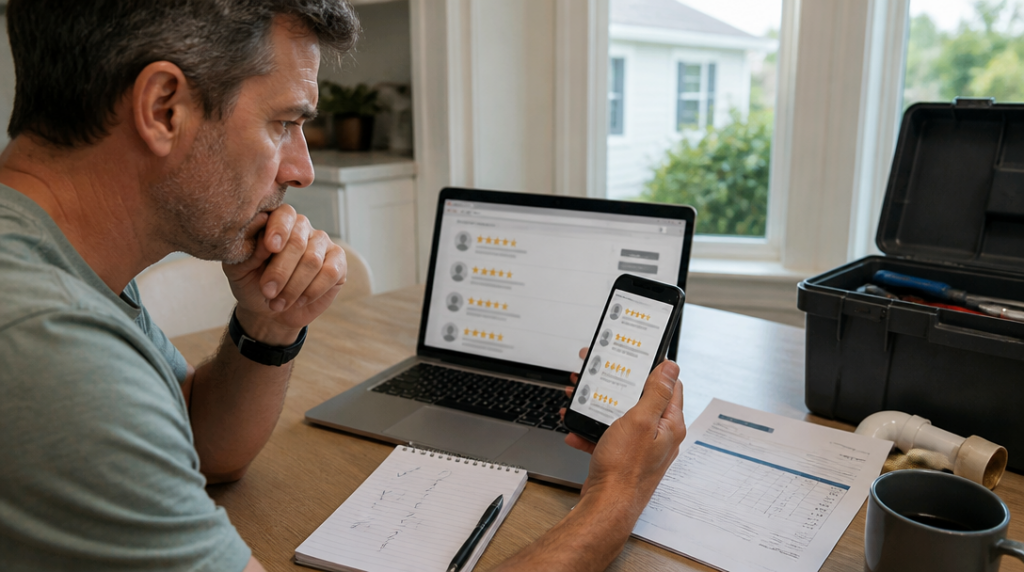
A few months ago, a homeowner named Daniel compared two local plumbers for a leaking water heater. One had 4.9 stars from hundreds of customers. The other had 4.7 stars, fewer reviews, and several complaints about late arrivals.
Daniel nearly chose the first company. Then he noticed that dozens of the glowing reviews used the same phrases: “highly professional,” “excellent service,” and “would definitely recommend.” The reviewer names changed, but the writing barely did. He called the second plumber instead, and the job went smoothly.
Fake reviews rarely announce themselves. They hide among genuine praise, rushed complaints, and ordinary comments from people who simply wanted their problem fixed. Hiring a cleaner, roofer, electrician, landscaper, or moving company requires more than scanning the star rating.
Read the review, not just the score
A rating is a useful starting point, but it is a poor investigation. A business with hundreds of reviews can still have a misleading profile if a large share of those reviews were created in a short period or encouraged through rewards.
Look for specific details. A credible review often mentions the service performed, the condition of the property, the timing, the price range, or how the company handled an unexpected problem. It does not need to be elegantly written. In fact, the slightly awkward review that describes a clogged drain, a muddy hallway, or a rescheduled appointment may tell you more than a polished paragraph of praise.
Generic enthusiasm deserves less trust. Phrases such as “best company ever” or “five-star service” mean little without an account of what actually happened. Several reviews repeating the same unusual wording are more revealing than one suspicious comment.
The reverse problem exists too. A one-star review may be genuine, exaggerated, outdated, or aimed at the wrong business. Read the company’s response and check whether the complaint concerns the service you are about to hire. A disagreement over a billing dispute is not the same warning as repeated reports of unfinished work.
Watch the timing and the reviewer accounts
A sudden burst of reviews can signal a campaign rather than a wave of delighted customers. This is especially noticeable when a company has a quiet profile for years and then collects dozens of five-star ratings within days.
The pattern matters more than the exact number. Check whether the new reviews appeared after a major promotion, ownership change, or reputational problem. If many reviewers have no other activity, use stock-sounding profile names, or praise several unrelated businesses in the same neighborhood, skepticism is sensible.
Multiple accounts posting nearly identical comments are another warning sign. So are reviews that describe services the company does not appear to offer. A glowing account of a kitchen renovation is not much help if you are considering the business for emergency electrical work.
Do not treat a reviewer’s profile picture as proof of identity. A photograph can make an account look human without proving that the person hired the company. The useful evidence is the experience described, not the visual polish of the profile.
AI-written reviews have made intuition less reliable
Many people now look for a certain “real person” feeling in online reviews. That instinct has become harder to trust. In a 2025 survey of 1,026 American adults, 46% said they considered a review suspicious when it appeared to be written by artificial intelligence. Another 42% became suspicious when they thought a review had been paid for or incentivized.
That concern is understandable, but AI detection by eye is a shaky method. A genuine customer may use a writing assistant, while a fake review may be written by a person with plenty of grammatical mistakes. Smooth prose is not evidence of fraud, and bad spelling is not evidence of authenticity.
Look for substance instead. Does the review contain verifiable details? Does it fit the company’s actual services? Does it resemble the language used in other reviews? A believable voice helps, but a consistent account of a real transaction matters more.
The numbers underline the problem. Only 24% of respondents in that 2025 survey said they had identified a fake review during the previous year, up from 19% in 2024. Most people are not confidently detecting manipulation; they are making a judgment under uncertainty.
That is why a review that “feels real” should be treated as one clue, not a verdict. My own rule is simple: if a review tells me how wonderful a company is but not what the company actually did, I give it very little weight.
Compare more than one platform
A company can manage its reputation aggressively on one platform while receiving a less flattering picture elsewhere. Search the business across at least two review sites, then compare the pattern rather than counting stars mechanically.
In the 2025 consumer survey, 74% of respondents said they checked reviews on at least two websites. That habit is becoming more practical as people rely less heavily on a single platform. Google’s share as a source of local reviews fell from 83% to 71% in the 2026 figures, a shift that supports checking multiple places before making a decision.
The platforms do not need to agree perfectly. A contractor may have strong reviews on a general search service and more mixed feedback on a trade-specific directory. That difference can reveal what each audience notices: punctuality, workmanship, communication, or pricing.
Pay attention to repeated complaints across platforms. One angry customer may be an outlier. Five customers independently describing poor cleanup or unexplained charges represent a pattern, even if the company’s overall rating remains high.
Local discussion groups can add context, but they are not automatically more reliable. Anonymous recommendations can be useful leads, not final proof. Ask for details about the job, the date, and how the person knows the company before treating the recommendation as evidence.
Understand what platforms prohibit
A legitimate review should come from a real customer describing a real experience. Google’s policies prohibit reviews created in exchange for payment, a discount, or a free service. They also prohibit reviews posted from multiple accounts or by people who never used the business.
Platforms can remove reviews that violate those rules. They may also temporarily restrict new ratings for a business or display a warning to people viewing its profile. A high rating is therefore not a permanent asset; it can change when suspicious activity is detected.
Businesses sometimes ask every customer for an honest review, which is different from asking only happy customers for five stars. The wording matters. “Please share your experience” leaves room for criticism. “Leave us a five-star review and receive a discount” attempts to purchase a particular outcome.
A business that openly offers rewards for positive ratings is showing poor judgment before you have even hired it. That does not prove every employee will do bad work, but it does weaken the credibility of the review profile and raises questions about how the company handles complaints.
The law raises the stakes for deceptive review practices
In the United States, a rule that took effect on October 21, 2024, prohibits buying or selling fake reviews. It also prohibits paying someone specifically for a positive or negative review rather than for an honest account of their experience.
Knowingly violating the rule can lead to civil penalties of up to $53,088 for each violation. That figure does not mean every suspicious review triggers a penalty, and it does not turn customers into investigators. It does show that fabricated reputation-building is treated as a serious commercial practice, not harmless internet decoration.
The rule cannot tell you whether a particular sentence was written by a real customer. It does give consumers a reason to examine incentives. If a company has a history of offering money, discounts, or free work for favorable ratings, the star count deserves much less trust.
Test the business outside the review page
Reviews should influence your questions, not replace them. Ask the company how long it has handled the type of job you need, who will perform the work, what happens if the estimate changes, and whether the quote includes materials, travel, cleanup, and follow-up visits.
A reliable business should be able to answer plainly. Vague replies, pressure to book immediately, or a refusal to provide basic written details are more useful warning signs than a suspicious adjective in a review.
Ask for references for comparable work when the job is expensive or intrusive. A recent customer who agrees to describe a roof replacement or major renovation provides a different kind of evidence from an anonymous five-star rating.
Check that the company’s name, phone number, service area, and business details are consistent across its profiles. Inconsistencies do not automatically indicate fraud; small businesses move, rebrand, and change numbers. They do justify a direct question before you schedule the work.
A review profile is a lead, not a guarantee. The safest choice often emerges from the unglamorous details: clear communication, a specific estimate, a verifiable track record, and a business willing to let customers describe the experience in their own words.