
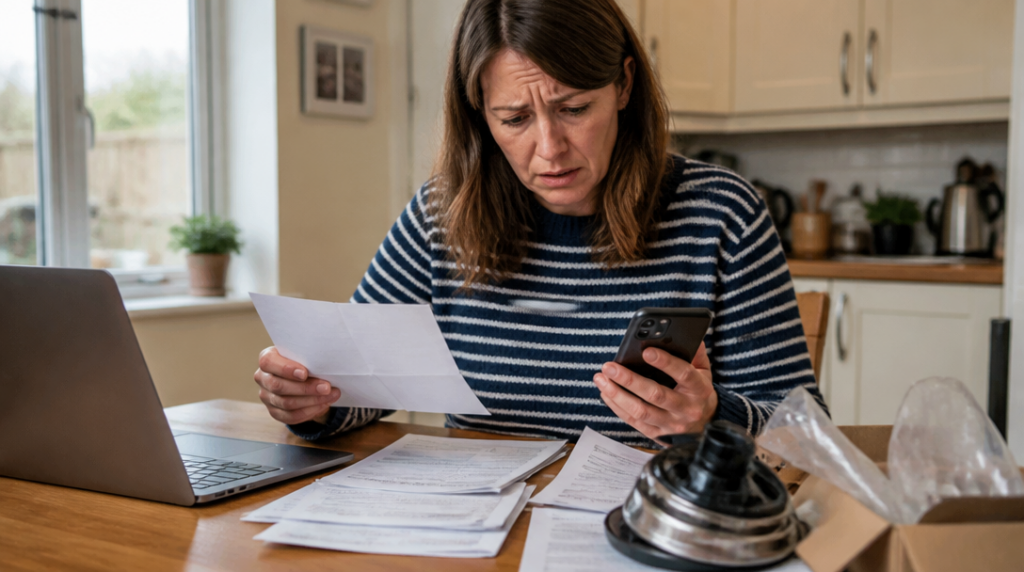
You paid a business, received something unusable, and now the company has developed the communication skills of a brick wall. Perhaps the trader never existed in the first place. Perhaps the invoice is suspicious, the documents are forged, or several customers have been treated to the same carefully polished bit of nonsense.
The right place to report it depends on what happened. A complaint about poor workmanship is not handled in the same way as a suspected scam, and neither belongs in the same queue as a tax-evasion report. Choosing the correct route gives your information a better chance of reaching the people who can do something with it.
If someone has tried to scam you
Report fraud or an attempted fraud to Report Fraud on 0300 123 2040. Reports are passed to the National Fraud Intelligence Bureau, which uses them to assess suspected fraud and identify patterns.
That includes more than the classic email promising a fortune from a mysterious relative. You can report a business that took payment and disappeared, used deception to obtain money, created false paperwork, or tried to persuade you to hand over personal or financial information through dishonest means. You can report an attempt even if you spotted it before losing money. Fraudsters do not receive extra points merely because their target noticed the trap.
Have the useful details ready: the business name, contact information, dates, amounts paid, what you were promised, and how the transaction took place. Keep emails, messages, invoices, photographs, bank records, and any other relevant material. Do not edit screenshots to make them look tidier. Real life rarely arrives in a well-designed folder.
A report is not the same thing as a guarantee that your money will be recovered. If money has left your account, contact your bank or payment provider as soon as possible as well. The fraud report records what happened and helps intelligence work; your bank deals with the payment route.
Poor work, faulty goods and rogue traders
If the problem is bad service, defective goods, or a trader whose business model appears to involve disappointing people at speed, contact the consumer advice service for the part of the UK where you live.
In England and Wales, call Citizens Advice on 0808 223 1133. In Scotland, contact Advice Direct Scotland on 0808 164 6000. In Northern Ireland, call Consumerline on 0300 123 6262. The case may be passed to Trading Standards where the circumstances suggest a wider consumer-protection issue.
This route is suitable for complaints such as work that was carried out badly, goods that do not function as they should, misleading sales practices, or a trader who refuses to deal with a legitimate complaint. It is not limited to dramatic doorstep scams. A company can cause serious trouble while remaining perfectly visible, fully registered, and remarkably confident in its own terms and conditions.
Before calling, gather the contract or order confirmation, receipts, photographs of defects, delivery records, messages, and a clear timeline. Note what the business promised and what it actually delivered. “They were terrible” may be emotionally accurate, but dates and documents are more useful to an adviser.
The consumer advice service can explain the next step and may refer information to Trading Standards. It does not mean Trading Standards will automatically take up an individual dispute or force a refund. Your own attempts to resolve the problem should still be documented, especially if you have asked the business to repair, replace, complete, or refund something and received silence in return.
When the company itself looks suspicious
A limited company can be reported through the government form “Complain about a limited company” at Companies House if you suspect fraudulent behaviour, false documents, or an issue involving the company’s debt.
This is the appropriate route for concerns about the company’s official records or conduct as a limited company. It may be relevant if filings appear false, documents do not match what has happened in practice, or the business seems to be using the corporate structure to conceal dishonest activity or unresolved debt.
Companies House is not a general-purpose complaint desk for every disappointing purchase. It cannot replace a consumer advice service when the central issue is a faulty product or poor workmanship. A company being listed in the register also does not prove that it is trustworthy. Registration is paperwork, not a character reference.
Describe the concern precisely and attach or retain material that supports it. Explain which document, statement, or action appears false or misleading, rather than relying on a broad accusation. Specificity makes a complaint easier to assess and reduces the risk of turning a serious report into an argument about tone.
Tax suspicions belong with HMRC
If you suspect a business is hiding income, evading tax, or deliberately reducing the tax it should pay, report it to HMRC. You can make the report online or call 0800 788 887, Monday to Friday between 9:00 and 17:00. You do not have to provide your personal details.
Tax concerns can overlap with other types of misconduct, but they still deserve their own report. A business that appears to be taking cash payments off the books, using false invoices, or concealing sales may also raise questions for other authorities, yet HMRC is the body equipped to examine suspected tax evasion.
Stick to what you know or what you have observed. Give the business name, address, relevant dates, the nature of the suspected activity, and any supporting documents. Avoid presenting rumours as established facts. “I saw three cash-only transactions and was not given receipts” is useful; “everyone says they are criminals” is mostly an invitation to waste everybody’s afternoon.
You can report a tax concern without identifying yourself. That does not mean every report will lead to visible action or that you will be told what happened. Confidential investigations are not designed to provide a running commentary to the person who raised the alarm.
If the harm reaches beyond your own purchase
Some business practices affect a whole group of customers or distort competition in a market. In that situation, inform the Competition and Markets Authority, known as the CMA.
The CMA is relevant to suspected unfair trading or conduct affecting multiple consumers, rather than a single argument over a late delivery. Examples might include a business-wide practice that misleads customers, a market pattern that appears unfair, or conduct that seems to limit competition. The focus is the wider behaviour, not simply whether your own order arrived in a sorry-looking box.
The CMA does not handle individual complaints and cannot advise you on recovering your money. If you want a refund, repair, replacement, or other remedy for your own purchase, use the appropriate consumer advice route as well. A wider report and an individual complaint can exist at the same time because they serve different purposes.
A strong report explains why the conduct appears to affect more than one customer. Include repeated wording in advertisements, identical complaints from other buyers, common contract terms, or a pattern of refusals. One unhappy transaction may be a dispute; dozens of customers describing the same mechanism may reveal a business practice.
What to do when danger is immediate
If there is an immediate danger or a crime is in progress, call the police on 999. Do not wait for a consumer helpline to open while someone is being threatened, property is being damaged, or a dangerous situation is unfolding.
For non-urgent matters, use the relevant reporting channel and keep a record of when you contacted it. Save reference numbers and copies of your complaint. If the business contacts you after the report, preserve those messages rather than getting drawn into a late-night exchange that begins with “we can sort this quietly.”
Be careful about sending more money to a business simply because it promises to fix the original problem. Fraudsters sometimes return wearing a second hat, offering refunds, legal help, or “account recovery” for an additional fee. The hat may be different. The scheme is not.
Write down the facts while they are fresh, report the conduct through the route that matches it, and keep the evidence in its original form. A clean timeline is often more persuasive than a furious paragraph, even when the furious paragraph is entirely justified.