
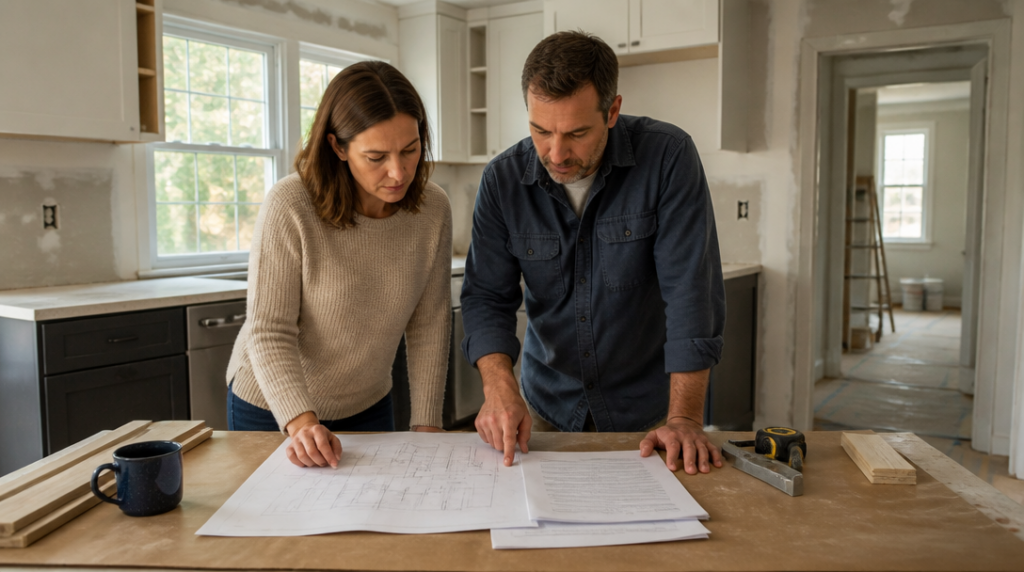
You are standing in a half-finished kitchen, staring at exposed wiring and a calendar that has already lost three weeks. The builder who sounded confident at the first meeting now answers messages sporadically, and the original price has begun to look more like a rough suggestion than a commitment.
This is the part of renovation advice that often gets flattened into a slogan: hire someone reputable. Fine, but reputation is not a feeling, and a friendly conversation is not a vetting process. A trusted builder has to withstand paperwork, questions, checks, and a little healthy suspicion before receiving a deposit.
Start with a Shortlist, Not a Handshake
Ask people you know about recent renovation work, but treat personal recommendations as leads rather than proof. A friend may have loved a builder who completed a small bathroom project; that does not automatically qualify the same person to manage a structural renovation, an addition, or a complicated home conversion.
Look for builders who regularly handle work similar to yours. The relevant experience is not simply “construction.” It might be older homes, complicated plumbing, listed properties, accessibility upgrades, or projects involving several subcontractors. The closer the match, the more useful the builder’s past work becomes as evidence.
You should also ask how much of the work the builder performs directly and how much is subcontracted. Subcontracting is normal, but responsibility should not become vague once several companies are involved. You want one clearly identified person or company accountable for the schedule, workmanship, communication, and unresolved defects.
A professional-looking website proves very little. So does a branded van. Those details may be reassuring, but they are presentation, not due diligence.
Get Three Written Estimates
Before choosing a builder, request three written estimates. This is not merely a way to find the lowest number. It gives you a chance to compare assumptions and spot the estimate that is suspiciously thin.
Each estimate should describe the scope of work, the materials to be used, the total price, and the expected completion date. If one proposal says “renovate kitchen” while another specifies cabinets, flooring, electrical work, appliances, waste removal, and painting, the two prices are not truly comparable.
Ask what the price excludes. Fixtures, permits, structural calculations, disposal fees, delivery charges, and repairs to hidden damage can all sit outside an apparently attractive quote. “We’ll deal with that later” is not a pricing method; it is an invitation to argue later, when your options are limited.
Pay attention to the language around allowances and provisional sums. These figures may cover items whose final cost is not yet known, but a large number of allowances can make a quote look cheaper than the eventual bill. Ask which parts of the estimate are fixed and which can change.
The cheapest estimate deserves questions, not automatic applause. It may reflect genuine efficiency, or it may omit work that the other builders included. A builder who wins by leaving out necessary tasks has not offered a bargain. He has postponed the cost.
Check the Builder Before Paying
Verify the builder’s license with the relevant state or county authority where licensing applies. Confirm insurance as well, including the type of coverage and whether it is current. Ask for references from recent customers, not only from a list of the builder’s most flattering projects.
Call those references. Ask whether the final cost changed, how the builder handled delays, whether the site was kept reasonably safe, and what happened when something went wrong. The last question often tells you more than a description of the finished kitchen.
If possible, visit a current job site or a recently completed project. Photographs can be selected, edited, and taken from flattering angles. A visit may reveal how the crew protects floors, stores materials, controls dust, and leaves the property at the end of the day. Those habits matter because renovation is lived at close range, not admired in a portfolio.
Check the company’s legal identity and address. Be cautious if a contractor insists on using only a personal name, avoids written communication, or changes business names whenever a problem appears. A business that is difficult to identify before the work begins may become impossible to reach afterward.
Treat Online Reviews as Clues
A large number of five-star reviews can create the impression that the decision has already been made for you. It has not. Reviews are useful for finding patterns, but star counts are not a substitute for independent checks.
That warning is not theoretical. In May 2026, federal regulators sued Premium Home Service over allegations involving thousands of fake online profiles and fabricated five-star reviews. The complaint said the network had contacted tens of thousands of consumers since at least 2018.
The practical lesson is narrower and more useful than “never trust reviews.” Read the wording, dates, and details. Look for repeated phrases, bursts of reviews posted close together, accounts with no other activity, and comments that praise friendliness without describing actual work. A genuine review may be imperfect, specific, and less polished.
Search for complaints in several places, and compare them with the builder’s response. A complaint does not automatically prove misconduct, just as a glowing review does not prove competence. What matters is the recurring pattern and whether the company responds with facts, documentation, and a credible remedy.
Ask Direct Questions Before Signing
A good builder should be able to explain who will be on site, who supervises the work, how changes are approved, and how progress is reported. You should know the expected working hours, arrangements for water and power, access to the home, and how rubbish will be removed.
Ask for a rough sequence of the project. Demolition, structural work, rough-ins, inspections, insulation, plastering, cabinets, finishes, and final corrections rarely happen in a random order. You do not need to manage the construction schedule yourself, but you do need enough information to recognize a serious delay or a missing stage.
Ask how the builder handles change orders. Every renovation carries some uncertainty, especially in older homes, but uncertainty should not become permission to charge whatever seems convenient. A change should be described in writing, with its effect on price and schedule, before the work proceeds whenever practical.
Notice how the builder reacts to questions. Evasion, irritation, exaggerated certainty, or pressure to decide immediately are all warning signs. A reliable professional does not need you to feel confused in order to win the job.
Read the Contract Slowly
The contract should match the estimate and spell out the scope, materials, price, payment schedule, start date, expected completion date, procedures for changes, and responsibility for permits. It should also explain how defects, delays, disputes, and termination are handled.
Do not accept a contract that leaves the critical details in text messages or verbal promises. Messages can help establish a record, but they are a poor substitute for one coherent document that both sides have reviewed and signed.
Be especially careful with the payment schedule. Large upfront demands deserve scrutiny, particularly when the builder wants most of the money before materials arrive or meaningful work begins. Payments tied to identifiable stages are easier to evaluate than payments tied to vague claims that the project is “nearly done.”
If you sign a contract at home or somewhere other than the builder’s regular place of business, it must include a right to cancel within three business days. Keep a copy of the signed contract and every attachment. A cancellation right is useful only if you can find the terms and act within the required period.
Consider having a construction lawyer review the agreement for a major renovation. The fee may feel irritating before work starts. It is usually less irritating than discovering that the contract never defined what the builder promised to do.
Keep Control Once Work Begins
Hiring well does not mean handing over the project and disappearing. Keep records of payments, decisions, approved changes, photographs, and conversations. A short written confirmation after a site meeting can prevent two different memories from becoming an expensive dispute.
Pay attention to early behavior. A builder who repeatedly misses small commitments, avoids documenting changes, or asks for unexplained extra payments may not become more organized when the project gets harder. Small problems are often the only affordable warning you will receive.
Do not make every decision based on the builder’s preferred materials or schedule. Ask why a substitution is needed, whether it changes the warranty, and whether it affects appearance or performance. You are not being difficult by asking what you are buying.
The right builder will still be capable of making mistakes. Trust is not the promise that nothing will go wrong. It is the evidence that problems will be acknowledged, explained, documented, and corrected without forcing you to chase someone through a maze of unanswered calls.