
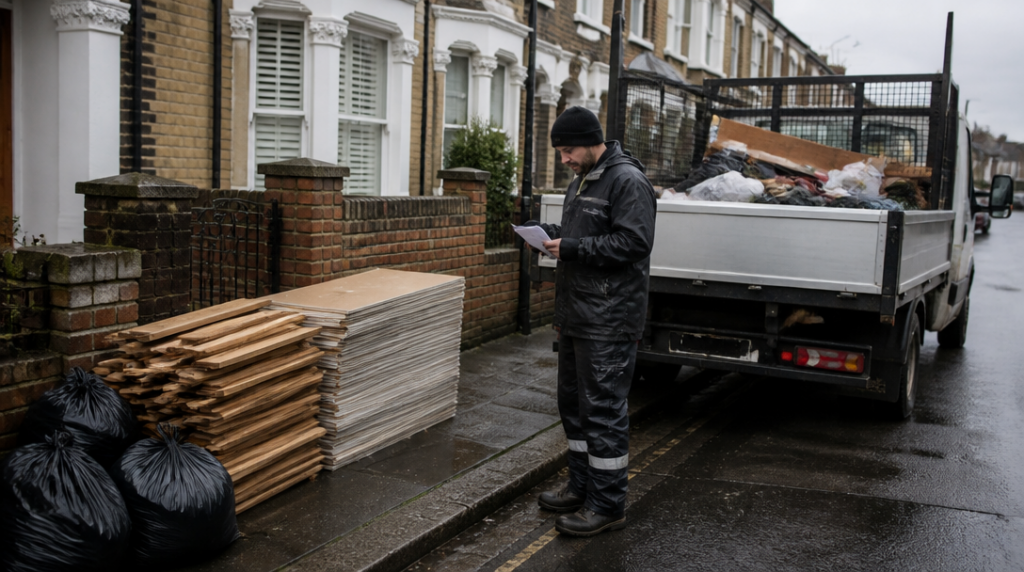
The van is already idling by the kerb when you step outside. Its rear doors are streaked with dried mud, and a worker is looking at the pile of broken plaster, timber and black bin bags beside the gate. Before anything goes into the vehicle, ask for the waste carrier’s registration details.
That small pause can prevent a much larger problem. If a carrier takes your waste for payment without the required registration, the responsibility may not end when the vehicle disappears around the corner.
In England, check the carrier on the official waste carrier register. You can search using the registration number, the company name or its postcode. The record should be current, and the carrier should have an upper tier registration.
Do not rely on a company name printed on a van or a social media profile. Names change, vehicles are borrowed and a neat-looking invoice proves very little. The register is where you confirm that the business is authorised for the work it is offering.
Ask the carrier to send its registration number before arranging collection. A legitimate operator should not become evasive when you ask. If the number does not produce a matching record, stop there and choose another company.
The distinction between paid waste collection and moving your own waste matters. A business that carries waste for payment must be registered. The current registration fee is £191.02, while transporting only your own waste is usually free.
That does not mean every person with a trailer can legally take rubbish from your property. If you pay someone to remove it, you need to establish that they are registered for commercial waste transport. A cheap quote from an unregistered operator can leave you paying twice: once for the collection, and again when illegally dumped waste is traced back to you.
The first useful conversation is more specific than “How much to clear this?” Describe the material, where it is stored and roughly how much there is. Waste made up of household furniture is not the same job as plasterboard, soil, asbestos-contaminated material or old electrical equipment.
Send photographs if the carrier asks for them, but do not let pictures replace a proper description. A pile hidden behind a shed can contain paint tins, gas cylinders or sharp metal. Those details affect the vehicle, handling method and destination.
Get the agreement in writing. It does not need to be an elaborate commercial contract, but it should identify the precise type of waste, the quantity, the collection address, the destination facility and the carrier’s registration number.
The destination deserves particular attention. “Taken away” is not a destination. Your paperwork should name the facility or clearly identify the authorised site receiving the waste. If the carrier refuses to say where the load is going, you have no sensible way to assess what will happen after collection.
A reliable operator will usually ask questions that seem almost fussy. Is the waste loose or bagged? Can the vehicle reach the driveway? Are there steps? Will the load contain plasterboard, soil or paint? Those questions are reassuring because they suggest the carrier is planning the job rather than improvising at the gate.
Price can be revealing too. A quote far below the others may simply exclude disposal charges, labour or difficult materials. Ask whether the price covers loading, transport, treatment or disposal, and whether it can change if the waste differs from your description.
Do not accept a vague promise that everything will be “recycled”. The word sounds comforting but says little by itself. Ask what facility will receive the waste and make sure the written terms describe the load accurately.
On collection day, watch what happens. The carrier should not mix your waste with materials that create a different disposal problem without discussing it. If the crew arrives with an overloaded vehicle, asks you to remove labels from containers or suggests leaving part of the load in another location, cancel the collection.
Before the vehicle leaves, request a waste transfer note. This records the transfer of waste from one person or organisation to another. It should describe the waste and provide the information needed to show what was collected, by whom and where it was going.
Keep the note with the invoice, photographs and the carrier’s registration details. A picture of the loaded vehicle can help establish what left the property, especially after a building clearance. It is not a substitute for proper documentation, but it takes seconds and can be useful later.
The transfer note is not decorative paperwork. Waste duties in England can carry an unlimited fine when they are ignored. The carrier may be the person physically driving the truck, but the waste producer still needs to take reasonable care when choosing who removes it.
This is especially important for businesses, landlords, builders and property managers. A householder clearing one garage still needs to think about who is taking the waste, but a business may have a continuing record-keeping responsibility across many collections. Build the checks into the job rather than trying to reconstruct them months later.
A quick call can expose a weak arrangement. Ask for the registration number, the proposed destination, the type of transfer note supplied and the name of the person responsible for the collection. If the answers keep changing, the company is not ready to handle your waste.
Be wary of operators who say registration is unnecessary because they are “just taking it to the tip”. The destination does not cancel the transport requirement. Nor does the use of a small van, a trailer or a casual labourer.
There is one important geographical trap. England, Scotland, Wales and Northern Ireland use different registration procedures. An English registration cannot automatically be used to validate a carrier operating under another nation’s system.
If the collection takes place in Scotland, Wales or Northern Ireland, check the relevant national register and rules instead of assuming the English search is enough. A company working across borders may need to explain which registration applies to the particular collection.
The same caution applies when waste crosses a border after collection. Ask the carrier to explain the route and destination in writing. You do not need a legal lecture at the doorstep, but you do need a paper trail that matches the journey.
For a domestic clearance, the essential exchange may take less than ten minutes. You provide the address, waste description and estimated quantity. The carrier provides its registration number, collection price, destination and transfer note arrangements.
For a larger job, walk the site together before accepting the quote. Point out the narrow passage beside the house, the loose tiles under the tarpaulin and the old freezer leaning against the wall. I have found that this kind of walk-through tells you more about an operator than a polished advert ever could: careful carriers notice hazards before they notice the invoice.
Put changes in writing. If the waste turns out to include materials that were not in the original description, pause the job and agree the new handling and price. A revised note is better than a hurried verbal promise made beside a running engine.
Do not hand over responsibility simply because the carrier has loaded the waste. Retain your records for the period required for your circumstances, particularly if the collection relates to a business, tenancy or construction project. Store them somewhere you can find them without searching through old messages and blurred photographs.
A registered carrier should make the process feel ordinary: clear answers, a matching record, a realistic quote, a named destination and a waste transfer note at the end. The truck may vanish quickly, but those details remain after the sound of its engine has faded.