
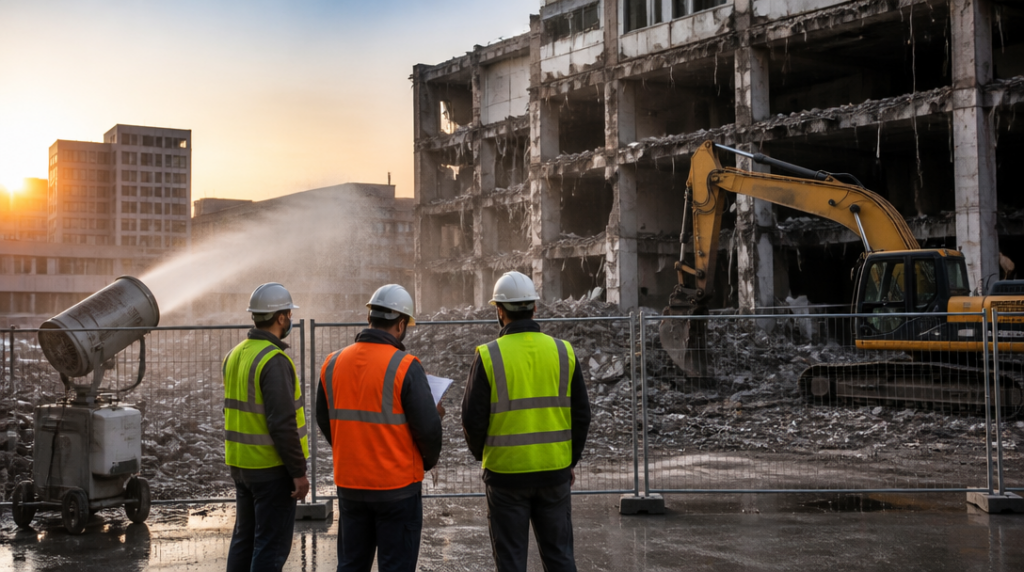
The excavator is already parked outside, the estimate is lower than expected, and the contractor says the building will be gone by Friday. Then someone asks the question nobody wanted to hear: who verified what is inside the walls?
That question separates a professional demolition project from an expensive cleanup operation. Hiring a demolition contractor is not mainly about finding a company with large machinery. It is about confirming that the company is legally qualified, properly insured, and prepared for the materials and risks hidden inside the structure.
There is no single nationwide designation in the United States called a “certified demolition contractor.” The phrase sounds official, but it does not replace an actual license. Start by checking the contractor’s state and local credentials, then verify any separate qualifications required for asbestos, lead, or other regulated materials.
A company may be perfectly capable of tearing down a garage and still be unqualified to remove asbestos insulation from a commercial building. Those are different jobs, with different rules and training requirements.
Start with the license, not the logo
Ask for the contractor’s legal business name, license number, issuing authority, and expiration date. Check the information independently through the relevant state or local licensing office. A screenshot supplied by the contractor is useful, but it should not be the final verification.
Look for restrictions attached to the license. Some credentials cover only certain types of construction work, project values, or locations. Others may not authorize hazardous-material abatement at all. If the contractor says a license is unnecessary, ask for that position in writing and confirm it with the local building department.
The same check applies to subcontractors. A demolition company may bring in a separate asbestos consultant, environmental testing firm, waste hauler, or crane operator. You should know who will perform each regulated part of the work and which company carries responsibility for it.
A polished website proves very little. Licensing records, current insurance certificates, training documents, and a clear scope of work tell you much more.
Treat asbestos as a planning issue
For commercial, industrial, and institutional buildings, a thorough asbestos inspection is required before demolition under federal asbestos rules. The inspection should not be a casual walk-through performed after the excavator arrives. It should identify suspect materials throughout the structure, including areas that may be concealed behind walls, above ceilings, beneath flooring, or around mechanical systems.
Ask who will perform the inspection and what qualifications that person holds. Request the written report, not just a verbal assurance that the building is “probably clean.” A credible report should explain where samples were taken, which materials were identified, and what remains inaccessible or uncertain.
The federal asbestos notification process generally requires written notice at least 10 working days before demolition begins. The exact filing route and additional requirements can vary by jurisdiction, but a contractor who treats the notice as an afterthought is not managing the project properly.
Small quantities do not automatically make the paperwork disappear. The exemption thresholds for removing or disturbing regulated asbestos are 260 linear feet, 160 square feet, or 35 cubic feet. Even when the amount falls below those limits, the demolition itself may still require notification.
That distinction catches property owners off guard. They hear “below the threshold” and assume “no rules apply.” Those are not the same statement.
The worksite must also have a trained asbestos supervisor. The supervisor’s training is renewed every two years, and proof of that training must be available for inspection. Ask to see the current documentation before work begins, then confirm that the named supervisor will actually be present rather than serving as a name on a form.
A contractor who becomes irritated by these questions is giving you useful information. Demolition moves quickly; regulated asbestos work should not.
Check lead credentials separately
Lead-related work has its own certification requirements. If the project involves lead paint or lead hazards, the company performing lead-abatement work must hold the required federal or state certification. A general demolition license does not cover that obligation.
Ask whether the contractor has assessed the age and condition of painted surfaces and how the work will prevent lead dust from spreading. The answer should cover containment, worker protection, cleaning, waste handling, and clearance procedures where required.
Since January 13, 2025, the relevant lead-abatement notifications are submitted electronically through the federal CDX system rather than by mail, fax, or in-person delivery. A contractor still using an outdated filing process may be relying on old procedures across the rest of the project as well.
Do not confuse a lead inspection with lead abatement. One identifies the hazard; the other controls or removes it. The contract should state who is responsible for each step.
Ask for insurance that matches the risk
A demolition company should be able to provide current certificates of insurance for general liability, workers’ compensation, and automobile coverage. Depending on the project, you may also need pollution liability or professional liability coverage related to environmental assessments.
Check the policy dates and coverage limits. More importantly, ask what exclusions apply. Some general liability policies exclude asbestos, lead, pollution, excavation, or damage to adjoining property. A large policy limit means little if the activity that causes the loss is excluded.
If the property is close to neighboring buildings, roads, utilities, or occupied spaces, ask how the contractor’s coverage addresses damage beyond the work area. Demolition is rarely contained as neatly as the drawing suggests. Vibration, falling debris, dust, and water can travel farther than expected.
You should also ask whether subcontractors are insured and whether they must name the property owner or developer as an additional insured. Have an attorney or insurance professional review the contract when the project is large enough to justify it.
Compare bids by scope, not by total
Two demolition bids can differ dramatically while describing what appears to be the same job. One may include permits, utility disconnects, asbestos handling, waste disposal, site fencing, dust suppression, grading, and final cleanup. The other may cover only the act of knocking down the structure.
Ask each bidder to describe the work in the same level of detail. The proposal should identify the structures being removed, the planned method, equipment, working hours, dust and noise controls, salvage arrangements, disposal facilities, and the condition in which the site will be left.
Waste disposal deserves particular attention. Ask how regulated materials will be packaged, transported, documented, and disposed of. Hazardous waste does not become ordinary construction debris because it has been placed in a dumpster.
Also ask about exclusions. Unknown foundations, buried tanks, contaminated soil, undocumented additions, unstable neighboring walls, and unexpected asbestos can all trigger change orders. The contract should explain how those discoveries will be handled, who can authorize additional work, and how pricing will be calculated.
A low bid built on vague exclusions is not a bargain. It is an invitation to renegotiate after the equipment arrives, when your leverage is weakest.
Examine the contractor’s actual plan
Ask the contractor to walk you through the sequence of work. A competent plan should address utility shutoffs, structural stability, pedestrian and vehicle protection, emergency access, dust suppression, debris removal, and the protection of nearby property.
For a larger structure, ask whether an engineer or other qualified professional has reviewed the demolition method. The answer depends on the building and local requirements, but a contractor who cannot explain how the structure will be made safe before removal is taking a dangerous shortcut.
Find out who will supervise the crew each day. Ask how incidents are reported, how weather affects the schedule, and what happens if the building becomes unstable. You are not trying to run the demolition yourself. You are testing whether the contractor has thought beyond the first swing of the excavator.
Visit a current or recently completed project if possible. Notice whether the site is controlled, whether workers use appropriate protective equipment, and whether debris is kept from spreading into public areas. A messy site is not automatically unsafe, but careless habits tend to appear in more serious places too.
Use references that can answer specific questions
Ask for references from projects similar in size, location, and complexity. A homeowner whose detached shed was removed cannot tell you much about a contractor’s handling of a hospital wing, factory, or multi-story commercial building.
Call the references yourself. Ask whether the final price changed, whether the schedule held, how the contractor handled unexpected materials, and whether the site was left as promised. Ask whether paperwork arrived on time and whether the crew respected neighboring properties.
You can also check public licensing and enforcement records where available. A single complaint does not prove misconduct, but repeated violations involving unsafe work, improper disposal, or expired credentials deserve a direct explanation.
Put accountability in the contract
The written agreement should name the parties, identify the property, define the demolition area, set the price and payment schedule, allocate permit responsibilities, and state the completion conditions. It should also address hazardous materials, subcontractors, insurance, waste documentation, site security, delays, change orders, and restoration of damaged areas.
Do not agree to pay nearly the entire amount before the work is complete. Retainage or milestone payments can give the contractor operating cash without leaving you powerless if the site is not cleaned, documents are missing, or a promised repair was never made.
Make sure the contract says who owns salvageable materials and who bears the cost of disposal. Scrap metal, fixtures, brick, and equipment can have value, but disputes begin when ownership is left to assumption.
The uncomfortable question is not whether the contractor can make the building disappear. It is whether the contractor can show, before demolition starts, exactly what will happen to the building, the hazardous materials, the debris, the paperwork, and the land beneath it.
If the answer lives only in a sales pitch, keep looking. A serious contractor will have it in licenses, inspection reports, training records, insurance documents, permits, and a contract precise enough to survive an unpleasant surprise.