
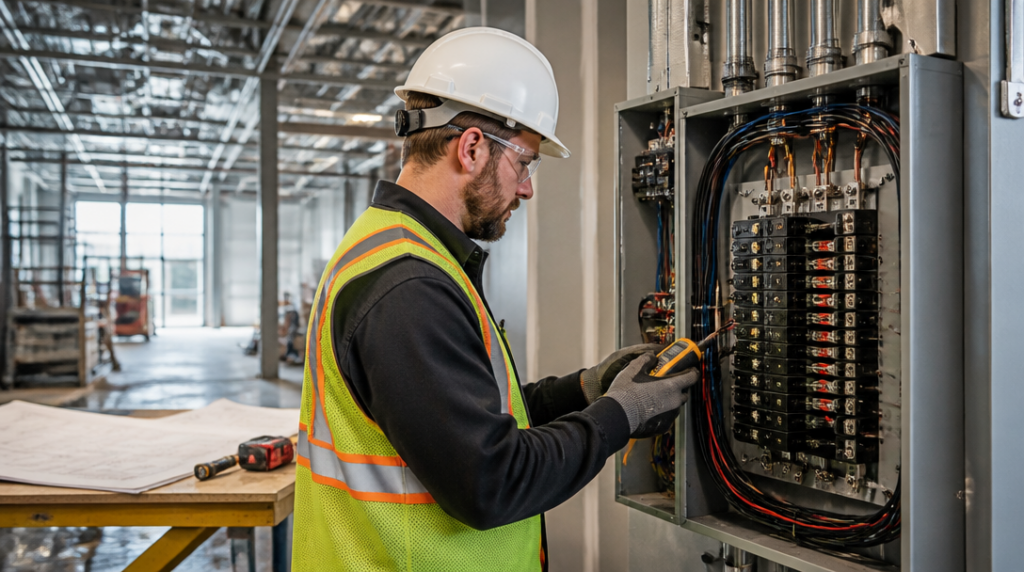
The lights go out in half the building, production stops, and someone suggests calling the electrician who fixed a neighbor’s kitchen outlet. That may be a fine person. It is not automatically a sound commercial hiring strategy.
Commercial electrical work involves higher loads, more complicated systems, stricter safety requirements, and a much larger bill if something goes wrong. A good electrician can keep a project moving. The wrong one can leave you with failed inspections, damaged equipment, unsafe wiring, or a beautifully organized invoice for work that now has to be done twice.
Start by defining the job before you start collecting names. A contractor handling a retail fit-out may need experience with service upgrades, lighting controls, emergency systems, and tenant improvements. A manufacturing facility may require familiarity with motor controls, distribution equipment, automation, and environments where dust, heat, or moisture affect installation choices. Office buildings bring their own collection of demands, including data rooms, backup power, fire alarm coordination, and occupied-space scheduling.
A vague request such as “we need some electrical work” produces vague bids. Describe the building, the equipment involved, the project deadline, whether the site will remain occupied, and any known problems. If you have drawings, equipment schedules, inspection reports, or photographs, make them available. A capable electrician will ask questions before quoting. That is a good sign, not a delay tactic. Anyone who offers a firm price after hearing only the word “wiring” is either astonishingly efficient or preparing an unpleasant surprise.
Then check the contractor’s license. In the United States, most states require electricians to be licensed, but the rules vary by state and by local jurisdiction. A license that is valid in one place may not authorize work in another, and a personal electrical license is not always the same thing as a contractor’s license for running commercial projects. Confirm the license directly through the relevant state or local authority, and check whether it covers the type and scale of work you need.
Ask who will actually perform the work. Some companies sell the project, then send a different crew to the site. That is not necessarily a problem, provided the arrangement is clear and the subcontractors are properly licensed, insured, and supervised. You should know who is responsible for permits, inspections, design coordination, safety documentation, and correcting defects. “Our team will handle it” is not an answer until you know what that team looks like.
The word “certified” deserves a little scrutiny. It may refer to a trade certification, manufacturer training, a safety qualification, or simply a word added to a website because it sounds reassuring. Ask what the certification is, who issued it, whether it is current, and whether it applies to the work at hand. More credentials are not automatically better. A contractor with relevant commercial experience, a valid license, and a disciplined safety record is usually more useful than someone carrying a folder thick enough to require structural reinforcement.
Experience should be specific. Ask for recent examples of projects similar to yours in size, systems, operating conditions, and schedule. An electrician who has spent years wiring homes may be highly skilled but still unfamiliar with a large commercial switchgear installation or a production environment. Request references from clients who hired the contractor for comparable work, and ask those clients whether the project stayed safe, compliant, and reasonably close to the agreed scope and schedule.
Commercial electrical work also demands a serious approach to safety. For commercial construction, OSHA’s electrical requirements appear in 29 CFR 1926, Subpart K, including Sections 1926.402 through 1926.408. You do not need to memorize those section numbers before calling a contractor, but the contractor should understand the requirements and be able to explain how they affect the project.
OSHA uses the term “qualified person” for a worker who knows how electrical equipment is constructed and operated and has been trained to recognize and eliminate the associated hazards. That is more than knowing which end of a tester to hold. Ask how the contractor trains workers, controls energized work, manages lockout and tagout procedures, and documents site hazards. A contractor who treats safety paperwork as an annoying ritual may also treat the physical safety rules as optional, which is a poor bargain for everyone near the panel.
Ask about compliance with the National Electrical Code, also known as ANSI/NFPA 70. OSHA generally considers electrical installations on construction sites that comply with the applicable National Electrical Code provisions to meet selected requirements in Sections 1926.403 through 1926.408. The code does not eliminate every project-specific obligation, and local authorities may impose additional requirements, but it provides an essential baseline for installation and safety.
Permits and inspections should be discussed before work begins, not after an inspector discovers that someone has been improvising behind a wall. Confirm which permits are required, who will obtain them, and who will schedule inspections. If the project involves a service change, generator, fire alarm system, or major equipment connection, ask how the electrician will coordinate with the utility, building officials, engineers, and other trades. Electrical work rarely exists in isolation. It tends to collide with plumbing, mechanical systems, ceilings, walls, schedules, and occasionally human patience.
Insurance matters just as much as technical ability. Request proof of general liability insurance and workers’ compensation coverage, and ask whether the limits are appropriate for the size and risk of your project. If the work involves vehicles, lifts, excavation, or specialized equipment, confirm that those exposures are covered. A contractor who hesitates to provide basic documentation is not offering a clever shortcut. They are offering uncertainty with a hard hat.
Once you have a shortlist, obtain written proposals from several qualified contractors. The cheapest bid can be attractive, especially when the spreadsheet is glaring at you, but price only becomes useful after the scope is comparable. One proposal may include permits, testing, cleanup, temporary power, and all required materials. Another may quietly leave them out and win the comparison by pretending they do not exist.
Read the details. The proposal should identify the work, materials, equipment, exclusions, assumptions, schedule, payment terms, warranty, and procedures for changes. It should make clear whether the price is fixed, based on time and materials, or subject to allowances. Ask how concealed conditions will be handled and what happens if the drawings conflict with field conditions. A fair change-order process protects both sides. A verbal agreement made beside a pile of conduit protects no one, although it may later become the subject of a very confident argument.
Pay attention to how the contractor communicates before you hire them. Do they return calls? Do they answer technical questions directly? Do they identify risks without turning every uncertainty into a catastrophe? Commercial projects depend on coordination, so poor communication at the quoting stage rarely transforms into excellent communication once the walls are open and the schedule is collapsing.
The proposal should also explain testing and handover. Depending on the project, this may include insulation resistance testing, grounding checks, equipment startup, labeling, panel schedules, as-built drawings, operating instructions, and training for facility staff. Ask what documentation you will receive at completion. A commercial electrical system is easier to maintain when the next electrician does not have to conduct an archaeological dig through unlabeled panels.
Before signing, verify the contract details and agree on the person authorized to approve changes. Establish working hours, site access, cleanup expectations, storage, shutdown procedures, and communication during outages. If the building will remain occupied, insist on a plan for protecting employees, customers, tenants, and sensitive equipment. Temporary power and planned shutdowns should be treated as part of the project, not as thrilling surprises reserved for Friday afternoon.
Availability is another practical consideration. The median annual wage for electricians in the United States was $62,350 in May 2024, rising to $71,820 for electricians working in manufacturing. Employment is projected to grow by 9 percent from 2024 to 2034, with about 81,000 job opportunities expected each year. Those figures help explain why established commercial electricians may be booked well ahead, particularly for specialized work. A full schedule is not proof of quality, but a contractor who can start tomorrow despite a supposedly overflowing operation deserves a few additional questions.
Be cautious with red flags: pressure to pay the full amount upfront, reluctance to provide a license number, missing insurance documents, unusually low bids, cash-only demands, no written scope, unexplained substitutions, or claims that permits are unnecessary. Also question anyone who dismisses your concerns about shutdowns, safety, or inspection requirements. Confidence is useful on a job site. Untested certainty is how buildings acquire stories.
The strongest hire is usually not the most polished salesperson or the lowest number on the page. It is the contractor who understands the facility, asks uncomfortable but necessary questions, documents the scope, respects the rules, and can show that similar work has been completed safely. A commercial electrical system should disappear into the background when it is working properly. Hiring the right electrician is how you keep it there.