
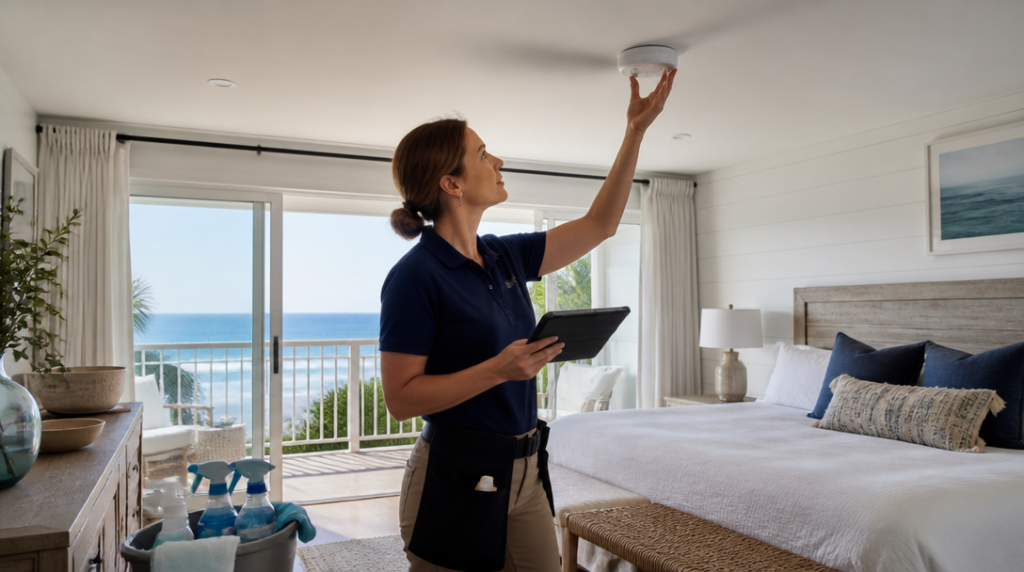
A caretaker can have the keys to your holiday home without holding a single federally recognized accreditation.
That sounds alarming, but it is the reality of the U.S. vacation-rental market. There is no unified federal accreditation for individual caretakers who look after short-term rental properties. A polished website, a confident interview, or a stack of glowing guest reviews may tell you something, but none of them proves that the person knows how to inspect a property, spot a safety problem, or keep a house ready for the next arrival.
A more reliable search combines professional certification with evidence of careful, repeatable work. The distinction matters most when your property sits several hours away and a small leak, missing smoke-alarm battery, or overlooked cleaning problem can become your problem from a distance.
Start with the credential that actually exists
For vacation-rental professionals in the United States, the most relevant professional certification route is offered through VRMA/VRHP. The program currently includes three designations: CVRH, CVRI, and CVRHP.
The letters are not interchangeable. CVRH stands for Certified Vacation Rental Housekeeper and is intended for workers responsible for housekeeping and routine maintenance in short-term rentals. That makes it the closest match for a caretaker whose regular duties include preparing bedrooms, checking supplies, reporting damage, and handling minor upkeep between stays.
The CVRH program contains 15 online modules covering housekeeping, safety, and property maintenance. A candidate who has completed that training should be able to discuss more than whether they “clean thoroughly.” Ask what they check after a guest leaves, how they document damage, how they handle a missing item, and what they do when a maintenance issue falls outside their skill level.
CVRI, or Certified Vacation Rental Inspector, is aimed at professionals who inspect short-term rentals after housekeeping or after guests have departed. An inspector may not be the person who changes linens or handles every turnover task, but the certification can be especially useful if your property needs a separate quality-control check.
The third designation, CVRHP, is also part of the current VRMA/VRHP certification system. Ask the candidate to explain which designation they hold, what duties it covers, and how that training connects to the work they would perform at your property. A credential should clarify a person’s role, not serve as mysterious decoration on a résumé.
There is one administrative detail worth checking before you accept a certificate at face value: the certification course must be purchased on the account of the individual worker taking it. The course and certificate are not meant to be transferred to someone else. If an agency presents one person’s certificate as proof that its entire team is certified, ask for the credentials of the people who would actually enter your home.
Watch the first inspection, not the sales pitch
Imagine meeting a prospective caretaker at the property on a bright Saturday morning. They walk in, glance around the living room, praise the view, and immediately start talking about how quickly they can turn the house over. That may sound efficient. It may also be a warning sign.
A careful caretaker notices the things guests rarely mention until they become serious: a loose handrail, a slow-draining shower, a dead bulb above the kitchen sink, a window that does not latch, or a damp smell under the bathroom vanity. They look inside drawers and behind doors. They test what they are qualified to test. They write down what they find instead of relying on memory.
Ask for a sample inspection or turnover report with private information removed. The document should make it clear what was checked, what was found, and what needs attention. Photographs are useful, particularly for damage, unusual wear, water stains, and supplies that need replenishing. A report that says only “everything good” is nearly worthless when you are trying to manage a property from another city.
A short trial assignment can tell you more than an hour-long interview. Pay the caretaker to complete one turnover or inspection while you observe the process, or arrange a supervised visit with the current manager. Notice whether they rush through bedrooms while spending ten minutes arranging cushions in the living room. The best work is often visible in uninteresting places: clean refrigerator seals, dry areas beneath sinks, secure outdoor furniture, and a properly stocked first-aid kit.
My favorite test is simple: ask the candidate to walk you through the property as if they were preparing it for a guest who arrives that evening. Good caretakers tend to think in sequences. They know what must happen first, what can wait, and which small defect could create a midnight phone call.
Match the certificate to the job behind your front door
The word “caretaker” covers several very different jobs. One owner may need someone to handle linen changes, cleaning, and restocking. Another may need a local contact who coordinates plumbers, checks the heating system, monitors storm damage, and visits an empty property twice a month. A third may want a dedicated inspector who verifies the work of a cleaning crew.
Define the role before you search. Write down how often the property must be visited, whether the caretaker will enter during guest stays, which tasks require approval, and how emergencies should be handled. Include the practical details that are easy to ignore: where keys are stored, who controls smart-lock access, how photos are uploaded, and how quickly the caretaker must report a safety concern.
Then match the designation to the actual responsibilities. CVRH training is relevant to housekeeping and routine property maintenance. CVRI is relevant to inspections after cleaning or guest occupancy. If a candidate holds CVRHP, ask them to describe the scope of that designation rather than assuming it covers every kind of caretaker work.
Certification does not grant permission to perform electrical, plumbing, gas, or structural repairs. A responsible caretaker knows the boundary between routine maintenance and a job for a licensed specialist. They should have a clear process for escalating problems, obtaining estimates, and getting your approval before costs grow.
You should also ask whether the person works alone or sends substitutes. The individual who completes the training may not be the person who arrives at your house on a holiday weekend. If an agency uses a rotating team, request the names and qualifications of the people assigned to your property, along with its procedure for onboarding replacements.
Verify the person behind the designation
A certificate is a useful filter, not a complete hiring decision. Speak with recent property owners who can describe the caretaker’s performance under pressure. Ask how the person handled a broken appliance, a guest complaint, a suspected leak, or a missed turnover. Vague praise is less revealing than a specific story.
Check whether the caretaker carries appropriate insurance for the work they perform and whether they are comfortable providing a written service agreement. The agreement should set out duties, visit frequency, payment terms, emergency authority, reporting requirements, key handling, and the treatment of personal information found in the home.
Pay close attention to communication habits. A caretaker who answers every question with “no problem” may simply be trying to win the job. A stronger candidate will ask about the property’s age, local weather, alarm systems, septic arrangements, pool equipment, guest capacity, and the nearest emergency services. Curiosity is a better sign than effortless reassurance.
The first visit should also reveal how the caretaker treats the house. Shoes left on a polished floor, cleaning chemicals stored carelessly, unlocked cabinets, or casual photographs of private rooms are not minor style differences. They show how the person behaves when they assume the owner is not looking.
For an owner who lives nearby, poor work can be corrected with a quick visit. For an owner who lives across the country, the caretaker becomes the property’s eyes, hands, and early-warning system. That makes the right hiring question less about finding someone who can clean a house and more about finding someone who notices what a guest, a storm, or a slow leak is trying to hide.