
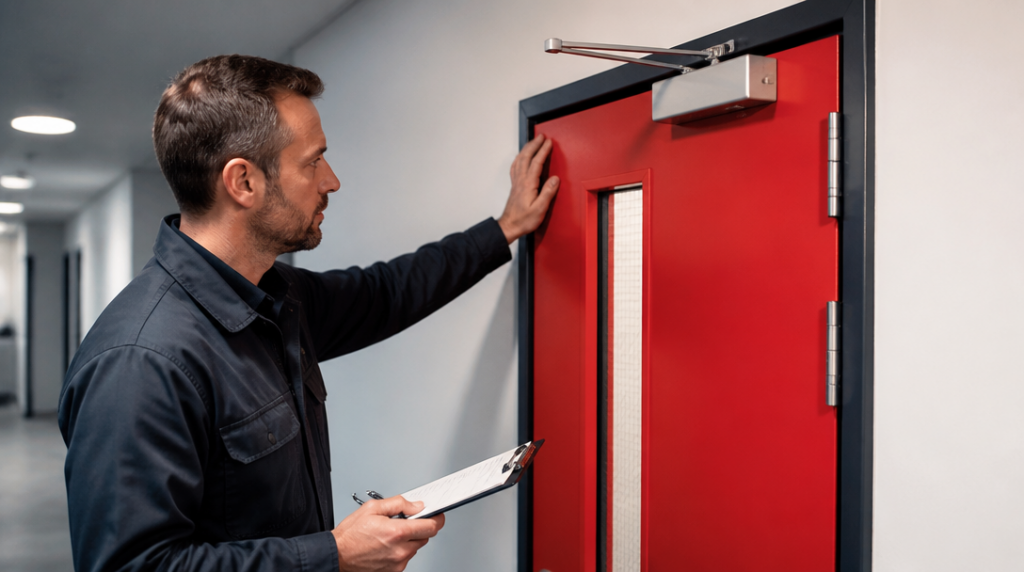
Picture a routine building inspection. The doors look clean, the hinges are in place, and nothing seems obviously wrong. Then an inspector checks the gaps, hardware, seals, closing action, and frame—and suddenly that reassuring hallway looks rather different. Fire doors are not ordinary doors, and finding someone qualified to inspect them takes more than choosing the first name in a search result.
An accredited inspector should be able to show recognised training and current credentials, not just years of general experience in construction or facilities management. Start by deciding which qualification applies in your country, then verify it through the relevant professional register or organisation. A confident answer is useful. A certificate you can check is much better.
In the United States, one of the clearest credentials to look for is the Certified Fire and Egress Door Assembly Inspector certification, commonly known as CFDAI, from the Door & Hardware Institute. The certification must be renewed every three years, so ask to see evidence that it is current. An old certificate may show that someone completed the programme once; it does not necessarily prove that the qualification remains valid.
You should also check whether the inspector meets the Intertek Certified Fire & Egress Door Inspector programme. Registration for that programme requires completion of a DHI course and examination. Those details matter because they connect the inspector’s status to a defined training and assessment route rather than a vague claim of expertise.
There is another useful option for finding professionals in the US. The Door Security & Safety Foundation maintains a directory that allows you to search for people with FDAI qualifications for fire doors. Use the directory as a starting point, then speak to the inspector directly. Ask which credential they hold, whether it is current, and what type of buildings they regularly inspect. A directory listing is helpful, but a short conversation can reveal whether the person understands the scale and quirks of your property.
That last point is easy to underestimate. A small office, a school, an apartment block, and a hospital can contain very different door arrangements and maintenance problems. You do not need an inspector who delivers the same generic checklist everywhere. You need someone who can explain what they are examining and why a particular defect matters.
In the United Kingdom, use the FDIS Approved Inspectors register to check an inspector’s status. The FDIS scheme is accredited by UKAS against BS EN ISO/IEC 17024:2012. That gives you a recognised framework for checking professional competence rather than relying solely on an individual’s marketing materials.
Do not stop at the name in the register. Check that the inspector’s approval is current, then ask about insurance. FDIS inspectors should have valid Professional Indemnity and Public Liability insurance. These forms of cover serve different purposes, and both are worth confirming before work begins. Request current evidence rather than accepting a casual assurance over the phone.
FDIS inspectors are also subject to continuing quality assurance and reassessment. That ongoing scrutiny is significant. Fire-door inspection is not a qualification someone should earn once and then forget about for the rest of their career. Standards, products, building use, and expectations can change, while practical judgement improves through regular work and review.
Once you have found a suitably qualified candidate, ask what the inspection will include. A proper inspection should examine more than the door leaf itself. The inspector may need to assess the frame, hinges, closer, latch, locks, glazing, seals, signage, gaps, and the surrounding condition. The exact scope will depend on the building and the inspection brief, so ask for it in writing before agreeing to the fee.
Ask how the findings will be reported. A useful report should identify each door or door set clearly, describe defects in plain language, and distinguish urgent safety concerns from routine maintenance issues. Photographs can make the report easier to use, especially when the person arranging repairs is not the same person who commissioned the inspection. You should also know whether the inspector will provide practical recommendations or simply list faults.
Be wary of a report that treats every defect as equally serious or offers no explanation at all. A long document is not automatically a good document. If a door has a damaged intumescent seal, a faulty closer, or an unsuitable modification, you should be able to understand what was found and what needs attention. Personally, I would rather receive a concise report that helps a maintenance team act than a thick file full of impressive-looking phrases and little direction.
Price deserves a sensible question, too. The cheapest quote may not be the cheapest result if important doors are missed or defects are recorded so vaguely that nobody knows how to fix them. Ask whether the fee covers every relevant fire door, follow-up questions, travel, photographs, and a final report. If the property has many doors, ask how they will be identified and tracked so that repairs can be matched to the correct location.
You can also ask about independence. An inspector who identifies defects and then immediately sells the repair work is not automatically unsuitable, but you should understand the arrangement. A clear separation between inspection findings and repair recommendations makes it easier to judge whether the advice is proportionate. Request a written quotation for any additional work, and do not feel pressured to approve repairs on the spot.
Before the appointment, prepare whatever information you have about the building. Floor plans, previous inspection reports, maintenance records, and details of recent alterations can help the inspector work more efficiently. Tell them about access restrictions, occupied rooms, recurring problems, or doors that are regularly wedged open. Small details often explain why a door behaves differently from the others in the same corridor.
During the conversation, notice how the inspector talks about uncertainty. A trustworthy professional will not pretend to know everything from a photograph or promise that every issue can be judged instantly. They should be willing to say that a component needs closer examination, that a record must be checked, or that a specialist opinion may be required. That kind of caution is more reassuring than theatrical certainty.
A good search therefore has three parts: verify the recognised credential, confirm that it is current, and test whether the inspector can deliver a clear and useful inspection for your particular building. In the US, check CFDAI, the Intertek Certified Fire & Egress Door Inspector programme, and the DSSF directory where relevant. In the UK, check the FDIS Approved Inspectors register, along with current Professional Indemnity and Public Liability insurance. Then ask practical questions about scope, reporting, independence, and follow-up before you book the visit.
The right inspector will not merely point at a faulty door and move on. They will give you enough information to understand the risk, organise the repair, and keep a reliable record of what happens next.