
England and Wales does not currently have a separate Law Society accreditation for construction law. That single fact changes how you should search for a solicitor, because an apparently impressive accreditation label may tell you far less than the lawyer’s actual experience with building disputes, contracts and claims.
The sensible approach is to treat accreditation as one piece of evidence rather than the answer itself. Start with the type of construction problem you have, search for solicitors who regularly handle that problem, and then verify that both the individual and the firm are properly regulated.
Start with the dispute, not the badge
Construction law covers a wide stretch of ground. A homeowner dealing with defective work needs a different kind of advice from a contractor pursuing unpaid invoices, while a developer facing delay claims may need someone experienced in complex commercial litigation. A solicitor who is excellent at negotiating a residential building contract may not be the right person for an adjudication involving several contractors and consultants.
Before searching, write down what has actually gone wrong. Is the issue defective workmanship, delay, non-payment, design responsibility, a professional negligence claim, a contract termination or a dispute over variations? You do not need to identify the legal label perfectly. A plain description is enough to steer your search in the right direction.
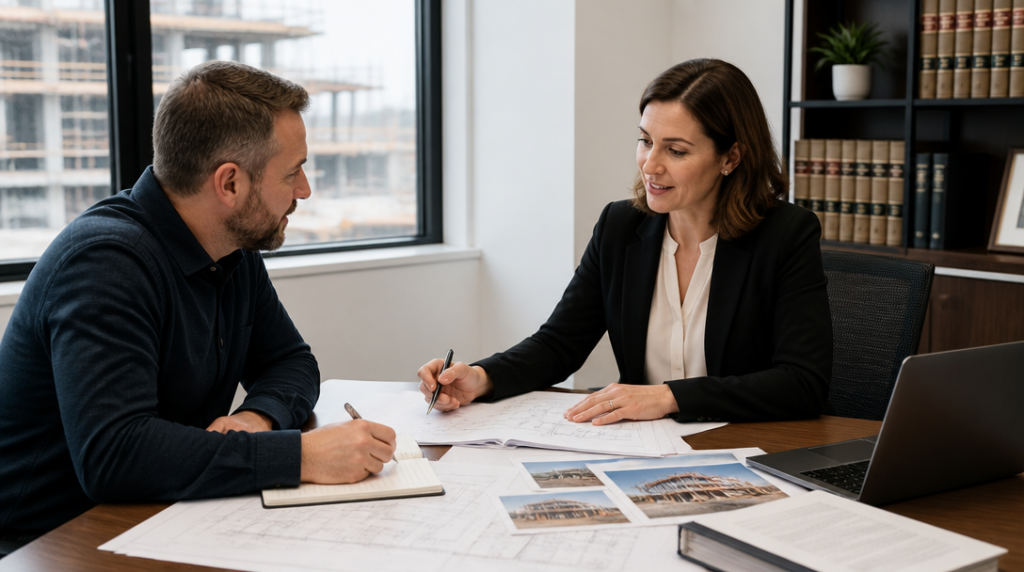
If the project is still under construction, gather the contract, drawings, payment records, programme, photographs, inspection notes and important emails. Keep a short timeline as well. Construction disputes often turn on sequence: who knew what, when an instruction was given, when work stopped and whether someone was given a chance to put things right. A tidy file can save time at the first meeting and make it easier for the solicitor to assess whether the claim is urgent.
Search for lawyers using terms such as construction disputes, construction litigation, building contract disputes or construction adjudication. If your matter involves a particular problem, add that word to the search. “Construction solicitor” is a useful starting point, but it is too broad to be your final test.
Use the Law Society directory as a shortlist, not a verdict
The Law Society’s Find a Solicitor directory contains approximately 216,967 legal professionals, so a broad search can quickly produce more names than you can sensibly contact. Its filters allow you to search by area of law, location, name, SRA ID and accreditation. That makes it useful for narrowing the field, especially if you know the region in which the solicitor or firm operates.
Choose the construction-related area first, then add your location if meetings in person matter to you. A local firm may be convenient, but location should not automatically outweigh experience. Construction disputes are often handled by solicitors who work with clients across the country, particularly where the project, parties or evidence are spread across several areas.
The directory also offers an “accredited specialists only” filter. This displays profiles with relevant Law Society accreditation. Use it if you want to see whether a particular solicitor or firm holds an accreditation, but do not assume that an accreditation specifically proves expertise in construction law. The Law Society does not currently list a standalone construction law accreditation in England and Wales, and its accreditation schemes are voluntary quality marks for individuals and firms.
That distinction matters. An accredited solicitor may have a strong professional record, but the accreditation alone does not establish that they regularly handle construction disputes. Read the profile carefully. Look for clear references to construction contracts, building claims, adjudication, arbitration, litigation or the type of project involved. Vague language about “commercial matters” is less useful than a precise description of relevant work.
Read the profile like a case file
A good profile should help you answer three practical questions: does this solicitor deal with disputes like mine, do they work with clients in a similar position, and can they handle the procedure my case may require?
For example, a contractor with an unpaid account may need someone familiar with payment notices, contractual payment mechanisms and adjudication. A homeowner may be more concerned with evidence of defects, expert reports and the cost of pursuing a claim. A developer might need advice on drafting, risk allocation and claims involving delay or disruption. The phrase “construction law” appears in all three searches, but the useful experience is not identical.
Pay attention to whether the profile describes contentious work. “Contentious” simply means work involving a dispute or the possibility of formal proceedings. A solicitor who mainly drafts contracts may be perfectly capable of preventing problems, but may not be the strongest choice once a claim has already become hostile.
Look at the firm’s wider practice as well. Construction disputes can involve property, insolvency, professional negligence, insurance or planning issues. A firm with access to those areas may be helpful when the disagreement refuses to stay inside the construction contract. Still, do not let a long list of practice areas distract you from the central question: how much of the solicitor’s work is genuinely relevant to your matter?
The best profiles tend to be specific without making extravagant promises. They explain the kind of clients served and the disputes handled. If every sentence could describe any commercial solicitor in the country, keep searching.
Check the regulator before discussing sensitive details
Once you have a shortlist, verify the solicitor and the firm in the Solicitors Regulation Authority register. This is the definitive official source for checking regulatory status. It can show whether the individual or organisation is regulated, who the employer is and whether any restriction or prohibition on practice applies.
Do this before sending a full bundle of contracts, personal information or commercially sensitive correspondence. A directory profile is not a substitute for regulatory verification, and a firm’s own website should not be treated as the final word on its status.
The name on the solicitor’s email signature should match the registered details closely enough for you to identify the correct person. If the solicitor has moved firms, check that the current employer is shown accurately. If something does not line up, ask the firm to explain it before proceeding.
Regulation does not tell you whether the solicitor is a good fit for a particular construction dispute. It answers a different question: whether you are dealing with a properly regulated solicitor or firm. Both questions matter, but they should not be confused.
Ask sharper questions at the first call
The first conversation is not merely an opportunity for the solicitor to decide whether to accept the case. It is also your chance to test whether they understand the problem quickly and explain it clearly.
Ask how often they handle disputes similar to yours and whether they mainly act for homeowners, contractors, subcontractors, developers or professionals. Ask what procedure they think may apply, while recognising that a responsible solicitor may need the documents before giving a firm view. You can also ask who would actually run the matter, whether another solicitor or a paralegal would do much of the day-to-day work, and how the firm charges for the initial assessment and later stages.
Do not be unsettled if the solicitor asks basic questions. Construction disputes are built from documents and chronology, not from a dramatic account of who behaved badly. A careful lawyer will want to know what the contract says, what notices were served, what payments were made and what evidence exists before making confident predictions.
Be cautious of certainty offered too early. “You will definitely win” is not a substitute for analysis, especially when the solicitor has not yet reviewed the contract or technical evidence. Clear explanations are more valuable than theatrical confidence. The right solicitor should be able to say what appears strong, what remains uncertain and what information could change the assessment.
A useful test is whether you can explain the proposed next step in your own words after the call. If the answer is no, ask the solicitor to slow down and clarify it. Construction law contains enough unfamiliar language without allowing the first meeting to become a fog of acronyms.
Keep the shortlist small enough to manage, perhaps two or three firms, and compare like with like. One solicitor may offer a quick document review, another may propose a longer investigation. Their fees may reflect different scopes of work rather than simple differences in price. The cheapest initial estimate can become expensive if it leaves important questions unanswered, just as the most polished accreditation can be unhelpful if the solicitor rarely handles disputes of your kind.