
The United States has no single national electrician’s license. That means a company can look polished online, arrive in a branded van, and still leave you responsible for checking whether it is properly licensed where your building operates.
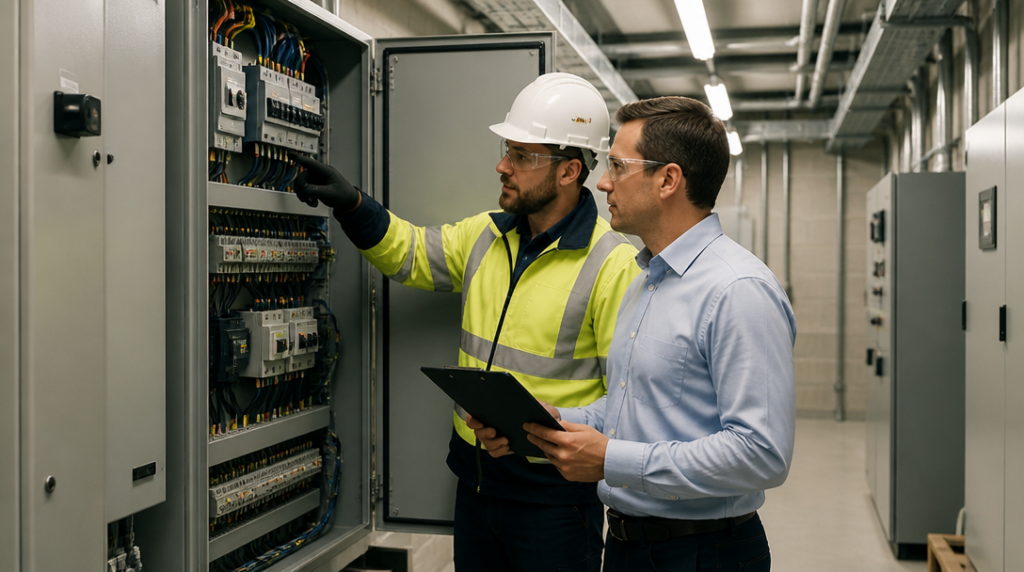
Commercial electrical work is too expensive and too dangerous for a handshake, a vague estimate, or a website featuring a stock photo of a man thoughtfully inspecting a circuit breaker. The right electrician should be able to prove its qualifications, understand commercial safety requirements, and explain exactly how the work will be managed.
Start with the license, not the logo
Ask for the company’s license number and the name or license number of the specific electrician who will supervise or perform the work. Then verify both through the relevant state or local registry. A business license and an electrical license are not the same thing, and a company’s ability to install a light fixture in someone’s kitchen does not automatically qualify it to rewire a warehouse, restaurant, medical office, or manufacturing facility.
Licensing rules vary across the country. Some states handle them centrally, while others leave substantial responsibility to cities or counties. The important detail is not where the electrician says it is licensed. The important detail is whether the license is active, matches the business name, covers the type of work involved, and has no restrictions that would make your project a creative interpretation of the rules.
California offers a useful example of how licensing information should appear in public-facing material. Contractors there must include their state license number in advertising, including on websites, vehicles, and flyers. If a California contractor’s marketing is mysteriously allergic to displaying that number, ask why. It may have an innocent explanation. It may also be the electrical equivalent of a magician refusing to show you the other hand.
A reputable contractor will not become defensive when you ask for verification. In fact, the request should be routine. If the response is a long story about how the license is “being renewed,” how the owner’s cousin handles the paperwork, or how online registries are unreliable, pause before signing anything.
Insurance is the part nobody wants to discuss after an accident
Before work begins, request current certificates for commercial general liability insurance and workers’ compensation coverage. Make sure the coverage is valid for the period of your project and appropriate to the risks involved. A certificate that expired last year is not a safety net; it is paperwork with excellent timing.
Commercial general liability coverage can help address property damage or bodily injury claims connected with the contractor’s work. Workers’ compensation coverage matters because employees may be injured while working on your premises. Without proper coverage, disputes over responsibility can become expensive very quickly, especially if the project involves ladders, energized equipment, lifts, confined spaces, or work at height.
Ask whether the contractor carries a surety bond when one is required or customary in your jurisdiction. A bond is not a replacement for insurance, but it can provide another layer of protection when a contractor fails to meet certain obligations. Check the bond’s status and amount rather than accepting the phrase “fully bonded” as a complete answer. Marketing language has a remarkable ability to become less specific when money is involved.
State registries may show more than a license status. In some places, you can also find safety violations, complaints, or claims involving a contractor’s bond. Those records do not automatically tell the whole story, but they can reveal patterns that a glossy homepage will not mention. Read the entries carefully and ask the contractor to explain anything relevant to your project.
You should also ask for proof that subcontractors are insured and properly licensed where required. A commercial electrical company may bring in specialists for fire alarm systems, controls, data cabling, generators, or other related work. You need to know who is actually entering the building and who carries responsibility for the work they perform.
Make the proposal reveal how the job will really run
A trustworthy electrician should produce a written proposal that describes the scope of work in plain language. It should identify the equipment, materials, labor, permits, testing, cleanup, and any exclusions. “Upgrade electrical system” is not a scope. It is a promising title for a meeting that will later contain several unpleasant surprises.
Look for details such as panel and circuit identification, expected shutdowns, temporary power arrangements, access requirements, inspection responsibilities, and the handling of concealed conditions. If the job involves an occupied office, retail space, apartment building, or production area, the proposal should address how the contractor will protect staff, customers, tenants, inventory, and operating hours.
The lowest bid deserves scrutiny rather than applause. A cheaper proposal may omit permits, testing, after-hours work, equipment rental, arc-flash labeling, patching, or coordination with other trades. Compare proposals by scope, not just by the final number at the bottom. Two bids that look different may describe the same work in very different levels of detail.
Ask who will be on site and who will supervise the crew. You should know whether the person estimating the work will actually manage it, whether a project manager will coordinate with your facilities team, and how urgent problems will be handled. A reliable contractor gives you a clear contact route before the first breaker is opened, not after something starts making an interesting smell.
References are most useful when they resemble your project. Ask for recent commercial clients with similar building types, operating demands, or equipment. A contractor experienced with retail fit-outs may not have much experience maintaining a large industrial distribution system. Speak with references about schedule control, communication, change orders, documentation, and how the contractor behaved when the job became complicated.
Safety knowledge should show up in the conversation
Commercial electrical work requires more than technical ability. The contractor should be familiar with workplace safety obligations and able to explain how the crew will manage hazards before work starts.
Ask how the company handles lockout/tagout, energized work, personal protective equipment, fall protection, job hazard analysis, and site-specific safety rules. The answers do not need to sound like a courtroom speech. They should, however, be specific enough to show that safety is part of the work plan rather than a poster taped to a break-room wall.
The contractor should understand OSHA requirements relevant to its operations, including the rules in 29 CFR 1904 concerning the recording and reporting of workplace injuries and illnesses. Electrical contractors fall within the industry classification NAICS 238210, which covers electrical contractors and other wiring installation contractors. You do not need to memorize classification codes for sport, but you should expect the company to understand the regulatory environment attached to its work.
Ask how incidents, near misses, and injuries are documented. Ask who is responsible for site orientation and daily safety communication. If the project involves multiple contractors, clarify who coordinates safety between trades. A good electrician will not treat your building’s safety procedures as decorative suggestions.
Pay attention to how the contractor discusses shutdowns and energized equipment. A vague answer such as “we’ll be careful” is not a method. You want to hear about planning, authorization, testing, boundaries, qualified personnel, and communication with the people affected by the outage.
Maintenance tells you whether the relationship will last
Installation gets the attention because it produces visible results: new panels, brighter lighting, new equipment, fewer extension cords snaking across the floor. Maintenance is less glamorous, which is precisely why it is often neglected until a problem becomes expensive.
For ongoing commercial maintenance, ask whether the contractor follows a documented process based on NFPA 70B. The standard applies to electrical equipment maintenance in industrial, institutional, and commercial buildings, and its current revision is NFPA 70B-2026. A contractor should be able to explain how it will inspect, test, document, and prioritize the condition of your electrical distribution equipment.
That process might include equipment inventories, inspection intervals, thermal imaging where appropriate, cleaning, torque checks, testing, condition reports, and records of corrective work. The exact program should reflect the building and equipment, not a generic checklist that treats a small office and a production plant as distant cousins with identical electrical systems.
Ask what documentation you will receive after service. Useful records may include test results, photographs, identified deficiencies, updated panel schedules, asset details, and recommendations ranked by urgency. Good records make future repairs faster and help facilities staff understand what has changed inside the building.
You should also ask whether the company provides emergency response and what that actually means. Is someone available around the clock, or does “24/7 service” mean an employee may answer a message sometime before breakfast? Clarify response expectations, rates, authorization limits, and who can approve emergency work.
The best commercial electrician is not necessarily the one with the biggest truck or the most dramatic promise. It is the contractor whose license can be verified, whose insurance is current, whose proposal survives close reading, and whose safety and maintenance practices remain sensible when nobody is watching. That combination may not make for a thrilling advertisement, but it makes a much better electrical system.