
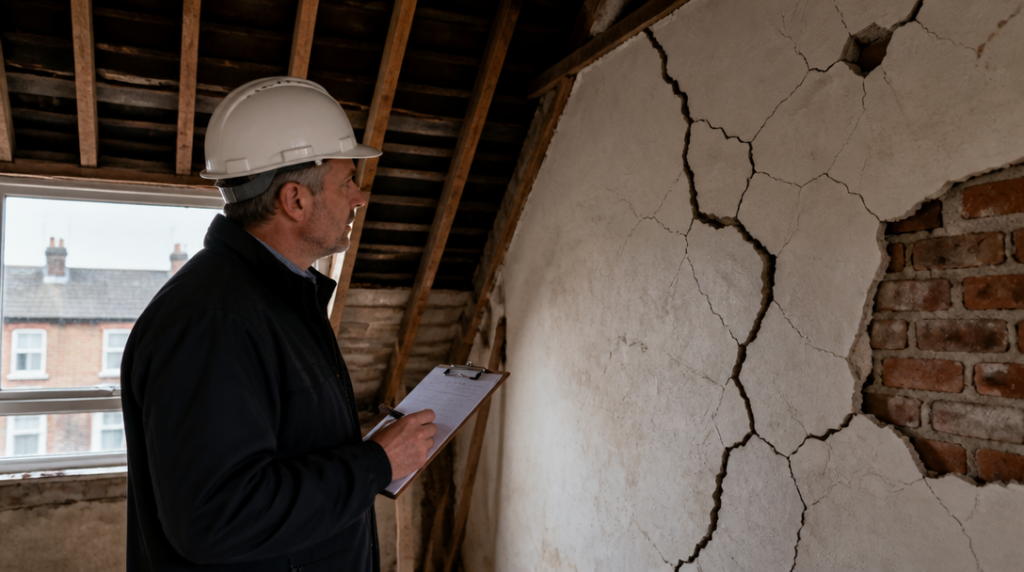
A few years ago, a friend showed me a structural survey for a Victorian terrace he was planning to buy. The report looked impressive: several pages of technical language, photographs of cracked plaster, and a reassuringly formal signature at the end. Then a builder who happened to visit the property noticed that the surveyor had treated a bowed rear wall as a cosmetic defect. It was not. The wall had been altered decades earlier, and part of the load path had been compromised.
That moment changed the way I think about choosing a surveyor. A long report is not proof of good judgement, and a professional-looking website tells me very little. The real question is whether the person understands this particular building, has the right qualifications for the work, and is prepared to explain what they have found without hiding behind jargon.
I would begin with the firm, not with a random internet search. From 13 July 2026, the RICS Find a Surveyor catalogue lists only firms regulated by RICS, so that is the directory I would use as a starting point. Regulation does not make a poor fit impossible, but it gives me something concrete to check: the firm’s status, its area of work, and whether it appears to handle the kind of property I am dealing with.
That last point matters more than many people realise. A surveyor who spends most of the year assessing modern commercial units may not be the best choice for a listed Georgian house with failing lime mortar. Someone experienced with ordinary residential surveys may not be equipped to investigate movement in a steel-framed warehouse. I would ask directly how many recent jobs they have completed on buildings of a similar age, construction, size, and condition.
The wording of the qualifications deserves careful attention. For a building survey, I would look for the designation Chartered Building Surveyor, together with MRICS or FRICS. The phrase “RICS-qualified” on its own is too vague. It does not necessarily show that the individual specialises in building construction or structural diagnosis. A qualification can be genuine and still not match the problem in front of you.
If I needed a genuine assessment of the load-bearing structure, I would look further than a general building-survey credential. I would want a chartered member of IStructE or ICE, particularly where the issue involves foundations, beams, retaining walls, roof structures, settlement, or substantial alterations. “Chartered Engineer” is a protected title, so I would expect the surveyor to use it accurately rather than as loose marketing language.
This distinction can feel fussy until you are standing beneath a cracked ceiling and trying to decide whether the problem is old plaster or a failing support. On a small, straightforward purchase, a building surveyor may be exactly the right professional. On a property with serious movement or proposed structural changes, I would want someone whose training and day-to-day work are centred on engineering judgement.
Before booking anything, I would ask for a CV or a capability statement. Not a glossy brochure full of stock photographs, but a document showing recent, relevant work. I would look for examples involving the same type of building and the same kind of defect. If the surveyor has investigated settlement in Victorian houses, repaired defective roof trusses, or assessed cracking after an extension, those details should be visible.
I would also ask about continuing professional development, often described as CPD. A capable professional does not stop learning after gaining a qualification. Building regulations change, repair methods develop, and older buildings behave differently from modern ones. A short record of recent training will not prove competence by itself, but an evasive answer would make me uncomfortable.
Then I would compare several written quotations. Price is part of the picture, but it is a poor substitute for clarity. One quote may cover a visual inspection and a short letter; another may include access equipment, a more detailed report, or consultation with an engineer. Unless I know what is included, comparing the figures is almost meaningless.
I would ask each firm to state exactly what the inspection will cover, what it will exclude, whether hidden areas will be opened up, and what happens if the surveyor finds something that needs specialist testing. I would want to know whether the report will identify likely causes, recommend further investigation, and distinguish urgent safety issues from routine maintenance. A vague promise to “inspect the structure” leaves too much room for disappointment.
A good surveyor should also be willing to discuss access. A roof void blocked by insulation, a basement hidden behind stored furniture, or an upper-floor wall concealed by finishes can limit what anyone can responsibly conclude. I would rather hear that before the inspection than receive a confident sentence based on an area the surveyor never saw. The same applies to drainage, neighbouring structures, historic alterations, and documents supplied by the seller.
Insurance is another box I would not leave unchecked. I would ask for confirmation of current Professional Indemnity Insurance and make sure it covers the services being offered. RICS-regulated firms must hold Professional Indemnity Insurance that meets RICS minimum requirements, which provides a useful baseline. I would still ask for the details in writing, especially for a substantial commission. If a firm treats a basic insurance question as an irritation, I would take that as a warning rather than an invitation to apologise.
The first conversation often reveals more than the website. I pay attention to whether the surveyor asks sensible questions about the property before giving a price. Have there been previous extensions? Is there a history of movement? Are cracks widening? Has an insurer, mortgage lender, or local authority raised a concern? Someone who quotes instantly without understanding the assignment may be selling a standard product rather than offering a considered service.
I would also ask who will actually carry out the inspection and sign the report. Some firms market access to a senior specialist but send a different employee to the property. That arrangement is not automatically a problem, provided the person inspecting has suitable experience and the senior professional reviews the work. I would want the arrangement explained plainly, along with a route for follow-up questions once the report arrives.
The report itself should help me make a decision, not merely prove that the surveyor visited. I would expect photographs, clear descriptions of defects, an explanation of probable causes, and a distinction between observed facts and professional opinion. Recommendations should be proportionate. “Obtain further advice” may be sensible, but the report should explain what kind of advice is needed and why. A list of alarming possibilities without priorities is not much use to a buyer facing a deadline.
For older buildings, I would be especially wary of modern assumptions. A patch of damp does not automatically call for waterproof cement render, and a crack does not automatically mean underpinning. Traditional buildings often rely on materials and movement patterns that require a different approach. If the property is historic or listed, I would look for an engineer accredited through CARE, the Conservation Accreditation Register for Engineers. That experience can prevent an ordinary repair from becoming an expensive and irreversible mistake.
I would never let a seller’s urgency make the choice for me. A surveyor who can inspect tomorrow may be convenient, but availability is not a qualification. Nor would I choose solely because the fee is the lowest. I once saw a buyer spend more on correcting a badly diagnosed defect than a careful inspection would have cost in the first place. The cheapest report was not cheap; it was simply paid for twice.
My shortlist would therefore be small. I would check the firm’s regulatory status, match the individual’s qualifications to the problem, request evidence of comparable recent work, confirm insurance, compare the scope of several quotations, and speak to the person who will take responsibility for the report. If the answers are precise and unhurried, I feel far more comfortable. If every question produces a sales pitch, I keep looking.
A reliable structural surveyor does not need to sound dramatic. In fact, I prefer the professional who can say, “I cannot establish that without opening this area,” because that sentence shows an understanding of the limits of an inspection. Buildings rarely fail in neat, isolated categories, and the best surveyors respect the evidence before they reach for a diagnosis.