
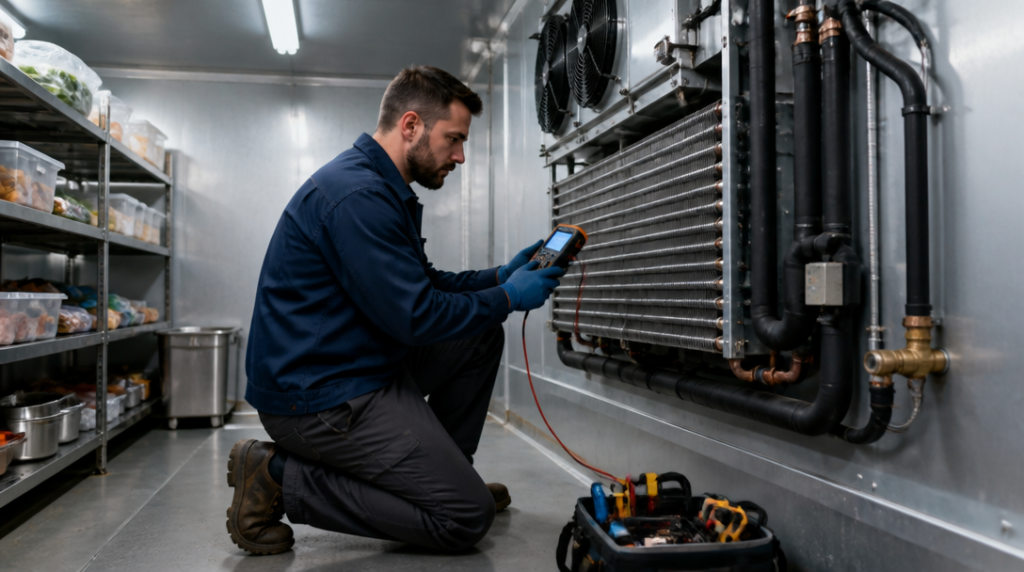
The walk-in cooler is already climbing past its safe temperature when the engineer arrives. He glances at the display, taps the compressor housing, and announces that the compressor needs replacing. No pressure readings. No inspection of the evaporator. No questions about when the fault began.
That is not diagnosis. It is a costly hunch delivered with confidence.
The uncomfortable question for any business owner is this: are you hiring a qualified refrigeration engineer, or simply the first person who answers the phone? Those choices can look identical for the first ten minutes. The difference appears later, when the new compressor fails to solve the problem, spoiled stock has to be discarded, and the original service bill grows into an avoidable repair project.
A competent engineer does more than make cold air. They work with electrical systems, refrigerants, controls, airflow, pressure, insulation, and safety procedures. They should be able to explain what has failed, what evidence supports that conclusion, and what will happen if the repair is delayed.
Start by asking what kind of refrigeration work the person regularly performs. Domestic appliance repair is not the same as servicing a supermarket refrigeration rack, a restaurant walk-in freezer, a pharmaceutical cold-storage room, or a low-temperature industrial system. Someone may be excellent in one area and poorly suited to another. “I work on refrigeration” is too vague to tell you much.
Ask for examples that resemble your equipment. A technician who routinely services reach-in coolers may not be the best choice for a large chilled-water plant. A residential heating and cooling contractor may understand compressors and refrigerant circuits but have little experience with the complex controls used in commercial food storage. The closer the engineer’s recent work is to your system, the less time they will spend learning on your premises.
Check the credentials before the emergency
In the United States, anyone whose service work could breach a refrigerant circuit must hold EPA Section 608 certification under 40 CFR Part 82, Subpart F. The certification does not expire, but that does not make every certificate equally useful for every job. Ask to see the actual credential and confirm which category it covers.
For commercial equipment, look for at least EPA Type II certification. Type III applies to low-pressure equipment, while Universal certification provides the broadest coverage. A technician who only holds a limited category may be perfectly legitimate for one system and unsuitable for another. That distinction matters more than a polished van or a five-star review.
The organization that issued the certificate should appear on the EPA’s list of approved certification programs. The current list was updated on July 7, 2026, so an engineer who sends an image of a certificate without identifying the issuing program has left an important question unanswered. You are not being difficult by checking. You are verifying that the qualification is recognized for the work being offered.
EPA certification is a legal baseline, not a complete measure of competence. It shows that the engineer has met requirements for handling regulated refrigerants. It does not automatically prove that they can find a restricted airflow problem, interpret a control fault, diagnose a failing condenser fan, or commission a system correctly after repair.
That is why additional training and trade experience deserve attention. NATE, a widely recognized voluntary certification body in the heating, ventilation, air-conditioning, and refrigeration field, offers specializations in Light Commercial Refrigeration and Commercial Refrigeration. Its traditional certification route includes a 50-question Core test and a 100-question Specialty test, with commercial refrigeration treated as its own specialty rather than an afterthought.
NATE recommends at least two years of experience before taking its service examinations. That recommendation is useful context when a candidate describes themselves as fully qualified after only a short period in the trade. A certificate can support a hiring decision, but it should not replace a conversation about the systems the engineer has actually opened, repaired, and commissioned.
Ask whether the engineer is comfortable documenting readings and findings. A professional should be able to provide operating pressures where relevant, temperature measurements, electrical observations, fault codes, and a clear account of the work performed. The paperwork does not need to read like a scientific paper. It should, however, give you enough information to understand whether the repair addressed the cause or merely silenced a symptom.
Education has a place here, although it is not the only route to skill. Typical postsecondary preparation for refrigeration and air-conditioning work ranges from six months to two years. That may involve a technical program, an apprenticeship, manufacturer training, or a mixture of classroom instruction and supervised field work. A strong engineer can explain how they learned the trade without becoming defensive about the route they took.
Be wary of anyone who treats experience as proof that rules no longer apply. Ten years of repeating the same shortcuts is not the same as ten years of improving diagnostic ability. Refrigeration systems change, refrigerants change, controls become more sophisticated, and safety expectations are not optional.
The questions that expose weak diagnosis
Before approving a repair, ask what the engineer believes is wrong and what tests led them there. This simple question often reveals more than a stack of badges. A careful answer might include several possible causes and explain how the engineer plans to eliminate them. A weak answer usually jumps straight to a part replacement.
Ask what has already been checked. Has the engineer inspected condenser cleanliness, fan operation, evaporator airflow, door seals, defrost controls, sensors, electrical connections, and refrigerant charge? The relevant checks will vary by system, but a reliable professional should not behave as if every temperature problem is caused by low refrigerant.
That shortcut is especially dangerous because adding refrigerant can make a failing system appear to improve temporarily. If the circuit is leaking, the business may pay for refrigerant and another emergency visit while the underlying problem continues. A qualified engineer should discuss leak detection, repair obligations, and the consequences of operating the equipment in its current condition.
Ask how the proposed repair will be verified. Replacing a component is not the same as proving the system is working properly. The engineer may need to confirm stable temperatures, correct superheat or subcooling where applicable, satisfactory defrost performance, normal amperage, proper airflow, or reliable operation through a complete cycle. You should not need to dictate the test, but you should expect the engineer to have one.
References can help, especially for a commercial installation that affects inventory or production. Request references from businesses with equipment similar to yours, not just homeowners who were pleased with a quick air-conditioning repair. Ask those businesses whether the engineer arrived prepared, explained the fault, returned calls, and stood behind the work when the problem was more complicated than expected.
Insurance and licensing requirements vary by location, so check the rules that apply in your state and municipality. Ask for proof of the coverage required for the job. A legitimate contractor should understand why a customer needs that information. If the engineer refuses to provide basic documentation, the refusal itself is useful information.
Price still matters, but the cheapest hourly rate can be a trap. A skilled engineer may diagnose the fault in one visit, carry the correct parts, and leave a useful service record. An inexperienced person may spend less per hour while consuming an entire day, replacing parts at random, or creating a second fault during the first repair. The invoice is only one part of the cost.
A federal labor report placed the median annual wage for heating, air-conditioning, and refrigeration mechanics and installers at $59,810 in May 2024. That figure does not tell you what a particular contractor should charge, but it does underline a basic reality: trained technical work has value. A suspiciously low quote may reflect limited experience, incomplete insurance, poor documentation, or a plan to recover the difference through unnecessary parts and follow-up visits.
The first conversation should also cover availability and response time. A restaurant may need emergency coverage outside normal hours, while a small office may be able to schedule routine maintenance. Find out who answers after hours, whether the person who takes the call is the person who performs the work, and whether emergency rates are clearly defined. “We’ll see what we can do” is not an emergency plan.
Look at how the engineer treats the equipment before they touch it. Do they protect food and surfaces, use appropriate instruments, isolate electrical power when necessary, and keep refrigerant cylinders handled correctly? Do they ask what changed before the failure? A technician who listens to the operator may learn that the fault began after a delivery blocked an air intake or after a door stopped closing fully. The person standing beside the machine often holds the first useful clue.
My own rule would be simple: never hire someone for a serious refrigeration repair who cannot explain the suspected fault in plain language. Technical vocabulary can clarify a diagnosis, but it can also hide an empty one. You should leave the conversation knowing which evidence supports the repair, what remains uncertain, and how the engineer will confirm that the system is safe and stable.
The best candidate may not promise the fastest fix. They may say the system needs testing before a price can be given, or that the evidence points to a control problem rather than a failed compressor. That caution can feel irritating while a cooler is warming up. It is usually far cheaper than confidence without proof.