
The lift stops between floors at 8:17 on a Monday morning. One person reaches for the emergency phone while another searches for the cheapest engineer who can attend before lunch.
In a different building, the same fault leads to a calmer response. The facilities manager already knows which engineer maintains the lift, what qualifications they hold and whether they have worked on that exact control system before. That difference is rarely visible until something goes wrong.
Finding a qualified lift maintenance engineer takes more than comparing hourly rates. You need someone with the right technical training, practical experience and understanding of the equipment’s safety obligations.
Start with the qualification, not the job title
“Lift engineer” can describe people with very different levels of training. A polished website and a confident phone manner do not tell you whether someone is ready to work independently on a passenger lift.
In the UK, one useful qualification to look for is ST0252 Lift and Escalator Electromechanic. A Level 3 NVQ or SVQ in Engineering Maintenance, or in Installation and Commissioning, can also be relevant, depending on the person’s role and the work they carry out.
The qualification should make sense for the job. Someone experienced in general engineering maintenance may still lack the specific knowledge needed for lift servicing. Ask whether the engineer’s training covers the equipment they will actually inspect, maintain or repair.
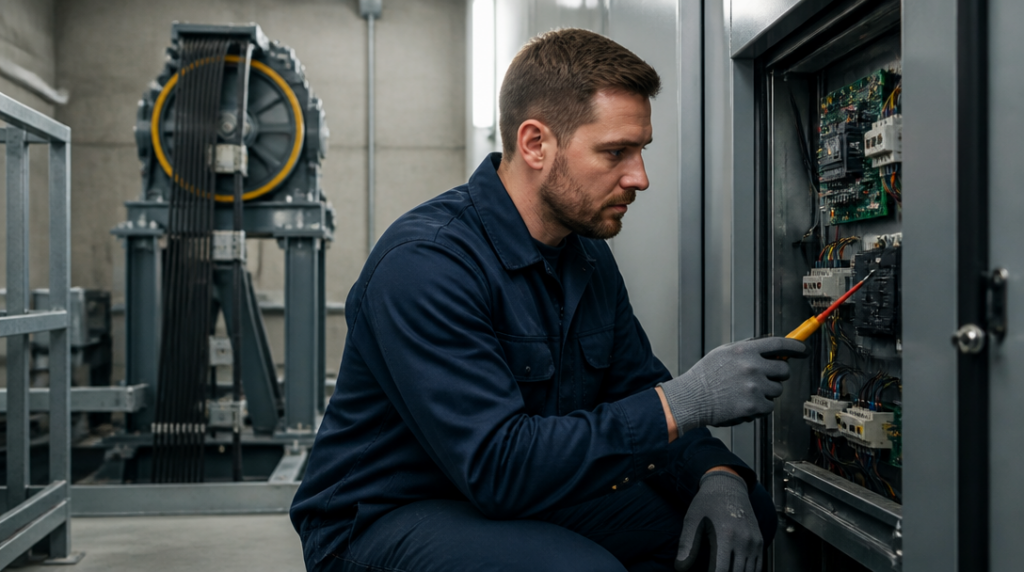
That distinction matters because lifts are not interchangeable machines. A traction lift with ropes, sheaves and a geared or gearless drive presents different maintenance demands from a hydraulic lift. A person who mainly installs equipment may not have the same experience with fault-finding and routine servicing. Repair work can require another layer of familiarity altogether.
Match the engineer to the lift
Before contacting companies, gather the basic details of the equipment. Find out whether the lift is traction or hydraulic, whether it carries passengers or goods, which manufacturer built it and what control system it uses. The model and approximate age can narrow the search further.
These details are more useful than a vague request for “lift maintenance.” An engineer who knows a particular manufacturer’s equipment may recognise common faults quickly, understand its service procedures and carry suitable parts or testing equipment. Someone who has only encountered the brand in a classroom may need far more time to understand the installation.
Ask directly about experience with your make, model and controller. Do not settle for a general answer such as “we work on all types of lifts.” Ask how often the engineer has serviced similar equipment and whether they have dealt with the kind of fault your lift has experienced.
A short conversation can reveal a great deal. If the engineer asks for the controller type, recent service history and details of previous faults, that is usually more reassuring than instant certainty based on almost no information.
Check whether the person is ready to work alone
A trainee can become an excellent engineer. That does not mean a trainee should be sent alone to maintain a complex passenger lift without a clear structure around their work.
Under the current LEIA Competency Plan 2025, a technician working without direct supervision should be able to demonstrate basic competence. A new entrant will generally need to be placed into an apprenticeship, NVQ or SVQ route within one year.
Ask the company who will supervise less experienced staff and how competence is assessed. You can also ask whether the named engineer is fully qualified, working under supervision or still completing a formal training route. A reputable provider should be able to explain this without treating the question as an inconvenience.
The important detail is not whether every person on a team has the same level of experience. It is whether the company knows exactly who is competent to perform each task and has assigned the work accordingly.
A certificate alone is not enough. Practical experience is what turns knowledge into safe work, particularly in a machine room where an unfamiliar controller can make a simple fault surprisingly difficult to diagnose.
Separate maintenance from independent examination
Maintenance and statutory examination are related, but they are not the same activity. Routine maintenance keeps the lift in serviceable condition and may involve adjustment, cleaning, lubrication, testing and repairs. A LOLER thorough examination is an independent safety assessment carried out at defined intervals.
For ordinary passenger lifts, a LOLER thorough examination is required at least every six months. Equipment used only for carrying goods generally requires examination at least every twelve months, unless a different examination scheme has been established.
The engineer who carries out routine maintenance should generally not also perform the independent LOLER thorough examination of the same equipment. Separating those roles helps preserve the independence of the examination and reduces the risk that defects are overlooked because the person assessing the lift is also responsible for the work already performed.
When choosing a contractor, ask who carries out the thorough examination and how that person is separate from the maintenance arrangement. A company may provide both services, but the roles should not simply blur into one another.
Do not confuse a service visit with a thorough examination. A lift can receive routine attention and still require a separate examination under the applicable schedule. Keeping those records distinct makes it easier to see what was done, what was found and what needs further action.
Look for evidence of practical competence
The best questions are specific. Ask the engineer to describe a similar lift they maintain, the type of drive it uses and the control system involved. Ask what kind of work they personally carried out rather than what the company offers in general.
You do not need to test them like an examiner. You are trying to establish whether their experience is real and relevant. Someone who has worked on your type of lift should be able to discuss the equipment naturally, including its maintenance challenges and the faults they commonly investigate.
HSE guidance makes the same basic point in practical terms: completing a course does not, by itself, prove competence. A person needs suitable knowledge, training and experience for the work they are expected to perform.
That is why a folder of certificates should never be the only thing you review. Ask for evidence of experience with the particular brand, lift type and control system. References from owners or facilities teams responsible for similar equipment can be useful too, especially if they can comment on the quality of fault diagnosis and follow-up work.
The service report can be revealing as well. Clear reports should identify the lift, describe the work completed and record defects or recommendations in language that a building manager can understand. If every report is a vague line saying “lift serviced,” you have little basis for judging the quality of the visit.
Pay attention to the proposed maintenance arrangement
A qualified engineer still needs enough time and information to maintain the lift properly. Ask how often visits will take place, what is included in routine maintenance and how urgent breakdowns are handled. The answer should reflect the equipment’s condition and use, not just a standard package copied from another building.
Give the contractor access to the lift’s existing records. Previous breakdowns, recurring faults and modifications can change the way an engineer approaches the equipment. If the contractor does not ask about the lift’s history, that is a reason to slow the process down.
Clarify who is responsible for reporting defects and arranging repairs. A maintenance engineer may identify a safety issue that requires specialist work, replacement parts or a further assessment. You should know how that information will reach the person responsible for the building.
Price deserves attention, but it should come after competence and scope. A low monthly fee becomes expensive if faults return, visits are poorly documented or repairs are recommended without anyone understanding the cause.
The warning signs are usually ordinary
Be cautious if a contractor refuses to name the qualification held by the engineer who will attend. The same applies if the company cannot explain whether that person works independently or under supervision.
Vague claims about servicing “any lift” are less helpful than a precise account of experience with your equipment. So is a promise to carry out a LOLER thorough examination without explaining who performs it and how independence is maintained.
Another warning sign is pressure to approve major repairs before the fault has been properly described. A trustworthy engineer should be able to explain what was found, what evidence supports the recommendation and whether the lift can remain in service while you obtain further advice.
The strongest contractor may not be the one with the flashiest presentation. It may be the engineer who asks for the controller details, checks the maintenance history and admits that a certain system is outside their normal experience.
That kind of honesty is valuable. A lift engineer who knows the limits of their competence is far safer to deal with than one who treats every machine as familiar.