
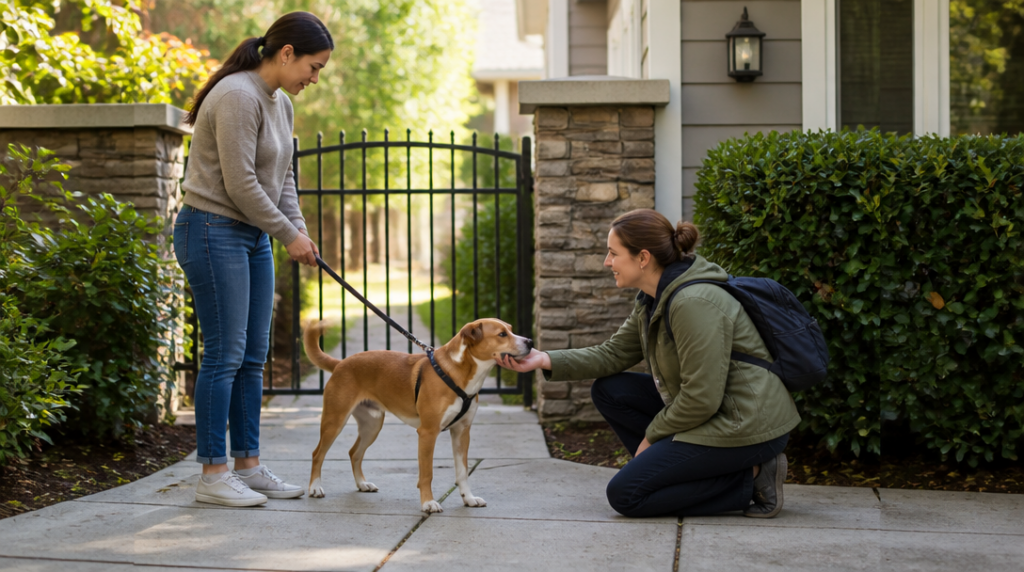
The first meeting lasts ten minutes, but your dog’s reaction may tell you more than a polished profile ever could. Watch whether the walker moves slowly, lets the dog approach, and notices signs of tension instead of reaching straight for the leash.
That meeting should happen before the first paid walk. Professional pet-care organizations recommend an in-person introduction and a careful check of how the dog responds to the walker. A friendly tail wag is encouraging, but a dog that hides, freezes, growls, or stays rigid deserves more time and attention.
Start with the person, not the app
A platform can make the search faster, but it should not make the decision for you. Look at the walker’s experience with dogs similar to yours: age, size, energy level, medical needs, leash habits, and temperament all matter more than a generic claim that they are an animal lover.
A person who regularly handles an energetic young dog may not be the right choice for an elderly dog with arthritis. Someone experienced with relaxed neighborhood walks may struggle with a reactive dog that barks at bicycles. The match has to work in ordinary conditions, not just in a carefully written introduction.
Ask how the walker handles common problems. What happens if your dog refuses to move, slips its collar, picks something up from the pavement, or reacts to another dog? You are not looking for a dramatic rescue story. You are listening for calm, specific answers that show the person has thought through real situations.
Good questions also reveal practical limits. How many dogs do they walk at once? Will your dog be walked alone or in a group? What happens during extreme heat, heavy rain, or a sudden illness? Who contacts you if the walker is delayed or cannot make the appointment?
Verify the paperwork
Trust should not depend on a warm smile. Ask for proof of liability insurance, and check what the policy actually covers. For professional dog walkers, current guidance recommends coverage that includes care, custody, and control, often abbreviated as CCC. This matters because a dog is under the walker’s responsibility during the service, and ordinary business liability coverage may not address every incident involving an animal in their care.
Ask whether the walker is bonded as well. Bonding is not the same as liability insurance, and neither replaces careful hiring, but it is one of the credentials professional pet-care groups advise clients to request. A serious walker should be able to explain what their coverage includes and provide documentation rather than asking you to take the claim on faith.
Background screening needs a date. A check completed several years ago tells you less than a recent one, so professional guidance recommends verifying a current criminal background check, ideally no more than one year old. You do not need to turn the conversation into an interrogation, but you should be comfortable asking when the check was completed and who conducted it.
Some booking platforms state that every walker listed on their service undergoes a background check through a named screening provider. That may be useful, but read the wording carefully. A platform screening process is not the same as a personal reference, proof of insurance, or an assessment of how someone behaves around your particular dog.
Treat references as evidence
Ask for recent references from clients whose needs resemble yours. A reference from the owner of a calm adult dog may not tell you much about how the walker manages a fearful rescue dog or a powerful breed that pulls hard.
Keep the questions concrete. Did the walker arrive on time? Did they follow feeding, medication, and leash instructions? Were updates clear? How did they respond when something unexpected happened? One reference can be unusually enthusiastic; patterns across two or three conversations are more useful.
Listen for details rather than adjectives. A client who says the walker always checked the gate latch, reported changes in appetite, and returned at the agreed time is giving you usable information. Someone who offers only that the walker is wonderful may be sincere, but the recommendation is harder to evaluate.
You can also ask why the previous arrangement ended. The answer may be entirely ordinary, such as a move, a schedule change, or a dog’s passing. A vague or defensive response is not proof of a problem, but it is a reason to ask another question.
Watch the first walk closely
Do not treat the first walk as a formality. Go over the route, harness, collar, identification tags, emergency contact details, and the exact routine for locking the door. If your dog has triggers, explain them plainly. A walker cannot manage a problem you describe as a minor quirk and then leave undefined.
Pay attention to handling. The walker should know where the leash attaches, how to use the harness, and which equipment is off-limits. Retractable leashes, choke collars, and correction-based methods should never appear by surprise. If you use a particular tool or technique, agree on it before the dog leaves the house.
Ask what information you will receive after the walk. A useful update can include the length of the outing, bathroom activity, unusual behavior, and any contact with other dogs. You do not need a minute-by-minute report, but silence after handing over your pet is poor communication.
The first few outings are also a test of consistency. Does the walker follow the agreed route and timing? Does the dog return settled, overstimulated, or unusually withdrawn? One awkward day can happen, especially with a nervous dog. Repeated changes in behavior deserve a direct conversation.
Separate credentials from guarantees
Membership in a professional association can show that a walker has looked for industry resources, but it is not a quality guarantee. One major pet-sitting association explicitly says it does not inspect, supervise, or police its members. Membership should therefore be treated as one piece of background information, not as a substitute for references, insurance, screening, and a meeting.
The same caution applies to testimonials, badges, and star ratings. They can help you build a shortlist, but they rarely explain how a person handles a dog that bolts toward a squirrel or panics when a delivery truck passes. A high rating is a signal to investigate further, not permission to skip the investigation.
Price needs context too. The cheapest option may reflect a shorter walk, group outings, less experience, or limited insurance; a higher rate may reflect a solo service and more careful reporting. Do not assume either direction tells you everything. Compare what the fee includes, especially travel time, cancellation terms, holiday pricing, and emergency care.
A professional should be willing to put the arrangement in writing. The agreement should cover the schedule, fees, access to your home, walking format, cancellation policy, emergency veterinary authorization, and what happens if the regular walker is unavailable. Even a simple written plan prevents small misunderstandings from becoming large ones.
Check the details people overlook
Home access deserves the same care as dog handling. Decide whether the walker will use a key, a lockbox, or an entry code, and remove unnecessary information from the key tag or access instructions. Change a code when the arrangement ends. If several employees or backup walkers may enter your home, ask who they are and how they are screened.
Confirm the dog’s identification and emergency information before the first outing. The walker should have your phone number, an alternate contact, the veterinarian’s details, medication instructions, and permission boundaries for emergency treatment. Keep the information current; a beautifully organized emergency sheet is useless if it contains an old number.
Ask how the walker transports or manages dogs if an emergency occurs away from home. A dog with a damaged paw, heat stress, or a loose collar may need immediate action. You want to hear a clear plan, not a promise that nothing unusual will happen.
Insurance documents, a recent background check, references, and a careful first meeting form a stronger picture than any single credential. The most reassuring sign is usually less dramatic: the walker notices the small things, answers direct questions without irritation, and treats your dog as an individual rather than as one more appointment on the calendar.
My own preference would be the person who spends an extra minute checking a gate and watching a dog’s body language over the person with the flashiest profile. A reliable routine is built from those unglamorous details, one walk at a time.