
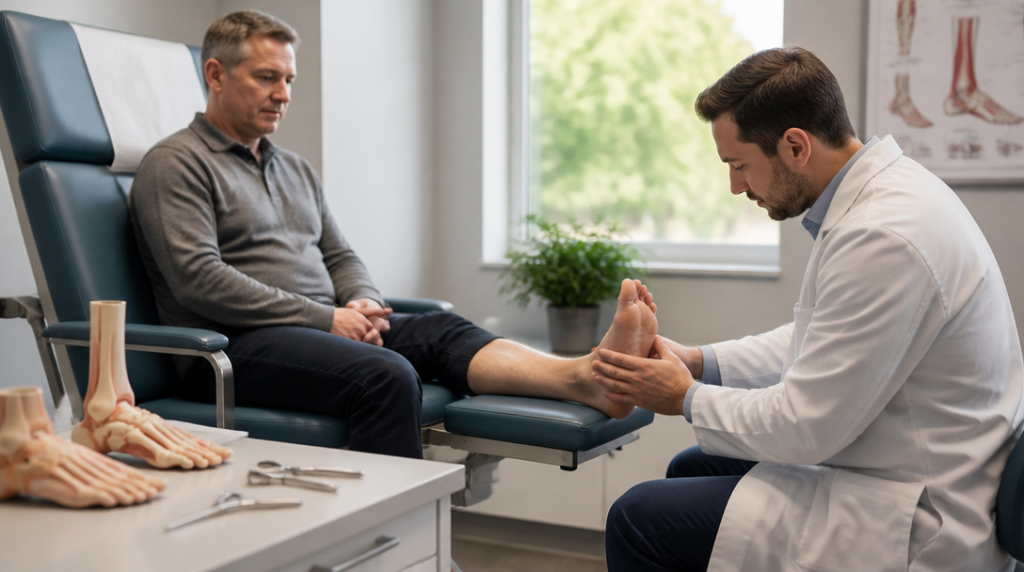
One patient walks into a bright clinic with a heel that hurts after long shifts at work. Another arrives with a diabetic foot wound, carrying a list of medications and the uneasy knowledge that a small problem can become serious. Both need a podiatrist, but they should not necessarily look for the same kind of specialist.
Finding a qualified foot-care professional is less about choosing the first name in an online search and more about matching the doctor’s training to the problem in front of you. A routine nail issue, recurring ankle pain, sports injury, structural deformity, and planned surgery can all lead to different questions during the search.
In the United States, the American Podiatric Medical Association maintains a directory that allows patients to search for podiatrists by city or ZIP code. The association lists roughly 18,000 podiatrists, so the challenge is rarely finding a name. The harder part is working out which name deserves a closer look.
Start with the problem, not the clinic’s advertising. A podiatrist who regularly treats sports injuries may be a sensible choice for persistent pain after running. Someone with a diabetic ulcer may need a doctor experienced in wound care and limb preservation. A bunion that has made walking difficult for years may lead you toward a podiatrist with substantial reconstructive or surgical experience.
That does not mean a patient has to diagnose the condition alone. The first appointment is often where the real sorting happens. A careful clinician should examine how you walk, inspect the skin and nails, check circulation and sensation, and ask when the pain began and what makes it worse. If the office rushes through those details and moves straight to a sales pitch for an expensive treatment, that is useful information too.
Look for the doctor’s full name, office location, phone number, and state license details. A polished website can show attractive treatment rooms and confident language, but it cannot replace a valid license. Your state medical licensing board is the place to confirm that the podiatrist is authorized to practice and whether any public disciplinary information appears in the record.
A basic directory listing is only the beginning. Ask the office who will actually examine you, whether the doctor treats your specific condition, and whether the practice handles urgent problems. If you have diabetes, poor circulation, nerve damage, or a history of foot ulcers, say so when you call. Those details can affect how quickly you need to be seen and what kind of clinical resources matter.
Checking training and board certification
Podiatrists in the United States complete four years of podiatric medical school followed by three years of hospital residency. That residency is where much of the practical work takes place: examining patients in busy clinics, assisting with procedures, managing injuries, and learning how foot and ankle problems connect with a patient’s overall health.
Board certification adds another layer of scrutiny, although the wording deserves attention. The two certification boards recognized by the Council on Podiatric Medical Education are the American Board of Foot and Ankle Surgery and the American Board of Podiatric Medicine. Their credentials do not mean exactly the same thing, and the phrase printed on a doctor’s profile can matter.
For a surgeon, use the American Board of Foot and Ankle Surgery’s Find a Surgeon database rather than relying only on a clinic biography. The database provides information about the podiatrist’s school, residency training, license, certification type, and the dates when certification was obtained and expires.
The distinction between “Board Certified” and “Board Qualified” is particularly important. With this surgical board, Board Certified means the podiatrist has met the requirements for both Part I and Part II examinations. Board Qualified means the doctor has met the requirements for Part I and is continuing through the certification process. It is not the same credential, even if the two phrases sit close together on a website.
The database also indicates whether a surgeon has an active license and hospital privileges. Certified and board-qualified surgeons must have both. Hospital privileges matter because they show that a hospital has reviewed the physician’s qualifications for specified procedures and has authorized the doctor to perform them there. They are not a guarantee of a perfect outcome, but they are more meaningful than a vague claim about being a “top specialist.”
A small practical detail can save time: check the exact spelling of the podiatrist’s name and the location of the practice. Large medical groups may list several clinicians, and certification can belong to one doctor while a patient assumes it applies to everyone in the office. If a profile is missing, outdated, or unclear, call the certification board or ask the practice for clarification before scheduling surgery.
Certification is most useful when it matches the treatment you may need. A patient seeking help for an ingrown toenail may not need a surgeon with an extensive reconstruction practice. Someone considering correction of a severe deformity should be more demanding about surgical training, hospital privileges, the number of similar procedures performed, and what happens if recovery does not go as expected.
Ask direct questions during the consultation. How often do you treat this condition? What are the nonsurgical options? What would make you recommend surgery? Where would the procedure take place? Who handles follow-up if pain, swelling, drainage, or a wound develops afterward? A doctor who can explain the reasoning in plain language is giving you something more valuable than a wall covered in framed certificates.
Reading the clinic before you book
The office itself can reveal more than its homepage. Pay attention to how the receptionist handles a basic question. Do you receive a clear answer, or are you pushed toward an appointment without anyone asking why you need care? Is the information about insurance, referrals, imaging, and medical records easy to understand? Confusion at the front desk does not prove poor medical care, but repeated evasiveness should make you cautious.
Reviews can help you spot patterns, yet they are a blunt instrument. A complaint about a long wait says little about surgical skill. Several patients describing rushed examinations, unexplained charges, or difficulty reaching the office after a procedure deserve more attention. Read for recurring details rather than treating a single angry or glowing review as a verdict.
Bring a list of medications, previous surgeries, allergies, and relevant diagnoses. Take photographs of a changing wound or swelling if the appearance varies during the day. Wear shoes that make the problem easy to discuss. These small preparations can make an appointment more informative, especially when the room is busy and the symptoms are difficult to describe.
A trustworthy podiatrist should be willing to explain what is known, what is uncertain, and what needs further testing. X-rays, ultrasound, or other imaging may be appropriate in some cases, but a test should have a reason attached to it. The same applies to injections, custom orthotics, antibiotics, and surgery. “Because this is what we always do” is not much of an explanation.
Be especially careful with urgent-sounding sales language. Foot-care offices sometimes offer products and procedures that are legitimate in the right circumstances, but a treatment package should not be presented as the only path before a proper examination. A second opinion is reasonable when surgery is recommended, the diagnosis remains unclear, or the proposed treatment is expensive or irreversible.
For a straightforward problem, convenience may reasonably influence the choice. A nearby podiatrist with a current license, suitable experience, and a clear approach may be all you need. For a complex condition, distance becomes less important than access to the right expertise and follow-up care. I would rather make one careful phone call from a waiting room with old magazines than spend months trying to undo a rushed decision.
The search becomes much easier once you separate three questions: Is the doctor licensed to practice? Does the training fit the problem? Can the certification and surgical credentials be independently confirmed? A clinic may answer the first question while leaving the other two vague. Keep asking until the record is clear enough to support a decision.