
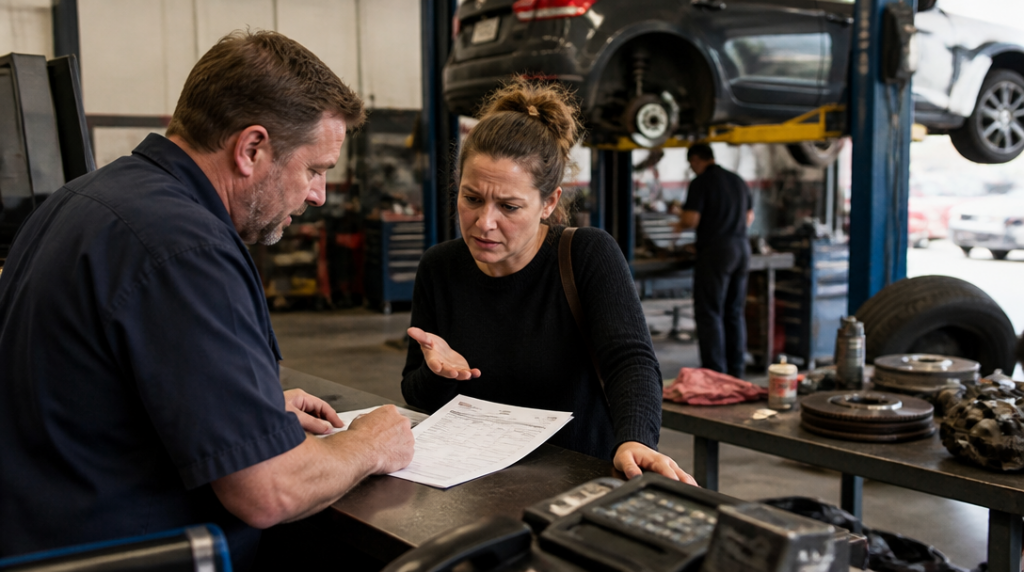
What do you do when the repair shop hands you a bill for $1,800 after promising the job would cost $950—and your car still makes the same grinding noise?
Do not start by shouting across the service counter. Start by slowing the dispute down. A garage repair bill is easier to challenge when you can show exactly what was promised, what changed, who approved it, and whether the work solved the problem.
The first thing to establish is whether the charge is actually unauthorized, unreasonable, or tied to work that was done badly. Those are different complaints, and each calls for slightly different evidence.
Pull out every piece of paper and every message connected to the repair. That includes the original estimate, the final invoice, text messages, emails, voicemails, photographs, inspection reports, and payment records. If the service adviser described the problem over the phone, write down what you remember while the conversation is still fresh. A short note such as “front brake noise; adviser said parts and labor would be about $600” is more useful than a general feeling that the shop “seemed expensive.”
Look closely at the estimate. A proper written estimate should identify the reported problem, the parts expected to be used, the labor, and the dollar amount above which the shop must obtain additional approval. A signed copy is especially valuable because it shows what both sides agreed to before the work began.
That approval threshold matters. There is no universal federal rule allowing a garage to add only 10 percent to an estimate. State requirements differ. Some states impose specific rules for written estimates, authorization, storage fees, or changes to the scope of work; others leave more room for the contract and the evidence. A shop cannot simply point to a made-up nationwide “10 percent rule” and treat it as permission for every surprise charge.
Read the final invoice line by line. Compare each part and labor charge with the original estimate. Watch for a second diagnostic fee, duplicate labor, shop supplies that were never explained, parts you did not authorize, or a repair described in vague language such as “miscellaneous service.” Ask for the reason behind every difference in writing.
A calm email is usually more effective than a furious phone call. State the date of the estimate, the amount quoted, the additional work performed, and the amount now demanded. Then identify the specific problem: “I did not authorize the replacement of the steering rack,” or “The invoice includes two hours of diagnostic labor that was not disclosed in the estimate.” Ask the garage to provide the approval record and to correct the bill by a clear date.
Do not write a long accusation. Mechanics and owners may be dealing with dozens of vehicles, but a precise dispute gives them something concrete to investigate. Keep the tone firm enough to show that you are serious and neutral enough that your message can be read later by a mediator, regulator, or judge without sounding like a personal attack.
If the vehicle is still at the shop, ask for an itemized invoice before paying. Do not sign a statement saying the work is satisfactory if you have not inspected the car or tested the repair. If the shop claims it will not release the vehicle unless you pay, the situation can become legally complicated because state rules may give repair businesses a lien for unpaid charges. Avoid trying to take the car by force. Ask what payment would release it, request that your disagreement be noted on the receipt, and get legal or consumer-protection advice quickly if the amount is substantial.
Build the paper trail before the argument grows
Photograph the car before and after the repair, including the odometer, warning lights, visible damage, and any parts the shop returns to you. Keep the old parts if they are offered. Save screenshots of online appointments and text messages; do not assume the shop will preserve them. If another mechanic examines the vehicle, ask for a written report describing what was inspected, what was found, and whether the original repair appears necessary or properly completed.
A second opinion can be decisive, but it should be independent. Tell the next mechanic that you are disputing a bill and ask for an honest inspection rather than a report designed to support your case. A vague comment that “this looks wrong” carries less weight than a detailed statement identifying a loose connection, an incorrect part, an unfinished procedure, or a continuing fault unrelated to the work billed.
Give the original garage a reasonable chance to inspect or correct the alleged defect, unless driving the car would be unsafe. If the engine is overheating, the brakes feel unreliable, or a warning light indicates a serious problem, do not keep driving merely to preserve an argument. Note the symptoms, arrange safe transport, and document why the car could not reasonably be returned.
Payment creates a separate track. If you paid by credit card and the amount is wrong or the repair was not provided as agreed, send a written billing dispute to the card issuer within 60 days after the first statement containing the error was sent. Use the address designated for billing disputes, which may differ from the address used for ordinary payments. Include copies of the estimate, invoice, approval messages, photographs, and your written complaint to the garage.
During the investigation, you may withhold the disputed amount, but you still need to pay the part of the bill you do not dispute. The card issuer must acknowledge the dispute in writing within 30 days and resolve it no later than 90 days. Keep proof of when your letter was sent and continue watching your statements. A phone call to the card company may be useful, but it does not replace the required written notice.
Federal credit-card protections for a normal purchase from a merchant generally apply only when the transaction exceeds $5 and the merchant is in the same state as your billing address or within 100 miles of it. That limitation can matter with a distant specialty shop or an online arrangement. It does not mean you have no other rights; it means this particular federal billing-dispute route may not cover the transaction.
A debit-card payment does not follow the same federal process. Contact the bank promptly, ask about its dispute procedure, and send the documentation it requests. If you paid cash, check, or bank transfer, your leverage may come more from the contract, state law, written demand, and the possibility of a formal complaint or lawsuit.
Before escalating, send the owner or general manager a final demand letter. Describe the agreed estimate, the unauthorized or defective work, the amount you believe is properly owed, and what you want done. That might be removal of unauthorized charges, reimbursement for a necessary corrective repair, or a partial refund. Set a reasonable response deadline and attach copies rather than originals.
Do not threaten criminal charges over an ordinary billing disagreement. Do not exaggerate the damage or post accusations you cannot prove. A public review describing dates, prices, documents, and observable results is safer and more credible than calling someone a thief. In disputes like this, restraint is not politeness for its own sake; it keeps the facts visible.
Where to take the dispute when the garage refuses
If the shop rejects your demand or stops responding, file a complaint with your state consumer-protection agency. You can also contact the state attorney general’s office. These offices may not recover every dollar for you, but a documented pattern of unauthorized repairs or deceptive billing can draw attention that an individual email does not.
Small-claims court is another practical option for a limited-dollar dispute, and many people handle these cases without hiring an attorney. The filing limit, fee, service rules, and deadline vary by state. Bring the signed estimate, itemized invoice, authorization records, payment evidence, photographs, written mechanic reports, and a simple timeline. Judges tend to have little patience for a pile of angry messages and much more patience for a clean sequence of events.
Your strongest presentation may fit on one page: the shop quoted one amount, performed or billed for specific additional work without approval, failed to fix the stated problem, and refused to correct the invoice. If the evidence supports that sequence, the size of the garage matters less than the clarity of your records.
The most useful sentence in the entire dispute may be the one written before the repair begins: “Please do not perform work above this amount without my written approval.” Once the car is on the lift and the old parts are scattered across a concrete floor, recovering that clarity becomes much harder.