
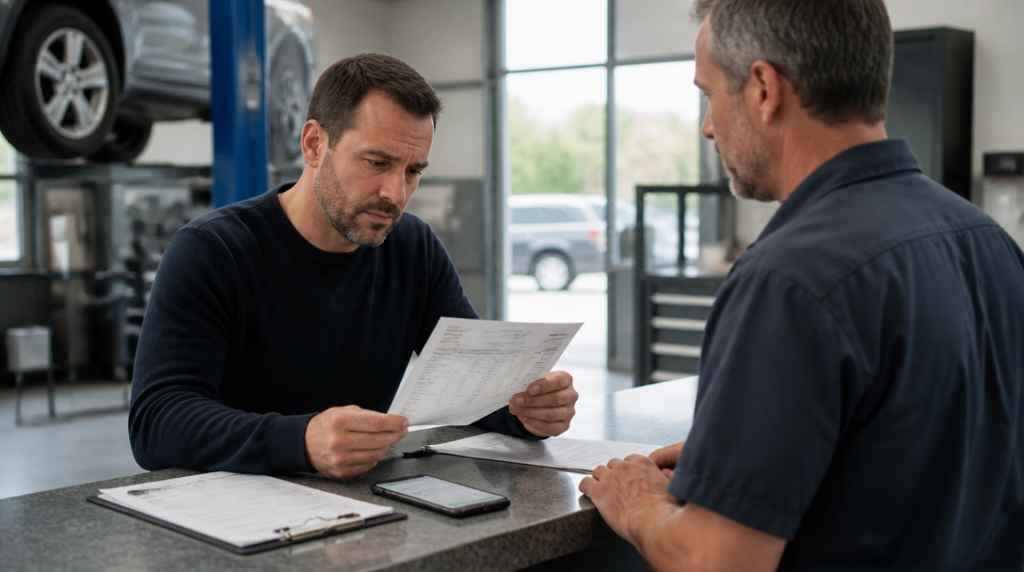
Did the garage have your permission to do all the work listed on the final bill? That single question often determines whether you are facing a legitimate price increase or an invoice you can reasonably challenge.
Start by comparing the bill with every document and message connected to the repair. Look for the original estimate, the description of the fault, the parts listed, the labor charge, and any statement about additional work. In the United States, a garage should provide a signed written estimate that identifies the problem, the parts and labor involved, and the expected cost. The estimate should also say whether work above a specified amount requires your approval first.
That approval requirement matters. A mechanic may discover another problem after taking the vehicle apart, but discovery does not automatically equal permission to repair it. If the garage performed extra work without asking, identify exactly which charges go beyond the agreed scope. A difference caused by a clearly disclosed complication is not the same as a bill padded with services you never authorized.
Gather the record before making a complaint. Keep the estimate, final invoice, text messages, emails, photographs, dates, amounts, and the names of the employees you spoke with. Write down what happened while the details are still fresh. If someone at the garage told you, for example, that the vehicle would not be repaired beyond a certain amount without your consent, record the date and the person’s name. Your notes will be more useful if they distinguish between what you personally saw, what the garage promised, and what you are inferring from the invoice.
Read the invoice line by line rather than arguing that it simply “looks too high.” Ask what each part was used for, how many labor hours were billed, whether a diagnostic charge was included, and which items were approved. A vague complaint gives the garage room to respond with another vague explanation. A specific objection is harder to dismiss: “I approved the brake inspection and replacement of the front pads, but I did not approve the additional suspension work listed here.”
Contact the service manager or owner first. Keep the conversation calm and factual, even if the bill is infuriating. The person who wrote the invoice may not have the authority to correct it, while a manager or owner can often review the estimate, authorization record, and technician’s notes.
Follow the phone call with a written complaint. State the vehicle details, repair dates, amount charged, amount you believe is disputed, and the remedy you are requesting. That remedy might be removal of unauthorized work, correction of a billing error, a refund for a service that did not solve the stated problem, or a chance to have the disputed repair inspected by an independent mechanic. Attach copies rather than originals and keep proof that your complaint was sent.
Do not overstate your case. A garage is not necessarily responsible for every mechanical problem that appears after a repair, particularly if the new issue is unrelated. The stronger argument is usually narrower: the garage charged for work without approval, billed for parts or labor that were not supplied, failed to perform the agreed service, or represented that a repair had solved a problem when it had not. If the vehicle is still malfunctioning, an independent written inspection can help separate a defective repair from a new fault.
You should also decide whether to pay the undisputed part of the invoice. If you agree that some work was authorized and properly completed, make that clear in writing and offer to pay that amount while disputing the rest. Refusing to pay everything can make a reasonable complaint look like an attempt to avoid a valid bill. Do not sign a statement saying the entire invoice is correct merely to get your vehicle back unless you understand what you are accepting.
If you paid by credit card, you may have an additional way to challenge an incorrect, unauthorized, or undelivered service. Send the dispute in writing to the card issuer so it arrives within 60 days of the date the first statement containing the error was sent. Include the transaction details, the amount in dispute, a copy of the invoice, your estimate, and your written complaint to the garage. Explain why the service was incorrect, unauthorized, or not provided as promised.
A telephone call to the card company may not be enough for this process. Use the billing-dispute address provided by the issuer rather than assuming the address for ordinary payments is the right one. Keep a copy of the letter and evidence of delivery. The card issuer must acknowledge the dispute in writing within 30 days and resolve it within 90 days. You must continue paying the portion of the credit-card bill that is not in dispute.
A credit-card dispute is not a substitute for a clear explanation. The issuer will need to understand the transaction and the precise defect in the service. “The repair was expensive” is usually weaker than “The garage charged for a replacement part that was not installed” or “The final amount included labor that exceeded the written estimate without my approval.” If the garage has already offered a partial correction, mention that as well.
Other payment methods may give you fewer practical options, so direct negotiation becomes even more important. A debit-card payment, cash payment, check, or financing arrangement can involve different procedures and deadlines. Do not assume that rules applying to a credit-card billing dispute automatically apply to another form of payment. Review the payment agreement and ask the financial institution what process, if any, is available.
The garage may threaten to hold the vehicle until the bill is paid. Rights concerning repair liens, storage fees, notices, and vehicle release vary by state, so do not guess about them. Ask for an itemized invoice and a written explanation of the garage’s position. If storage charges are accumulating, that creates a practical problem separate from whether the repair bill is fair. You may need local legal advice quickly, especially if the amount is substantial or the vehicle is essential for work.
When the garage refuses to correct the account, file a complaint with your state consumer protection office. Include the same organized record you used in your letter to the garage. If you believe the business engaged in fraud rather than merely making a billing mistake, you can also report the matter to the Federal Trade Commission. A complaint does not guarantee a refund, but it creates a formal record and may help identify a broader pattern of misconduct.
Small-claims court is another option in the United States, particularly when the disputed amount fits within your state’s limit and the evidence is straightforward. You generally do not need an attorney for small claims. Bring the signed estimate, invoice, messages, photographs, payment records, independent inspection, and a timeline of events. Courts tend to respond better to a clean sequence of documents than to a long account of how angry the experience made you. I would rather carry ten well-labeled pages into a hearing than a folder stuffed with every message ever exchanged.
Before filing, check the court’s rules for the correct defendant, filing deadline, service requirements, and maximum claim amount. Consider what you can prove, not just what feels unfair. A judge may award the cost of unauthorized work or another documented loss, but a demand based only on frustration is difficult to calculate. If the vehicle was repaired correctly and the dispute concerns an estimate that was plainly subject to change, the garage may have a stronger defense.
A well-documented dispute gives you room to negotiate. Send a precise complaint, preserve the evidence, separate approved charges from disputed ones, and escalate through the payment issuer or state authorities when the garage will not address a clear error. The goal is not to win an argument in the service bay; it is to make the invoice, the authorization, and the actual repair line up on paper.