
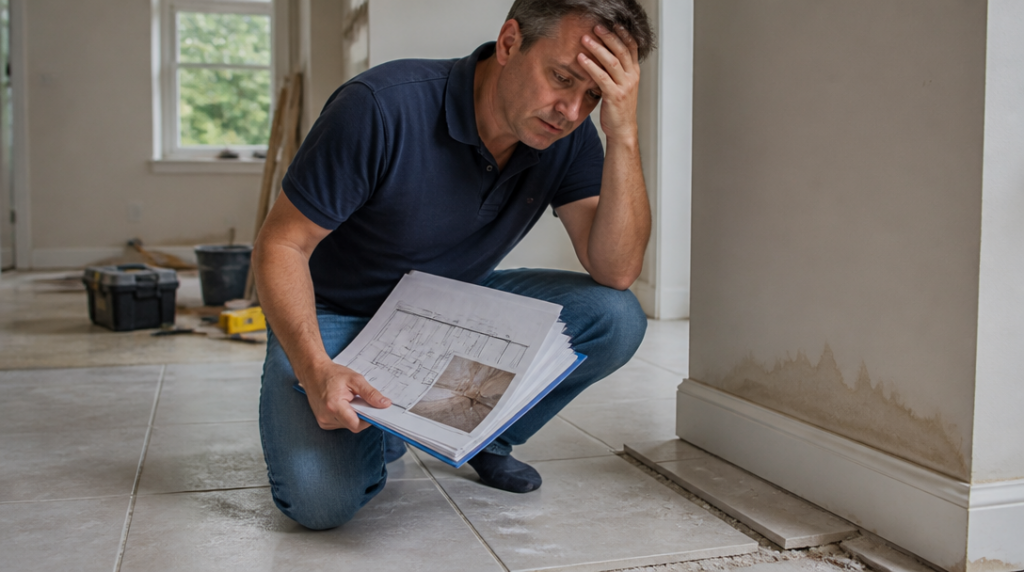
A builder can leave your home looking finished while still owing you money for work that was badly done.
That may sound harsh, but “finished” does not mean “properly completed”. Cracked render, uneven flooring, leaking pipework, poorly fitted windows, and unsafe electrical work can all point to poor workmanship. If you paid for a professional job, you are entitled to expect one.
In England, building work on a private home is covered by the Consumer Rights Act 2015. The builder must carry out the work with reasonable care and skill. That standard is more useful than it may sound: it gives you a legal basis for challenging work that falls below what a competent tradesperson should have delivered.
Start by checking what you actually agreed
Before demanding compensation, gather the original agreement. This might be a formal contract, a written quotation, a set of plans, a series of emails, or even messages exchanged before the work began.
Look for the scope of the job, the materials to be used, the price, the expected completion date, and any promises about the result. A builder may argue that a particular repair or finishing detail was never included. Your paperwork helps separate a genuine disagreement about the job from defective work.
Do not discard the quotation simply because the final price changed. Keep the first version, revised versions, invoices, and records of every payment. A small detail in an early message can become surprisingly important later.
Photograph the defects as soon as you notice them. Take wide shots showing where the problem is and close-ups showing the damage. Keep the original files if possible, and record the date each photograph was taken. If the defect changes over time, take further photographs rather than relying on memory.
Give the builder a chance to put it right
Your first formal step should usually be a written complaint to the main contractor. Explain what is wrong, refer to the agreed work, and state what you want done. If the builder used subcontractors, address the complaint to the builder you hired rather than trying to manage every subcontractor yourself.
Keep the tone calm and specific. “The work is terrible” may reflect exactly how you feel, but “the bathroom floor slopes towards the wall and water collects beside the door” is much harder to dismiss.
Ask for a free repair or for the work to be carried out again. Under the consumer rules, that is normally the first remedy for defective work. Give the builder a reasonable deadline for responding and suggest suitable dates for an inspection or repair.
You do not have to accept an endless cycle of promises. If the builder refuses to return, repeatedly misses appointments, or makes a repair that creates another problem, explain this in writing. A second attempt may be reasonable in some circumstances, but you are not expected to let your home become a permanent testing ground.
When can you ask for your money back?
If the builder refuses or is unable to repair the work properly, you may be able to ask for a price reduction. Depending on the seriousness of the defects, that could mean a partial refund or, in some cases, a full refund for the affected work.
The amount should reflect the loss you have suffered, not an arbitrary figure chosen to punish the builder. Obtain a realistic estimate for putting the work right. If another contractor says the defective work must be removed and replaced, keep that written assessment and quotation.
A refund is particularly relevant where repair is impossible, would cause unreasonable delay, or has already failed. If you and the builder agree on a refund, the money should be returned within 14 days.
Be precise about the figure you are claiming. Set out the cost of remedial work, any reasonable additional expenses, and payments already made for work that has not been properly delivered. Avoid inflating the demand with every inconvenience you experienced. A focused claim is usually more convincing than a dramatic one.
Build your evidence before the argument grows
A strong claim is rarely based on photographs alone. Put together a simple timeline showing when you hired the builder, when work started, when you paid, when you first reported the defect, and what happened afterwards.
Include the contract or quotation, receipts, invoices, bank statements, photographs, messages, emails, and notes of phone calls. After a telephone conversation, send a short message confirming what was discussed. This gives the builder an opportunity to correct your account and creates a record if they do not.
An independent expert’s opinion can make a major difference, especially where the defect is technical or the builder denies responsibility. A surveyor, engineer, or suitably qualified specialist may be able to explain what was done incorrectly, what should have been done, and how much the repair is likely to cost.
Ask the expert to be clear rather than theatrical. You need an explanation that another person can understand, not a report filled with obscure terminology. The best report may be the one that calmly connects the defect to the builder’s work and gives a practical repair estimate.
Do not rush into repairs without documenting the problem
If the defect makes the property unsafe or exposes it to further damage, you may need to act quickly. A leaking roof cannot always wait for a lengthy dispute, and an unsafe electrical installation should not remain untouched just to preserve evidence.
Take photographs, obtain an expert opinion where practical, and keep invoices for emergency work. Ask the replacement contractor to record what they found before beginning. If the original builder has had a fair opportunity to inspect the problem and still refuses to act, that may strengthen your position.
For less urgent defects, give the original builder a reasonable chance to inspect and repair before hiring someone else. If you arrange expensive remedial work immediately, the builder may argue that they were denied the opportunity to put things right.
This is one of those moments where a few careful emails can save a great deal of trouble. I have seen disputes become much harder simply because a homeowner covered up the defect before anyone independent had examined it.
Send a formal letter before court action
If informal complaints have gone nowhere, send a formal letter setting out your claim. State the work involved, the defects, the dates on which you reported them, the remedy you requested, and the amount you now seek.
Attach or refer to the important evidence. Explain that the work was not carried out with reasonable care and skill and that you are seeking a repair, a reduction in price, or compensation for the reasonable cost of putting the work right.
Give a clear deadline for a response. Do not make threats you do not intend to follow through on. A useful letter is firm, factual, and easy for a third party to understand if it later becomes part of court papers.
You should also consider whether the builder belongs to a trade association or operates under an approved dispute-resolution scheme. Some contracts contain a complaints or mediation procedure. Using it may resolve the dispute without the cost and stress of court proceedings.
Check how you paid
The payment method may give you another route to compensation. If the work was paid for with a credit card, you may, in certain circumstances, have a claim against the card issuer under Section 75 of the Consumer Credit Act 1974.
This is not automatic. The legal conditions must be met, and the transaction must fall within the relevant rules. Still, it is worth checking before assuming that your only option is to pursue the builder personally.
For other payment methods, ask your bank or payment provider whether a dispute process is available. Do not assume that a card chargeback has the same legal effect as a statutory claim, and do not let a payment dispute replace your evidence-gathering and written complaint.
If the builder still refuses
Court action may be the next step if negotiation, complaints procedures, and a formal demand have failed. Before issuing a claim, calculate the amount carefully and make sure you can prove both the breach and your financial loss.
In England and Wales, a standard claim for breach of contract generally has a six-year limitation period. That does not mean you should wait. Memories fade, messages disappear, defects are repaired, and evidence becomes harder to obtain.
You may be able to make a money claim for the reasonable cost of remedial work or another recoverable loss. The court will look at the contract, the quality of the workmanship, the evidence, and whether you acted reasonably after discovering the problem.
Legal advice can be sensible where the repairs are expensive, the building is structurally affected, or the builder has threatened a counterclaim. A solicitor or qualified adviser can also help you decide whether the likely recovery justifies the cost and effort of litigation.
The most effective claim is usually not the loudest one. It is the one that shows, in order, what was promised, what went wrong, what the builder was told, what a proper repair costs, and why the amount demanded is fair.