
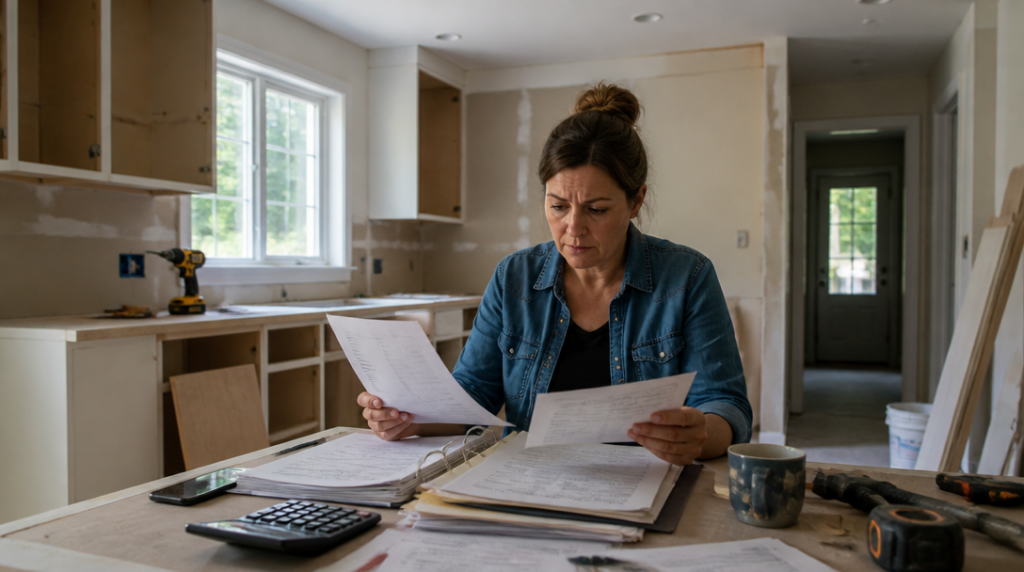
Maria expected her kitchen remodel to take six weeks. Three months later, the cabinets were stacked in her dining room, the sink was still disconnected, and the contractor had stopped giving firm answers. She had plenty of messages proving the delay, but no clear plan for turning that frustration into a compensation claim.
A late project does not automatically create a right to a fixed payout. Your position usually depends on the contract, the losses you can prove, and the law in your state. The good news is that a careful paper trail can make the difference between a vague complaint and a serious demand.
Start with the contract
Read the agreement from beginning to end before sending an angry message. Look for the promised start and completion dates, payment schedule, description of the work, materials, change-order process, and any clause dealing with delays or late completion.
A solid home improvement contract should describe the work, price, materials, and planned start and finish dates. State requirements differ, so a document that looks ordinary may still leave out information your state expects contractors to provide.
Search for terms such as “completion date,” “delay,” “liquidated damages,” “breach,” “change order,” or “termination.” Some contracts set a daily amount for late completion. Others allow extra time for events outside the contractor’s control, such as delayed materials, severe weather, or changes requested by the homeowner.
That wording matters. A contractor who misses a deadline after promising a fixed completion date may be in a stronger position if your own changes caused the delay. A contractor who repeatedly leaves the site without explanation may have a much harder time defending the same delay.
Build a delay file
Create one folder for the entire project, whether it is digital, paper, or both. Save the signed contract, estimates, invoices, receipts, change orders, text messages, emails, and notes from phone calls.
Take dated photographs of unfinished work and the condition of the property. Photograph missing fixtures, exposed areas, damaged surfaces, stored materials, and any part of the project that prevents you from using the home normally. A few clear images taken every several days can show the progression of a delay better than a long argument in an email.
Write down the timeline while the details are fresh. Record when work began, how often workers appeared, when the project stopped, what the contractor promised, and every date that passed without progress. Keep the language factual. “No workers were present from May 4 through May 18” is more useful than “They completely abandoned us.”
Keep evidence of financial losses too. That may include reasonable costs for temporary accommodation, storage, replacement work, emergency repairs, extra materials, or other expenses directly connected to the delay. Whether a particular loss is recoverable depends on the contract and applicable state law, so do not assume every inconvenience has a dollar value in court.
Your own time and stress are real, but they may be difficult to claim as compensation. Receipts, canceled bookings, bank records, and written estimates usually carry more weight than a rough guess.
Ask for a firm explanation
Before making a formal demand, send a short written message asking what remains unfinished, why the schedule has changed, and when the contractor will return. Give a specific deadline for a response, such as five business days.
Avoid turning the message into a complete history of every irritation. State the agreed completion date, describe the current delay, list the main unfinished items, and ask for a written schedule. If the contractor claims that materials, subcontractors, inspections, or your own changes caused the problem, ask for the details and supporting records.
A realistic schedule is more useful than a promise to “be there soon.” Ask for actual dates and milestones. If the answer remains vague, that exchange may help show that you gave the contractor a reasonable chance to correct the problem.
Do not casually agree to a new completion date without understanding what it changes. A revised schedule may help resolve the dispute, but it can also replace the original deadline or weaken an existing late-completion claim if the wording is unclear.
Calculate the amount you are seeking
There is no single nationwide compensation amount for a delayed renovation. The figure may come from a late-completion clause, documented financial damage, or another remedy allowed by your state’s law.
Start with the contract. If it sets a daily charge or another agreed amount for late work, calculate the sum using the contract’s wording. Check whether the clause has a maximum, a grace period, or exceptions for certain kinds of delay.
Then separate documented costs from estimates. A receipt for a short-term rental is different from an estimate of what living elsewhere might have cost. A paid invoice for correcting defective unfinished work is different from a broad claim that the project reduced your home’s value.
Do not inflate the demand to punish the contractor. A precise figure supported by records often looks more credible than a dramatic number with no explanation. Include the amount already paid, the reasonable cost of completing the remaining work if you have a reliable estimate, and any other losses that the contract or state law may recognize.
You may need to reduce your losses where practical. For example, if a less expensive temporary solution was reasonably available, a court or insurer may question a much more expensive choice. This does not mean accepting unsafe conditions or spending your own money without limits. It means keeping a clear explanation for each major expense.
Send a formal demand
If informal messages produce nothing, prepare a formal demand letter. State the contract date, the promised completion date, the work still unfinished, the amount you are requesting, and the action you want the contractor to take.
You can ask for a completion schedule, payment of a specified amount, reimbursement for documented costs, or a discussion about ending the contract and resolving the outstanding work. Set a reasonable response deadline and explain what you plan to do if the contractor does not respond.
Send the letter by certified mail with a return receipt, and keep a copy of everything you send. You can also send it by email if that is how you normally communicate, but do not rely on an informal text message as your only formal notice.
The letter should be firm without making accusations you cannot prove. Avoid threats, insults, or statements that you will “destroy” the contractor online. A calm demand creates a cleaner record and leaves less material for the other side to use against you.
Check whether a quick cancellation right applies
A separate federal rule may allow you to cancel a contract within three business days when you signed it at home or somewhere other than the contractor’s permanent place of business. Saturday counts as a business day under this rule, while Sunday and federal holidays do not.
If you cancel properly under that rule, the contractor generally must return your money within ten days. This is not a general escape route for every late renovation. The location and circumstances of signing matter, and state law may provide additional cancellation rights.
If you believe this protection applies, follow the cancellation instructions in the paperwork and keep proof that your notice was delivered on time. Do not confuse a cancellation notice with a complaint about delay. They are different legal paths with different requirements.
Protect yourself before hiring someone else
Bringing in another contractor may be necessary, especially if unfinished work is creating a safety problem or exposing the property to damage. Before doing so, document the original contractor’s work and give written notice unless an emergency makes that impossible.
Ask the replacement contractor for a detailed inspection and estimate. Have them identify what is incomplete, what is defective, what can be reused, and what must be removed. A vague statement that the first contractor “did everything wrong” will not help much later.
Do not destroy materials or remove disputed work before photographing it and preserving relevant records. If the dispute becomes formal, the condition of the project may matter. Keep the original invoices and identify which costs relate to completion, correction, or entirely new improvements.
Also review your payment position. If you still owe money, do not simply withhold every remaining dollar without checking the contract and state law. If you paid by credit card or used financing, ask the issuer or lender about its dispute process, but continue meeting any obligations that are not formally paused.
Escalate when the contractor goes silent
If the contractor ignores your demand, contact your state Attorney General’s office or a local consumer-protection office. These agencies may accept complaints, identify licensing problems, or provide information about the next step, although they may not recover every dollar for you.
A licensing board may also be relevant if your state regulates the contractor’s license. Keep your complaint organized: attach the contract, timeline, payment records, photographs, demand letter, delivery confirmation, and the contractor’s replies or lack of replies.
Small claims court may be suitable for a lower-value dispute, subject to your state’s monetary limit and filing rules. Larger claims, complicated contracts, liens, defective construction, or substantial property damage may justify speaking with a construction or consumer-law attorney.
Deadlines can apply to contract claims, property damage, administrative complaints, and payment disputes. If the project involves a large amount of money, an attorney can help preserve the claim before a deadline disappears.
A delayed renovation can make the whole house feel like a waiting room. The strongest response is not the loudest one. It is a dated timeline, a contract-based calculation, a formal demand, and evidence that makes every important sentence easy to verify.