
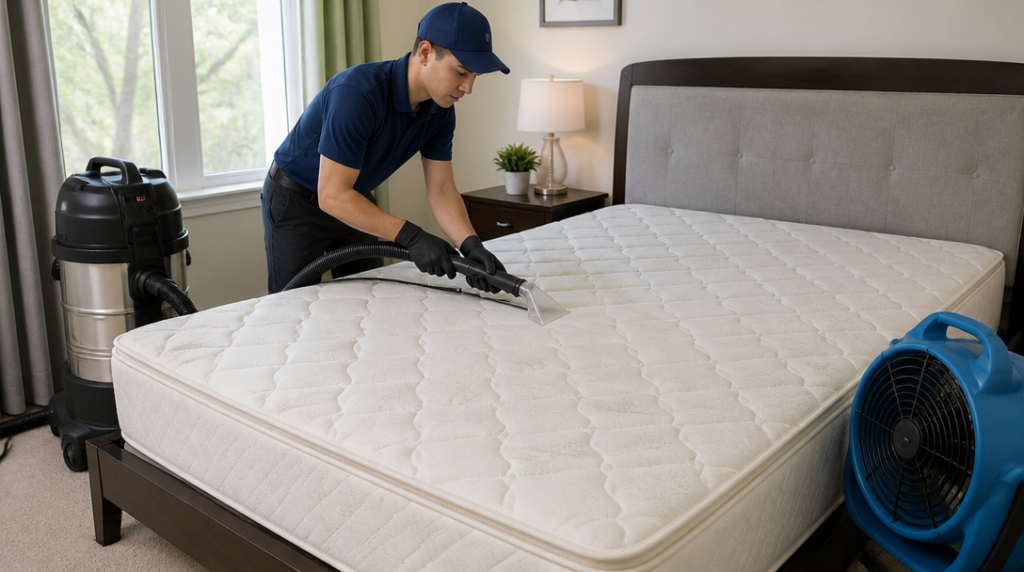
A technician arrives with a compact machine, a bottle of cleaning solution, and a promise that your mattress will be “sanitized” in no time. Before you let anyone start, ask one question: how will you know the mattress is dry all the way through?
That answer tells you more than a glossy website ever will. A mattress should not be drenched during cleaning, and any damp material needs to dry within 24 to 48 hours to reduce the risk of mold growth. If a company cannot explain how it controls moisture, extracts the cleaning solution, and checks the drying process, keep looking.
The best service is not necessarily the one with the most impressive equipment or the lowest price. It is the one that understands mattresses as complicated, absorbent items. Foam, springs, fabric covers, adhesives, stains, sweat, dust, and old odors all respond differently. A careful cleaner asks what the mattress is made of, how old it is, whether it has been exposed to spills, and whether anyone in the household has allergies.
Questions to Ask Before Booking
Start with the company’s experience. Mattress cleaning is not identical to carpet cleaning, upholstery cleaning, or general house cleaning. A technician who treats every fabric with the same solution and the same amount of water may create more trouble than they remove. Ask whether the company regularly cleans mattresses and whether its technicians have received relevant training.
IICRC training or certification is a useful sign because it points to professional education in cleaning and restoration practices. It does not guarantee perfect work, but it is more meaningful than vague claims about being “specialists” or “experts.” Ask what the credential covers and whether the person coming to your home is actually trained, rather than assuming the company’s owner completed a course years ago.
The cleaning method deserves a plain-English explanation. A responsible technician should be able to describe the order of operations: inspection, dry soil removal, spot treatment, controlled cleaning, extraction, and drying. The exact method can vary with the mattress, but the company should not sound secretive or evasive. If the answer is simply “We use our special formula,” press for more detail.
Ask how much moisture the process uses and how long the mattress usually takes to dry. A company that says you can put sheets back on immediately may be offering a convenient answer rather than a safe one. Drying time depends on the material, room temperature, airflow, humidity, and the amount of liquid applied. Good technicians may use fans, extraction equipment, moisture checks, or clear instructions about ventilation. They should also tell you what to do if the mattress still feels damp later in the day.
This is where a small detail makes a big difference: the room itself matters. Indoor humidity should stay below 60 percent, with 30 to 50 percent considered a better range for limiting moisture-related problems. A cleaner who talks about airflow and humidity is thinking beyond the few minutes spent running a machine over the bed.
Be especially precise about words such as “disinfect,” “sterilize,” and “kill germs.” These terms are not interchangeable with “clean.” If a company makes a disinfection or sterilization claim, ask for the exact product name and its intended use. Disinfecting products must be properly registered for those claims, and the label should identify the surfaces and organisms covered by the instructions. In January 2026, four Texas companies faced a sales ban after making improper claims about disinfecting products, a useful reminder that confident language is not proof of a legitimate treatment.
You should also ask whether the product is suitable for mattresses and whether the technician follows the label directions. A chemical that works on a hard bathroom surface may be inappropriate for a sleeping surface, especially one that remains close to the skin and face for hours every night. “Hospital-strength” is marketing language unless the company can explain the actual product, its registration, and how residue will be removed.
Look at the estimate, too. A professional quote should make clear whether inspection, stain treatment, deodorizing, extraction, drying equipment, travel, and taxes are included. Some companies advertise a very low starting price and add fees once the technician is inside your home. A written estimate reduces that unpleasant surprise.
Do not expect every stain to disappear. Old urine, vomit, blood, body oils, and dye transfer can permanently alter fabric or foam. A good cleaner will explain what may improve and what may remain. Promising a flawless result before seeing the mattress is a warning sign, particularly if the company also promises complete odor removal from a heavily contaminated interior.
One of the best questions is also the simplest: “What would make you refuse this job?” A thoughtful answer might include severe structural damage, extensive mold, pest infestation, or a mattress that is too wet or degraded to clean safely. A company willing to walk away from unsuitable work often has better judgment than one that says yes to everything.
Allergies, Mold, and the Details That Matter
For people with asthma or allergies, the vacuuming stage matters as much as the cleaning solution. Look for a service that uses HEPA-filtered vacuum equipment. HEPA filtration helps reduce the amount of extracted dust escaping back into the room, which is particularly useful when removing dry skin particles, dust, and other debris from a mattress.
Ask whether the mattress will be vacuumed before any moisture is introduced. Dry removal first is sensible because it lifts loose particles without turning them into a damp paste inside the fabric. The technician should also protect the surrounding room and floor, especially if the mattress must be moved or cleaned in place.
Mold requires a different level of caution. A musty smell does not prove that mold is present, and a dark mark on a mattress is not automatically mold. Still, visible growth, repeated dampness, water damage, or an odor that returns after cleaning deserves more than a standard deodorizing treatment. If suspected mold covers more than 10 square feet, professional help is recommended, and the company should have genuine mold-remediation experience rather than merely offering a mold-killing spray.
Ask how the company distinguishes a cleanable stain from a contaminated mattress. Some mattresses, especially those affected by prolonged water damage, may not be suitable for routine cleaning. A technician who promises to “seal in” mold or mask the odor with fragrance is not solving the underlying problem. Strong perfume can make a bedroom smell cleaner for an afternoon while leaving the source untouched.
For allergy-sensitive households, ask whether the company uses fragrances, enzymes, solvents, or other additives, and whether fragrance-free options are available. Request information about residue and drying time. A mattress can look spotless yet remain irritating if too much product is left behind or if it is covered before it has fully dried.
Check the company’s reviews, but read them for specifics rather than star ratings alone. Look for comments about punctuality, moisture control, communication, odor, stains, and how the mattress felt afterward. Reviews that mention the technician explaining limitations are often more useful than a string of vague compliments. You can also ask for proof of insurance and find out what happens if the mattress is damaged during service.
The technician’s behavior during the inspection is revealing. They should examine seams, labels, stains, sagging, fabric damage, and signs of moisture before quoting a final price. They should not pressure you into an expensive package because you mention allergies, and they should not claim that a single treatment can eliminate every allergen permanently. Cleaning can reduce accumulated dust and debris; it does not turn an old mattress into a new one.
Finally, consider the mattress itself. If it has severe sagging, broken foam, persistent contamination, or years of embedded odor, replacement may make more sense than repeated professional cleaning. A trustworthy cleaner will say so, even when that advice costs them a job. My favorite test is to ask what they would do with the same mattress in their own home. The answer often reveals whether you are speaking to a careful technician or a salesperson with a machine.