
A high-voltage electric vehicle battery can remain dangerous even when the car is silent, parked and apparently switched off. That single fact should change how you choose the person who opens its casing.
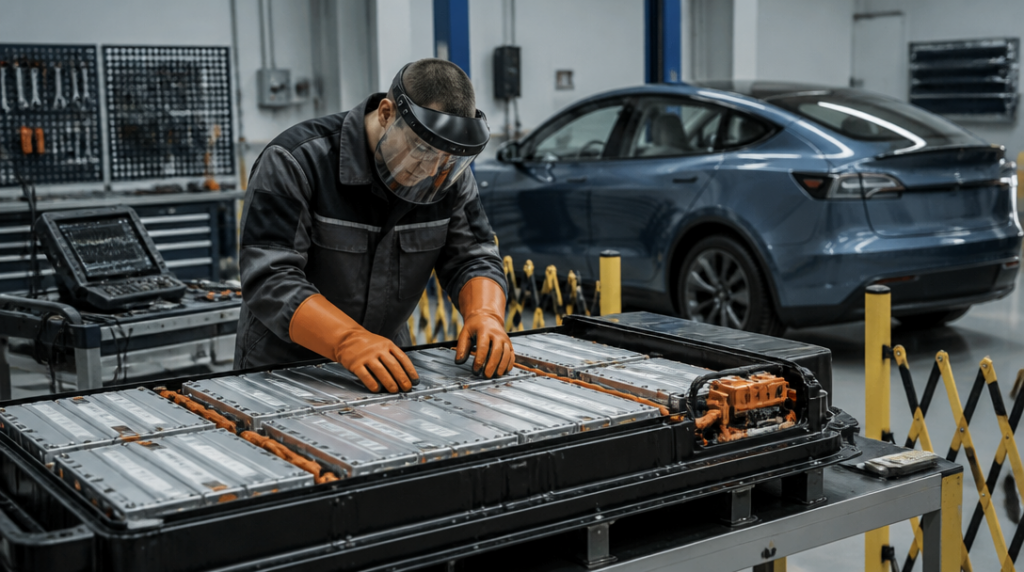
Walk into a serious EV workshop and the atmosphere is different from a conventional garage. There may be fewer oil stains, but there are insulated tools, warning signs, heavy gloves, battery lifting equipment and a deliberate pause before anyone touches the vehicle. The technician checks the service disconnect, confirms the system state and treats the pack less like a car part than a huge electrical installation sitting beneath the floor.
That caution is not theater. Electric vehicle systems above 60 volts DC or 30 volts AC fall into the high-voltage category used by ASE. A specialist should understand what that means in practice, not simply repeat the number. They need to know how the vehicle isolates the pack, how voltage can be measured safely, how capacitors in the power electronics can retain energy and how a damaged battery should be secured before diagnosis begins.
The first question to ask is not, “How much will the repair cost?” Ask who will perform the work and what training that person has completed.
Start with the technician, not the workshop sign
In the United States, the clearest qualification to look for is the ASE L3 Light Duty Hybrid/Electric Vehicle Specialist certification. It is not a general electric-car badge. The certification tests knowledge across the systems that make an electrified vehicle move and stop: the battery, electric drive, power electronics, inverter and supporting hybrid systems.
The L3 test itself has 55 questions, with 45 scored, and a 150-minute time limit. A candidate must already have passed the A6 Electrical/Electronic Systems and A8 Engine Performance examinations. Those prerequisites matter because battery diagnosis rarely stays inside the battery. A vehicle can show a charging or propulsion fault when the real problem lies in wiring, control logic, sensors, thermal management or another part of the vehicle’s electrical architecture.
A certificate alone still does not tell you whether the specialist has handled the kind of failure your car has developed. Ask how often the technician works on high-voltage packs and whether they repair them at module level or replace the entire assembly. Some shops are equipped only to install a complete replacement pack. That may be perfectly legitimate for certain vehicles, but it is a different service from locating a weak module, testing cell groups or repairing a battery management system fault.
Listen to the answer. A technician who works with packs should be able to explain the proposed diagnostic process in plain language. They might discuss isolation testing, state of charge, cell-voltage differences, temperature sensors, contactors or the battery management system. They should also tell you what they will not do until the pack has been made safe.
Vague confidence is less reassuring than a careful explanation. A specialist who says, “We need to identify whether the problem is inside the pack or elsewhere before deciding on a repair,” is giving you more useful information than someone who promises a battery replacement after hearing a warning light described over the phone.
Practical high-voltage battery training is another strong sign. One current three-day VSH33 course provides 24 CPD credits and covers battery management system diagnosis, module testing and cell balancing. Training of that kind does not replace workshop experience, but it shows that the technician has studied the operations that determine whether a pack repair is sound or merely temporary.
The same principle applies to specialists working closer to manufacturing. In 2026, SACA introduced five new certifications into pilot testing covering EV production and battery fundamentals. Those credentials are especially relevant when you are choosing someone who works on battery packs, individual cells or production processes rather than carrying out ordinary vehicle servicing.
Ask to see the relevant certificate, the training record or a description of the technician’s actual role. A respectable shop should not react as if you have asked for trade secrets. You are placing a high-energy system in its hands.
Standards reveal how the repair will be handled
The second test is procedural. A competent specialist should be able to tell you which safety and technical standards guide battery diagnosis, repair and transport. For battery-pack work, ask whether the process follows UL 2580, SAE J2929 and ISO 6469-1. These standards address different aspects of electric vehicle battery safety and vehicle operation, but together they point to a workshop that follows defined procedures rather than improvising around a metal box full of cells.
The answer should affect more than the technician’s choice of gloves. It should shape the entire job: how the vehicle is isolated, how the battery is removed, how a damaged pack is stored, how modules are tested and how the repaired assembly is checked before it returns to the vehicle.
Look around the workshop if you can. Is there a marked area for high-voltage work? Are removed batteries protected from impact and moisture? Are tools and measuring equipment suited to the voltage involved? Does the staff know where the emergency shutoff equipment is? You do not need to be an electrical engineer to notice disorder. A battery repair area that resembles a crowded storage corner, with loose parts and unidentified cables underfoot, deserves questions.
Transport is part of the repair, too. If a battery or module has to be shipped, the specialist should understand UN/DOT 38.3 requirements. That knowledge becomes particularly important after collision damage, overheating or water intrusion, when the pack may not be in the same condition as a healthy unit. The cheapest workshop can quickly become an expensive choice if it cannot legally or safely move the battery that needs attention.
Ask what the diagnostic report will contain. At minimum, you should expect a clear account of the fault, the condition of the relevant modules or cell groups, any balancing work performed and the checks completed after repair. A professional may not promise that every old battery can be restored economically. They should explain why a repair is possible, why replacement is safer or why further testing is needed.
This is where the difference between a battery specialist and a parts installer becomes visible. A parts installer sees a fault code and searches for the assembly associated with it. A specialist considers the evidence behind the code. They may compare voltage readings under load, examine temperature data and check whether the vehicle’s charging behavior matches the battery management system’s report. That process can take time, especially when a fault appears only after the pack warms up or the vehicle is driven under a particular load.
The best conversation may happen beside the car, with the hood open and the technician pointing to the isolation fault or the service disconnect. I have always found those moments more revealing than a polished reception desk: a good technician becomes precise when explaining what can hurt you, what can damage the vehicle and what remains unknown.
Be wary of specialists who dismiss safety questions, guarantee a dramatic increase in range without testing the battery, or insist that every problem requires the most expensive repair. Be equally wary of a shop that cannot explain how it handles a damaged or unbalanced pack. Battery chemistry, pack design and failure modes vary widely, so a confident diagnosis should come from measurements and inspection rather than from the vehicle’s model name alone.
Price still matters, but it belongs later in the conversation. First establish that the technician understands high voltage, has relevant credentials and follows recognized procedures. Then ask for a written estimate separating diagnosis, removal, repair, testing, transport and installation. If the shop cannot describe those stages, the low quote may be little more than an entry fee for a much larger repair.