
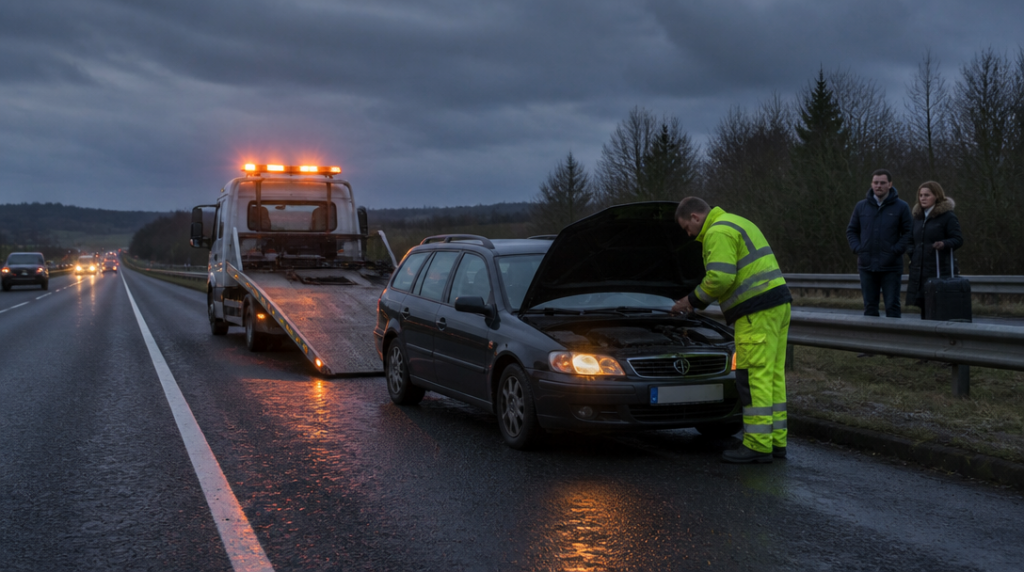
A driver who only wants the lowest monthly price may be perfectly happy with basic roadside assistance. Someone who regularly makes long journeys, drives an older car or carries a full family needs a very different policy. Both are buying breakdown cover, but they are not buying the same protection.
The price on the advert is only the first comparison. The real question is what happens when the car will not start, how far the recovery vehicle can take it and whether the policy still helps after the first few incidents.
Start with the type of cover, not the brand
Breakdown policies usually differ in two fundamental ways: what is covered and where assistance applies. A vehicle-based policy follows the car, while a personal policy is generally linked to the named driver. That distinction matters if several people drive the same vehicle or if you regularly use more than one car.
The next question is location. Roadside cover may help when the car stops away from home, but it may not include a fault on your driveway unless you choose a home-start option. This is an easy detail to overlook because many breakdowns happen before a journey has even begun: a flat battery, a failed starter motor or a car that simply refuses to wake up on a cold morning.
RAC Home Start, for example, deals with a breakdown at home. If the vehicle cannot be repaired there, it provides recovery to a garage within 10 miles. That is a narrower promise than taking the car anywhere in the country, but it can be far more useful than roadside-only cover for a car with a history of starting problems.
Compare recovery distance carefully
Roadside assistance is not the same as national recovery. Under roadside cover, a mechanic may attempt a repair where the car has stopped. If that fails, the vehicle might be taken to a nearby garage, depending on the policy terms. National recovery is designed for the more disruptive situation: the car cannot be fixed locally and you need to reach a chosen destination elsewhere in the UK.
RAC includes National Recovery from its Standard level. Its nationwide towing benefit begins 24 hours after the policy is purchased, so buying cover after a car has already failed will not create instant access to the full benefit. That waiting period is precisely the kind of condition that can disappear behind a low monthly price.
A national recovery clause is especially valuable for long-distance commuters and families travelling with luggage. A local garage may be reasonable when you are five miles from home. It is a very different proposition when the breakdown happens hundreds of miles away on the return leg of a holiday.
Read the wording around destinations, too. Some policies may recover the vehicle and passengers to a home address, a chosen garage or another suitable location, while others impose limits or require the operator to decide where the car goes. The difference is not academic when the nearest repair shop is closed or unfamiliar.
Count the call-outs you are likely to use
A policy with a limit on annual assistance can be good value for a reliable car that rarely breaks down. It becomes less convincing for an ageing vehicle, a car shared by several drivers or anyone who has already needed help more than once in the past year.
RAC Basic and Standard allow five call-outs annually. RAC Extra and Complete offer unlimited call-outs. That gap should be considered alongside the price difference, not treated as a minor upgrade buried in the product names.
Five call-outs is a substantial allowance for many drivers. It is not unlimited, though, and repeated electrical faults can consume it surprisingly quickly. A cheap policy that ends after the fifth incident may leave you paying separately at exactly the point when the car has become most troublesome.
Unlimited assistance also needs to be read with the rest of the terms. It does not necessarily mean every incident is covered without conditions, and it does not turn poor maintenance into an insured event. Still, for drivers who want predictable access to help, removing a call-out ceiling can be worth more than a modest saving each month.
Use the price as a starting point
RAC’s promotional pricing starts at £5.29 a month. Its Standard and Extra packages start at £8.09, while Complete starts at £9.69. The offer is scheduled to end at 9:00 a.m. on 30 July 2026, so those figures should be treated as promotional prices rather than a permanent market benchmark.
The small jump from £8.09 to £9.69 is particularly interesting. A difference of £1.60 a month may look trivial in isolation, but the value depends on the additional benefits attached to Complete and whether you would actually use them. Paying for features that duplicate another insurance product is wasted money; paying slightly more for protection you would otherwise buy separately can be sensible.
AA pricing gives another useful reference point. Its published sales data shows that 10% of new customers paid £5.49 a month for vehicle cover, based on sales between 1 March and 31 May 2026. That figure is not the same as a universal quote for every driver, but it shows how widely advertised entry prices can sit below the price many motorists might expect after personal details and selected options are applied.
Monthly cost should be converted into an annual figure before comparing policies. A difference of a few pounds per month can become a meaningful amount over twelve months, particularly when two policies provide similar roadside assistance but only one includes home start or national recovery.
Check what happens to passengers
A breakdown is rarely just a mechanical problem. It can strand a driver with children, colleagues, pets or several passengers in an unfamiliar place. The passenger benefits may therefore matter almost as much as the towing provision.
AA Onward Travel covers the driver and up to seven passengers, with a maximum of three claims per year. That makes the benefit potentially relevant to larger families and group journeys, although the claim limit means it should not be confused with unlimited travel assistance.
Onward-travel cover can provide options such as alternative transport, accommodation or car hire, but the exact combination, limits and eligibility rules need checking before purchase. A policy that promises help getting home may still leave you paying part of the cost or arranging the first stage of the journey yourself.
Passenger capacity is another detail worth checking. A recovery vehicle may have room for the driver but not everyone travelling in the car. If you often carry a full load, look for clear wording about the number of people covered and what happens when the vehicle cannot transport them all together.
Do not ignore cover near home
Home assistance is easy to dismiss because drivers tend to imagine breakdowns on motorways and country lanes. In practice, the driveway is where many failed starts are discovered.
AA’s At Home cover applies when the vehicle breaks down within a quarter of a mile of the registered home address. That radius is precise, and it illustrates why policy descriptions should be read literally. A car that fails just beyond the boundary may be treated differently from one that will not start outside the house.
For motorists who mainly make short local trips, home assistance may offer more practical value than an expansive national recovery benefit. For people who drive across the country every week, the priority may be reversed. The right balance follows the driving pattern, not the order in which features appear in a brochure.
Look for exclusions before you buy
Breakdown policies are designed for unexpected mechanical or electrical failure, not every problem that leaves a car immobile. Lost keys, running out of fuel, punctures, incorrect fuel and accidents may be covered only through specific options, or not at all.
Wear and tear can also affect eligibility. A provider may help with the immediate breakdown while refusing to cover a fault that existed before the policy began or a vehicle that has been modified beyond the stated conditions. The policy booklet matters more than a short sales description here.
Age, vehicle type and usage can affect availability and price. Some policies apply different rules to caravans, trailers, commercial vehicles or vehicles used for business. If the car is leased, shared or regularly driven abroad, make those circumstances clear when obtaining a quote rather than assuming standard cover will respond.
The purchase timing matters as well. RAC’s National Recovery benefit becomes available after a 24-hour period, so a policy bought after a problem has started is not a substitute for arranging immediate assistance. Policies may contain other commencement restrictions, and these are worth finding before an emergency rather than discovering them at the roadside.
Match the policy to the car and the driver
A dependable newer car used for occasional local journeys may need little more than roadside assistance and a reasonable call-out allowance. An older vehicle used for long motorway trips calls for a closer look at national recovery, home start and the number of permitted incidents.
The driver’s habits matter just as much. A single commuter who travels alone has different priorities from a household that carries seven passengers, crosses the country on weekends and relies on one vehicle for every journey. For the latter, onward travel and passenger arrangements can justify a higher premium even when the car itself is rarely unreliable.
I tend to think of breakdown cover as a logistics policy rather than a repair policy. The mechanic is only one part of the problem; the harder question is how everyone gets home and where the disabled car ends up.
Before buying, compare the annual price, the first-day restrictions, the number of call-outs, home assistance, recovery destination, passenger limits and the treatment of common incidents such as lost keys or misfuelling. A policy becomes good value when its limits fit the way the car is actually used, not simply when its monthly price is the smallest number on the screen.