
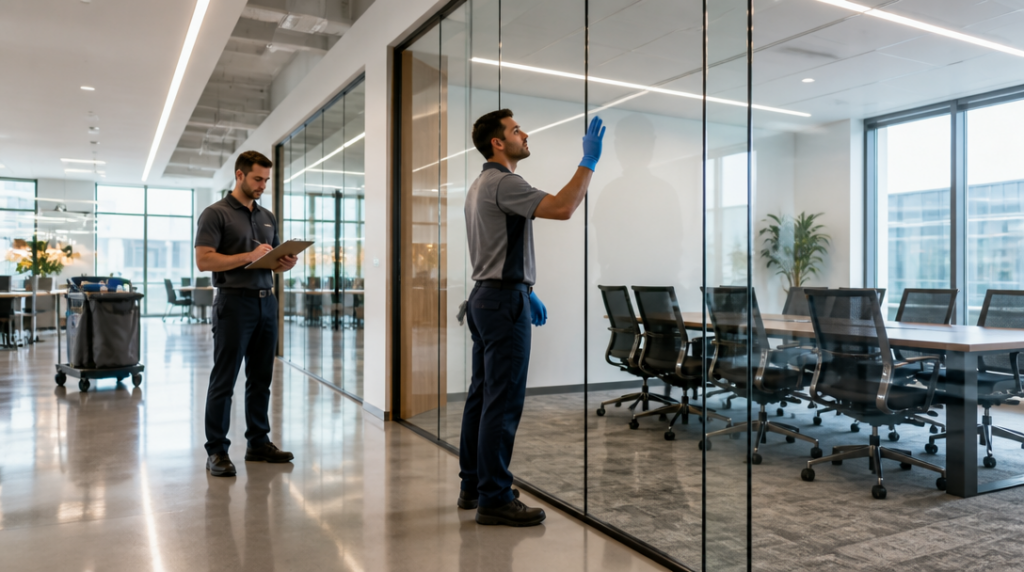
The conference room is ready for a client meeting, but the glass is streaked, the bins are full, and someone has left muddy footprints across the entrance. A cleaning company can promise a flawless workplace in five minutes. Your job is to find out whether it can deliver one every night.
Accreditation gives you a useful starting point, but the badge alone is not enough. You need to understand what it covers, who verified it, and whether the company’s systems match the demands of your building.
Start with the accreditation itself
Ask the provider to name the exact accreditation, not simply to say that it is “certified” or “fully compliant.” Those phrases can describe almost anything. A credible company should be able to explain the standard, show current documentation, and tell you which parts of its operation were assessed.
The Cleaning Industry Management Standard, known as CIMS, is one of the more substantial credentials for cleaning organizations. It is designed for both cleaning contractors and in-house facility teams, regardless of the size of the organization. That makes it relevant to a regional office, a large corporate campus, or an internal department managing several sites.
CIMS is not awarded for having a smart website and a tidy folder of policies. Certification requires every mandatory element in each section, plus at least 60 percent of the recommended elements in every section. That structure matters because a company cannot compensate for a weak area by being excellent somewhere else.
The assessment is carried out by an accredited external ISSA auditor. The auditor reviews documentation, visits the operation, and checks customer locations. That combination is much more revealing than a desk-based review: written procedures need to exist, staff need to follow them, and the results need to be visible in real workplaces.
Ask to see the current certificate and confirm its scope. A company may hold an accreditation for one division, one location, or a particular service line while presenting it as if the entire business were covered. A precise answer is a good sign. Evasion is not.
Separate company accreditation from building accreditation
Infection prevention creates another common source of confusion. GBAC STAR Service is a separate accreditation for commercial cleaning companies. It checks cleaning, disinfection, and infection-prevention procedures through third-party review.
That distinction is crucial. A building may have its own accreditation, but that does not automatically mean the cleaning contractor has been assessed. If a proposal mentions GBAC STAR, ask whether it refers to Service Accreditation for the company or accreditation connected only to a specific facility.
The accreditation for an accredited facility must be renewed every year. A provider that takes the program seriously should be comfortable discussing its renewal status and the procedures it has in place between assessments. You are not looking for a dramatic promise about eliminating every risk. You are looking for controlled processes that staff can repeat under pressure.
Pay attention to the language used in the proposal. “We disinfect high-touch points” is vague. A stronger response explains which surfaces are included, how frequently they are treated, which products are used, how contact times are managed, and how completion is recorded. The details are where operational competence shows itself.
Match specialist credentials to the building
Not every facility needs the same type of expertise. A general office cleaning team may be perfectly capable of maintaining desks, washrooms, kitchens, and common areas. It may not be the right choice for a site with delicate carpets, recurring water damage, smoke contamination, or demanding restoration work.
The Institute of Inspection Cleaning and Restoration Certification, or IICRC, is especially relevant for companies specializing in carpets, water damage, fire damage, and restoration. In 2025, the organization reported more than 6,000 certified firms across 22 countries. That scale makes its credentials useful when a routine cleaning contract includes specialist work or when you need a contractor after an unexpected incident.
Do not select a specialist simply because its certification sounds impressive. Ask for examples of similar assignments. A contractor experienced with hotel carpets may not have much insight into a manufacturing site, healthcare environment, or busy transport hub. The type of soil, surface, equipment, and disruption involved can change the job completely.
A good provider will ask questions before quoting. What flooring is installed? Which areas operate around the clock? Are there controlled-access rooms? How are chemicals stored? Who handles waste streams? If the representative only wants the square footage and preferred start date, the survey is probably too shallow.
Watch the site survey closely
The site visit often tells you more than the sales presentation. A serious representative notices worn floor finishes, hard-to-reach ledges, washroom traffic, loading areas, elevator interiors, and the places staff actually touch. They ask how the building is used rather than treating every square metre as identical.
The best surveys include conversations with the people who live with the cleaning service: reception staff, facilities managers, security personnel, and perhaps the night team. These employees know which rooms are repeatedly missed, which doors must remain locked, and which “quick fixes” create problems the next morning.
Notice whether the provider records measurements and conditions or relies on memory. The eventual service plan should identify tasks, frequencies, responsible roles, equipment, and inspection methods. It should not read like a list of pleasant adjectives such as thorough, professional, and high quality.
Ask how the company handles changes. A new tenant, a renovation, a seasonal event, or a sudden increase in attendance can alter the workload within days. You want a process for revising schedules and prices, not an argument every time the building’s needs move beyond the original assumptions.
Test the staffing model
A spotless proposal can collapse if the staffing plan is unrealistic. Ask how many cleaners are assigned, how long they are expected to work, who supervises them, and what happens when someone is absent. A low price based on impossible time allowances usually appears later as skipped tasks and hurried work.
Find out whether cleaners are employees or subcontractors, and whether the same people will regularly work at your site. Familiarity improves security and consistency. It also makes it easier to spot a genuine change in performance instead of constantly explaining the building to a new person.
Training should cover more than operating a vacuum and spraying a surface. Ask about chemical handling, dilution, personal protective equipment, infection-prevention procedures, machinery, lifting techniques, and site-specific security rules. If the company cannot describe how training is recorded and refreshed, its staffing system may be informal in ways you do not want inside your workplace.
Background checks and access control deserve direct questions. Who holds keys or access cards? How are lost credentials reported? Can the company provide a list of authorized workers? These matters may sound less glamorous than floor care, but a cleaning contractor often works in the building when nearly everyone else has gone home.
Examine quality control in ordinary language
Ask what happens after a task is missed. The answer should involve more than “the supervisor will take care of it.” Look for inspection records, complaint handling, corrective action, and a clear person responsible for closing the loop.
Digital inspection systems can help, but software is not proof of quality. A completed checklist may show that someone tapped a screen. It does not prove that the washroom was stocked, the carpet was vacuumed properly, or the high-touch surfaces were treated.
Request a sample inspection report with sensitive information removed. See whether it records actual conditions, photographs where appropriate, follow-up actions, and the date those actions were completed. A useful report should help you manage the service rather than merely reassure you that a report exists.
References should come from buildings that resemble yours. Ask the reference contact how often supervisors visit, how quickly issues are corrected, whether staff turnover has affected service, and whether invoices match the agreed scope. The awkward questions are often the productive ones.
Read the contract before admiring the quote
A cleaning quote can look attractively simple while leaving important costs somewhere else. Check whether consumables, equipment, periodic floor care, window cleaning, waste handling, emergency callouts, and specialist treatments are included. Ask which tasks are daily, weekly, monthly, quarterly, or triggered by a specific event.
Look for rules covering termination, price adjustments, additional work, damage, insurance, confidentiality, and service failures. The contract should say what happens if agreed standards are missed. Vague promises create friction precisely when everyone is already frustrated.
The cheapest bid often wins by removing time from the schedule. Compare the labor assumptions, not just the total price. A contractor that plans enough time for the work, pays attention to training, and maintains useful supervision may cost more on paper while creating fewer disruptions in practice.
Before signing, arrange a short transition period with defined checks. Walk the site after the first few shifts. Look at the entryway before opening, the washrooms during peak use, and the less visible areas that tend to disappear from attention. Those early inspections reveal whether the service plan belongs to the building you actually operate or to a generic template sitting in a sales folder.