
A campervan advertised at £70 a day can cost far more than one listed at £95 once deposits, insurance excesses, cleaning fees and one-way charges are added. The daily rate is often the least useful number in the entire quote.
Choosing a trustworthy motorhome or campervan hire company means examining the contract behind the photograph. A polished website, modern vehicles and enthusiastic reviews are helpful, but they do not tell you what happens after a cracked windscreen, a punctured tyre or a late return. Those details sit in the small print, where a bargain can quickly lose its shine.
Start with the company, not the vehicle
A reputable hire business should make its legal identity, contact details, rental conditions and complaints process easy to find. Be cautious if the only reliable way to contact the company is through a booking platform or social media message. A genuine operator should be able to explain who owns the vehicle, who provides the insurance and which business will actually take your deposit.
In the United Kingdom, membership of the British Vehicle Rental and Leasing Association is a useful signpost. The organisation has more than 1,000 members, and those members must follow mandatory codes of conduct. Disputes can also be handled through an approved alternative dispute resolution service. Membership is not a substitute for reading the agreement, but it gives renters a clearer route if communication breaks down.
That distinction matters because motorhome hire often involves more money than an ordinary car rental. The vehicle may be worth tens of thousands of pounds, the deposit can be substantial and a dispute may involve several parties: the hire company, an insurer, a roadside assistance provider and sometimes a booking intermediary.
Look for a company that answers practical questions before payment. Can you see the full rental agreement? Is roadside recovery included? Are additional drivers covered? What happens if the vehicle becomes unusable during the trip? A company that responds clearly before the booking is more likely to be manageable when something goes wrong.
Compare the complete price
The price shown on the first screen should not be treated as the price of the holiday. Before booking, the offer should set out the total amount, including mandatory charges and taxes. It should also explain the fuel policy, one-way fees, age-related surcharges and any charge for collecting the vehicle outside normal opening hours.
These costs can change the comparison completely. Imagine two five-day rentals. Company A advertises a lower daily rate but adds a mandatory preparation fee, a higher young-driver charge and a one-way supplement. Company B looks more expensive at first but includes those items. The second quote may be cheaper by the time both vehicles are ready to leave the depot.
Fuel policy deserves particular attention. A full-to-full arrangement is usually easier to understand: you collect the vehicle with a full tank and return it full. A policy requiring you to pay for fuel in advance may be reasonable in some circumstances, but check whether unused fuel is refunded and whether the company adds an administration charge. Motorhomes can have large tanks, so an unclear policy can leave you paying for fuel you never use.
The same scrutiny applies to mileage. Some rentals include unlimited mileage, while others impose a daily allowance and charge for each additional mile or kilometre. A route that looks modest on a map can become much longer once detours, campsites and sightseeing stops are included. A low daily rate with a tight mileage cap is not a genuine bargain for a touring holiday.
Treat the deposit and excess as separate costs
The security deposit and the insurance excess are not the same thing. The deposit is money the company may block or take temporarily as security. The excess is the amount you may have to pay towards an insured claim. Both figures should be clearly displayed no more than one click away from the advertised price.
A cheap tariff may carry a very high excess. That can make the headline saving meaningless if a minor accident leaves you liable for several thousand pounds. Ask whether the excess applies separately to different incidents, whether it changes for theft or damage while parked, and whether the driver must pay first before seeking reimbursement from another insurer.
Independent excess insurance can cost less than the company’s own damage waiver, but it does not necessarily remove the immediate financial pressure. The rental business may still block the full deposit on your card. You may then have to pay the hire company for the damage and claim the money back from the independent insurer later, subject to its terms.
The word comprehensive should never end the investigation. Standard collision damage waiver often excludes tyres and glass, precisely the parts most exposed on a large vehicle travelling narrow country lanes. Check the treatment of windscreens, mirrors, wheels, tyres, the roof, the underside and internal fixtures. A low bridge or a scraped awning can fall outside ordinary cover even when the main bodywork is insured.
Read the insurance conditions as operating instructions
Insurance documents tend to describe the situations in which cover disappears. Security requirements may include locking the vehicle, using an alarm, storing keys safely and following specific rules when the motorhome is unattended. If the contract requires an approved campsite or a particular security device, ignoring that condition could affect a later theft claim.
The agreement should explicitly deal with accidental damage, theft, personal belongings, vandalism and roadside recovery. It should also state who pays towing or repatriation costs if the vehicle cannot be driven. Current Financial Ombudsman Service guidance on motorhome insurance, updated on 10 July 2026, emphasises the need for these matters to be addressed clearly in the policy.
Do not assume that a breakdown service covers every cost. Recovery to a local garage may be included while transporting the vehicle, passengers and personal possessions back home is not. Nor should you assume that personal travel insurance covers a rental excess, because many policies exclude motor vehicles or impose conditions that do not fit a motorhome trip.
The contract should tell you what to do after an accident. Usually that means contacting the hire company promptly, reporting the incident to the police where required, collecting details from other parties and avoiding an admission of liability. The exact procedure matters more than a reassuring sentence on the booking page.
Inspect the vehicle like an auditor
The handover is not a ceremonial walk around the vehicle. It is your best opportunity to establish what was already damaged before you drove away.
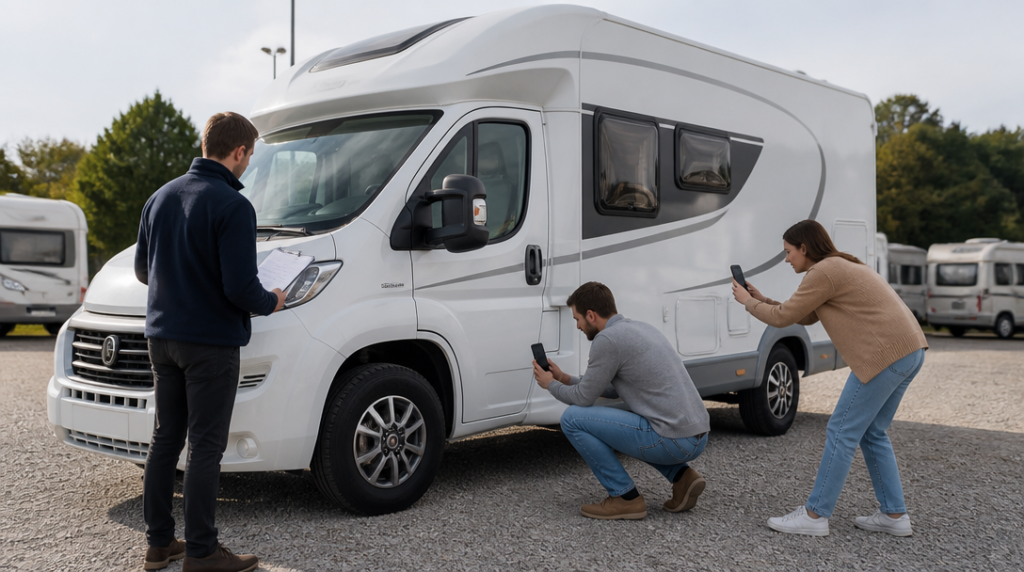
Every scratch, dent, cracked light, stained cushion and missing item should be recorded on the check-out document. Ask the staff member to acknowledge the condition in writing. Then take your own photographs and video, including wide shots that show where each mark sits on the vehicle. Photograph the roof and lower bodywork if possible, as well as the windscreen, tyres, wheels, mirrors, awning and interior equipment.
A few minutes spent filming the dashboard, fuel gauge and mileage can prevent a surprisingly long argument later. I would rather look slightly obsessive in a depot car park than try to prove the condition of a vehicle from memory after a week of driving through rain and gravel.
Check that the inventory matches reality. If the contract lists a camping table, chairs, cooking equipment, cables or safety items, confirm that they are present and usable. Test the fridge, heating, water system, lights and charging equipment before leaving. A missing adapter may be a small problem; a faulty leisure battery can disrupt an entire trip.
Make sure the driving controls and dimensions are explained. A motorhome’s height, width, length and rear overhang affect route planning, particularly on rural roads, ferries and older campsites. Ask about the fuel type, water tank, waste water, toilet system and reversing camera. These are not glamorous details, but unfamiliar equipment creates more trouble than the vehicle’s interior design ever will.
Check the rules that affect your trip
Age limits, licence requirements, international travel permissions and additional-driver rules vary between companies. Some operators restrict travel to particular countries or require advance permission for ferries. Others impose different insurance conditions once the vehicle leaves the country where it was collected.
Review the cancellation terms before paying a deposit. A flexible booking may cost more but protect you if a medical problem, transport disruption or family emergency makes the trip impossible. Find out whether the deposit is refundable, transferable or simply forfeited. Also check the policy for late collection: arriving after office hours may trigger a fee or make the handover impossible.
Returns deserve equal attention. Clarify the required fuel level, cleaning standard, waste disposal, return time and procedure for reporting new damage. If the depot is closed, ask how the keys and vehicle condition should be documented. Take photographs again, especially of the fuel gauge, mileage and exterior, before handing over the keys.
Judge reviews by their details
Reviews are most useful when they describe a specific event: how a deposit was returned, how a breakdown was handled or whether pre-existing damage was recorded correctly. Vague praise about a friendly team tells you less than a detailed account of a puncture resolved on a Sunday evening.
Look for patterns rather than isolated complaints. One unhappy renter may have misunderstood the mileage policy. Several customers reporting unexplained deductions from deposits suggest a more serious problem. Pay attention to how the company responds publicly. A calm, factual reply is encouraging; blaming every dissatisfied customer is not.
The strongest booking is the one you can explain in plain language: this is the total price, this is the deposit, this is the maximum excess, these items are excluded, this is the breakdown procedure and this is how the vehicle must be returned. If any of those answers remain vague, the cheaper quote has not earned your trust.