
Start with the care your cat actually needs
The first warning sign appeared in the litter box. Mia had asked a neighbor to check on her cat, Jasper, during a long weekend away. The neighbor meant well, but stopped by only once instead of twice, missed a change in Jasper’s appetite, and left the back door unlocked. Jasper was fine in the end, but Mia spent most of her trip calling home and wondering what else had gone wrong.
A professional cat-sitting service should remove that kind of uncertainty, not add to it. The right sitter gives your cat familiar surroundings, regular attention, and a dependable human presence while you are away. Choosing one takes a little more than reading a few cheerful reviews, though. You need to understand who will enter your home, what the visit includes, and what happens if something goes wrong.
Begin by describing your cat’s routine in plain terms. Does your cat need medication? Is she nervous around strangers? Does he bolt through open doors? Some cats are content with food, water, and a clean litter box. Others need playtime, grooming, insulin injections, or a quiet person who will sit on the floor for ten minutes without trying to force affection.
A trustworthy service will ask these questions before giving you a price. If someone treats every booking as a standard feeding visit, they may not be prepared for a cat who hides under the bed or refuses tablets.
Look for experience with cats, not just pets
Pet care is a broad field. A person who is excellent at walking energetic dogs may not understand feline behavior, medication routines, or the particular problems that can arise when a cat stops eating. Ask how much of the service’s work involves cats and whether the actual sitter assigned to your home has cared for cats before.
Professional membership can provide one useful starting point. A major pet-sitting association has operated since 1994 and offers a directory that lets owners search for sitters by ZIP code. Its membership figures also show that 73 percent of members have been in business for at least five years, while 96 percent offer cat care. Those numbers do not guarantee that a particular sitter will be a good match, but they make professional membership more meaningful than a vague claim of being “pet-friendly.”
Experience should still be examined closely. Five years in business does not tell you whether a sitter has handled diabetic cats, anxious cats, senior cats, or multi-cat households. Ask for examples of situations similar to yours. You are not testing the sitter with a trick question; you are finding out whether their experience resembles the care your cat needs.
Pay attention to how they answer. A careful sitter will explain what they would do if your cat vomited, disappeared under furniture, refused food, or developed a swollen paw. They should also know when a problem requires a veterinarian rather than a casual message saying that the cat seems “a little off.”
Check the person who will enter your home
A company’s reputation is only useful if you know who will actually arrive at your door. Some services use one primary sitter. Others send different employees depending on availability. Ask whether you will meet the assigned sitter in advance and whether a backup person might have access to your home.
Background checks should apply to every sitter and worker who enters a client’s house. A professional association recommends asking for checks completed within the previous year. That is a reasonable standard, especially if the service has several employees or contractors. You can ask when the check was performed, who conducted it, and whether the policy covers replacements and emergency staff.
This is not an accusation. You are handing someone access to your living space, alarm system, personal belongings, and animal. A serious business should understand why you want a clear answer.
The initial meeting also reveals a lot. Does the sitter take notes, repeat feeding instructions, and ask where the circuit breaker is? Do they check that windows are secure and learn which doors must remain closed? A polished sales conversation matters less than quiet attention to small details. Cats are experts at finding the one loose screen, open cupboard, or forgotten string that humans overlook.
Ask what insurance really covers
“Fully insured” sounds reassuring until you ask what the words mean. The policy should include Care, Custody and Control coverage, often shortened to CCC. This is designed to address incidents involving the animals under the sitter’s care as well as damage connected with the client’s property.
Ask whether the business carries coverage for the type of visits you are booking, whether its employees are included, and what happens when a subcontractor is used. You can also request proof of insurance rather than relying on a sentence on a business card or website.
Bonding is a separate protection that may cover theft by an employee or other covered worker. It is not identical to ordinary liability insurance. If a sitter enters your home, ask whether the business has bonding against theft and what conditions apply.
A short conversation about insurance can feel awkward, but it is easier before a problem than after one. The same applies to keys, alarm codes, and access instructions. Find out how keys are stored, whether they are labeled with your address, and how the service handles them after the booking ends.
Read the contract before you book
A written agreement should explain the service in enough detail that two strangers would interpret it the same way. It should state the dates and frequency of visits, the length or general scope of each visit, the price, cancellation rules, and any extra charges for holidays, medication, additional cats, or emergency trips.
The agreement should also cover veterinary care. Decide in advance who may authorize treatment, which clinic should be contacted first, and how you will be reached if your cat becomes ill. If you have a spending limit for urgent care, put it in writing. A sitter should not have to guess whether you would approve an examination when your cat is struggling to breathe or has stopped responding normally.
Look for instructions about photos and updates as well. Some owners want a short message after every visit; others prefer one daily report. A good service can follow your preference without turning communication into a performance. One clear photo of your cat eating dinner can be more useful than a dozen blurry pictures and a string of cheerful emojis.
Verify training, first aid, and references
Pet-sitting does not always require a formal license, and the rules vary by location. Ask whether the business holds any license or registration required where it operates. Then ask about training. Cat-specific handling, medication administration, animal first aid, and emergency procedures are all relevant, particularly if your cat has a medical condition.
Professional guidance commonly recommends checking seven areas: licensing, insurance and bonding, background checks, references, a written contract, training or first aid, and membership in a professional organization. Treat that as a practical framework rather than a certificate of perfection. A business can satisfy every item and still be a poor fit for your cat if it rushes visits or ignores your instructions.
References are most helpful when you ask focused questions. Was the sitter punctual? Did they follow feeding and medication instructions? Did they communicate quickly when something unusual happened? Did the cat seem relaxed after the owner returned? Ask for references from clients whose pets have needs similar to yours, not only from someone with an easygoing kitten.
A service that refuses reasonable questions or offers only vague assurances should not receive your keys. That is the whole test.
Compare the visit, not just the price
Low prices can be attractive, especially for a long trip, but the number alone tells you very little. Two services may charge similar rates while providing very different visits. One may stay for a set period, clean the litter box thoroughly, refresh water, give medication, and send a report. Another may perform a quick food drop and leave.
Ask what happens if the sitter cannot make it. Is there a trained backup? Will you be notified before someone new arrives? Does the service guarantee a visit window or only a general part of the day? Cats are creatures of habit, and a late visit may matter if medication or meals follow a strict schedule.
You should also ask how the company handles multiple cats. Some charge extra; others include a second or third cat if they share the same routine. Neither approach is automatically wrong. The important thing is that the fee and workload are clear before the booking.
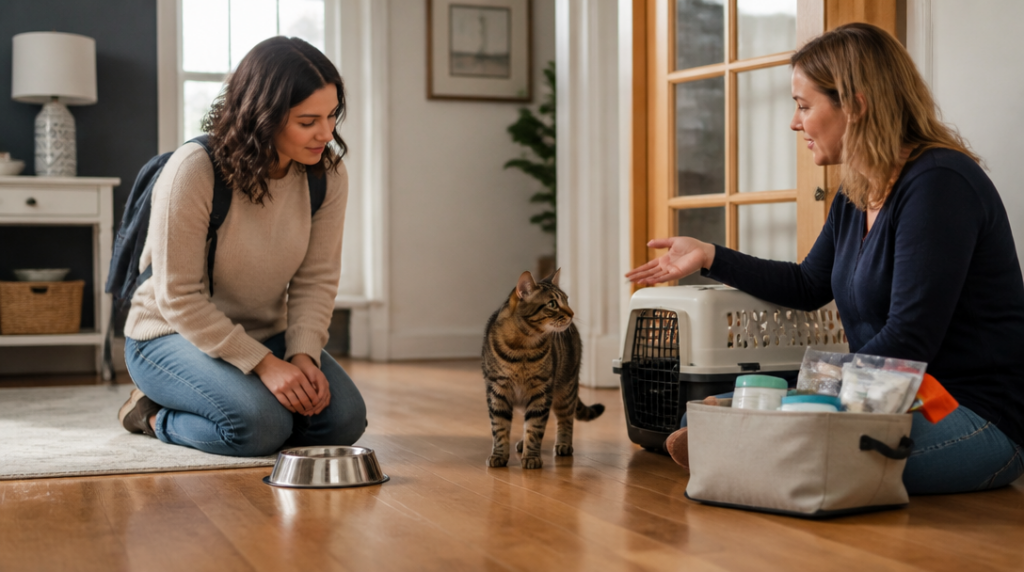
The meet-and-greet is your chance to watch the cat’s reaction. A cautious cat may hide, and that is normal. The sitter should not drag the animal out or insist on touching it. Instead, they can sit nearby, speak softly, and learn where the cat feels safe. Trust often begins with someone who knows not to rush.
Before you leave, write down the routine in the language a tired person can follow: half a can on the left side of the bowl, tablet inside the soft treat, litter scoop after breakfast, balcony door kept shut. Add the veterinarian’s number, your travel details, a local emergency contact, and permission instructions. Clear notes help even an excellent sitter do the job consistently.
The best service is rarely the one with the most polished promises. It is the one that notices the water fountain is making a strange noise, sends a message when your cat skips dinner, and understands that a closed bedroom door may be the difference between an ordinary visit and a night spent searching for a frightened animal.