
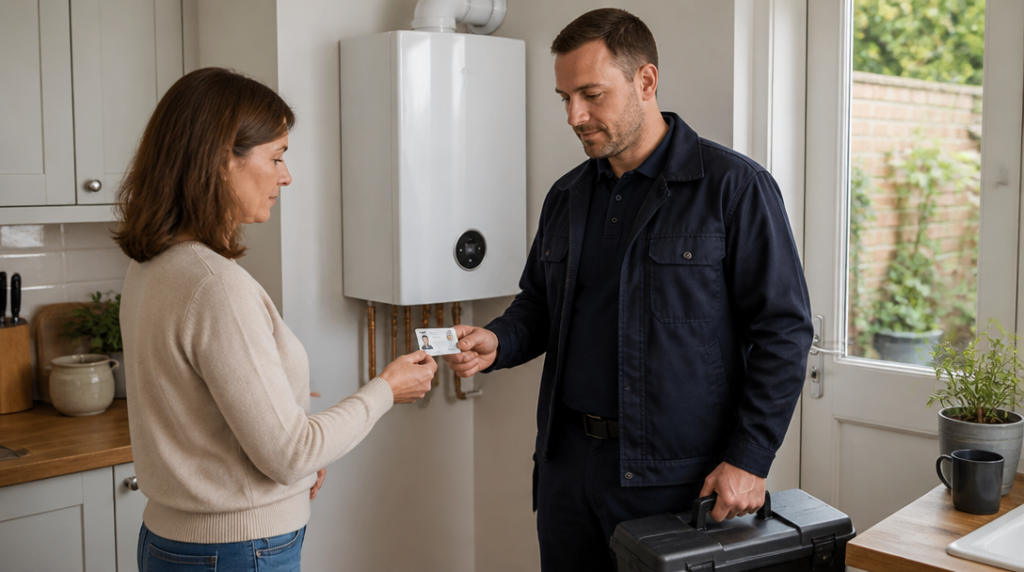
A boiler engineer once arrived at a terraced house in Leeds carrying a toolbox, a reassuring smile and a business card covered in promises. The homeowner asked to see his Gas Safe ID card. He produced it, but the card showed qualifications for gas fires and cookers, not the boiler he had been hired to service. The engineer left empty-handed. The homeowner had spent five minutes checking a detail that could have prevented a much bigger problem.
That small moment captures the awkward question many people avoid: are we choosing a qualified gas contractor, or merely choosing the person who sounds confident on the phone?
For gas work, the first answer is non-negotiable. The engineer must be registered with Gas Safe Register. In the UK, the Isle of Man, Guernsey and Jersey, carrying out work on gas appliances, pipework or flues without the required registration is illegal. This is not a decorative membership badge or a sign that a company has filled in the right forms. It is the basic legal threshold for the job.
Gas Safe Register recorded 150,847 registered engineers and 4,710 newly accepted businesses as of 31 March 2025. That is a large pool of contractors, and it creates a practical problem: registration narrows the field, but it does not choose your plumber for you. A register cannot tell you whether an engineer turns up on time, explains the fault clearly or leaves your kitchen looking as though a small explosion took place beneath the sink.
The check needs to happen before work begins, not after the invoice arrives. Ask to see the engineer’s current Gas Safe ID card. Check the engineer’s name, the business name and, crucially, the qualifications listed on the card. The relevant details are particularly important on the back, where the engineer’s specific areas of competence are shown.
The word “specific” matters here. A contractor may be qualified to work on a gas cooker but not a boiler. Someone competent with natural gas may not be qualified for an LPG appliance. A gas fire, a flue and a central-heating system can all sit under the broad description of “gas work”, yet they require different knowledge and authorisations. A company’s registration does not automatically mean that every engineer it sends out can legally carry out every type of job.
A sensible customer asks a plain question: “Are you qualified for this exact appliance and this exact type of work?” A serious contractor will answer without irritation. If the reply is vague, rushed or based on the company’s reputation rather than the named engineer’s qualifications, stop there. You are not being difficult. You are checking whether the person in front of you is authorised to touch the equipment in your home.
There is an odd social pressure around this conversation. People worry that asking for identification will offend the tradesperson, as if a boiler were less dangerous because the engineer seems friendly. That instinct deserves to be resisted. A professional should expect the question. In fact, a contractor who welcomes a quick ID check is giving you useful information about how they approach safety.
The registration check still does not answer several questions that matter to your household budget. Gas Safe Register checks gas safety competence. It does not grade prices, length of experience or customer service. Those details need separate investigation, and this is where many homeowners become strangely careless. They will compare supermarket prices to the penny, then accept the first gas repair quote that appears in a search result.
Ask for a written explanation of the work, even if the diagnosis is not yet certain. The document should make clear whether the price covers inspection, labour, replacement parts, testing and any follow-up visit. A contractor who cannot explain what is included may still be honest, but you will be left guessing when the bill changes. That uncertainty is rarely cheap.
A low quote is not automatically a bargain. It may reflect a genuinely efficient business, but it may also exclude essential testing, use an unsuitable replacement part or rely on the engineer finding additional work once the job has started. The opposite mistake is just as common: assuming the most expensive quote represents the safest contractor. Price can tell you something about the job, but it cannot certify the person doing it.
Experience needs a sharper definition than “in the trade for 20 years”. Ask how often the contractor works on your type of boiler, appliance or heating system. Someone with decades of general plumbing experience may have less relevant experience with a modern condensing boiler than a newer engineer who works on that equipment every day. The useful question is not simply how long the company has existed. It is whether the engineer regularly handles the problem you actually have.
References can help, but they are not sacred. Read recent customer feedback for patterns rather than isolated praise or anger. Repeated complaints about missed appointments, unexplained charges or unfinished repairs deserve more attention than one glowing review describing a contractor as “a lovely chap”. A recommendation from a neighbour who has used the same engineer more than once is often more valuable than a page of anonymous ratings, especially if the neighbour can tell you what work was done and how the contractor dealt with complications.
Insurance is another reasonable question. Ask whether the business has appropriate public liability cover and whether the person attending is employed by the company, a subcontractor or an independent engineer. None of these arrangements is automatically unacceptable, but you should know who is responsible for the work and whom to contact if something goes wrong. A contractor who treats basic questions as an accusation may be more interested in closing the sale than building a durable reputation.
There are warning signs that should make the decision easy. Be cautious if someone refuses to show an ID card, claims that registration is unnecessary for a “small” gas job, presents a card whose qualifications do not match the appliance, or pressures you to approve work immediately without a clear explanation. Be equally wary of a contractor who diagnoses a serious fault over the phone without inspecting the appliance. Gas problems can be urgent, but urgency is not a licence for theatrical certainty.
For routine work, take a few minutes to compare contractors before the heating fails on a freezing evening. Keep the name of the engineer who attended, the details of the work and any paperwork provided. Ask what safety checks will be carried out and whether the contractor will issue the relevant documentation after the job. These records are not exciting, but they are far more useful than trying to reconstruct a conversation six months later from a bank statement.
Emergency situations require a different pace. If you smell gas or suspect an immediate danger, follow the appropriate emergency safety guidance and do not treat online searching as a substitute for urgent help. Once the immediate risk has been dealt with, the same principles still apply: confirm the engineer’s identity, check the relevant qualifications and ask what has been found before agreeing to non-urgent remedial work.
Choosing a gas contractor is therefore less about finding a magical five-star professional and more about refusing to confuse legal registration with a full endorsement. The register can tell you whether an engineer meets the required safety standard and whether their qualifications match the task. It cannot promise a fair quote, careful workmanship or a pleasant experience.
That distinction may sound severe, but gas work deserves a little severity. The contractor who is annoyed by a two-minute check is telling you something; the one who calmly shows the back of the card, explains the qualification and sets out the price is telling you something too.