
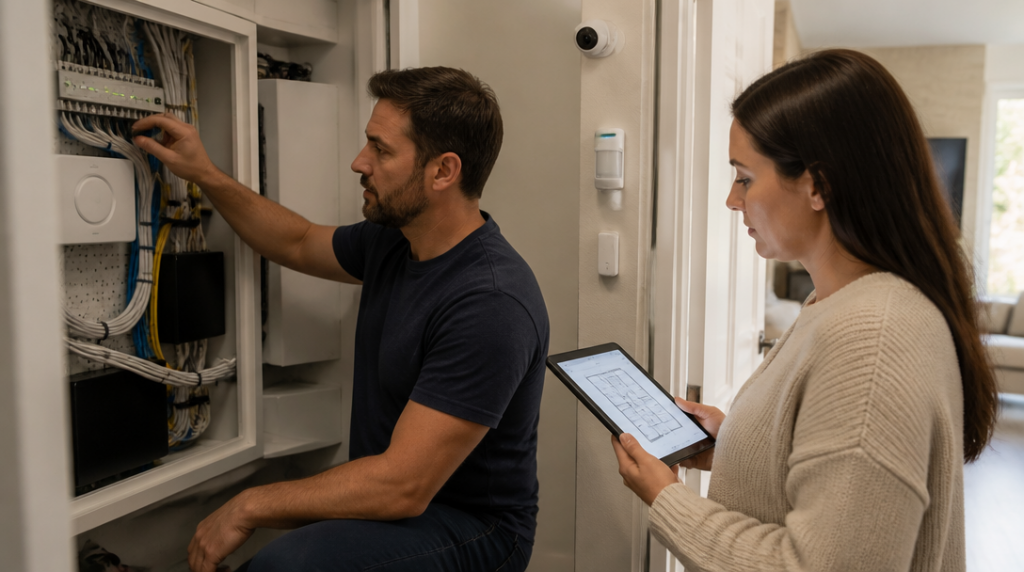
The alarm starts screaming at 2:17 a.m. You reach for your phone, discover that the app has logged you out, and realize you have no idea whether anyone is monitoring the system. The installer’s emergency number goes straight to voicemail. Your carefully chosen security system has become an expensive wall decoration with a siren.
Choosing the installer deserves at least as much attention as choosing the equipment. Cameras, sensors, control panels, and smart locks all matter, but the company designing, installing, configuring, and maintaining them determines whether the whole arrangement works under pressure. A reliable installer should be able to explain the system without hiding behind technical vocabulary or theatrical confidence.
Start with the company, not the camera resolution
A trustworthy installer should be able to tell you exactly what it does and what it does not do. Some companies design and install systems but leave monitoring to another provider. Others handle the full chain, including alarm response and ongoing maintenance. Neither model is automatically better. Confusion is the problem.
Ask for the company’s legal name, physical business address, insurance details, licensing information where required, and the name of the monitoring center it uses. A reputable firm should answer directly. If the salesperson becomes mysteriously busy as soon as you ask who receives an alarm after hours, keep looking.
References are useful, but ask for relevant ones. A customer with a small retail shop can tell you how the installer handled access control and false alarms. A homeowner may have a very different experience. Ask whether the system has been reliable, whether service calls were handled promptly, and whether the final invoice resembled the original quote. That last question has saved many people from discovering that every useful feature was apparently an optional extra.
Look for an installer with experience in buildings like yours. A warehouse, a suburban house, a medical office, and a multi-tenant apartment building do not present the same risks. An installer who understands the site will ask about entrances, blind spots, power failures, network equipment, lighting, pets, deliveries, staff routines, and the awkward door that never quite closes. Those questions are more reassuring than a brochure full of glossy cameras.
Check the UL Listing instead of admiring the badge
If the project requires a professionally recognized security installation, check whether the installer is UL Listed. This is not a decorative phrase a company can simply add to its website. The designation applies to companies enrolled in the relevant UL program, and its validity can be checked in the public UL Product iQ directory.
For security system installation, look for alignment with UL 681. That standard addresses the installation and servicing of burglar-alarm systems. If the system includes central-station monitoring, the monitoring center should meet UL 827, the standard used for central-station alarm services.
The distinction matters. An installer may be perfectly capable of mounting sensors and programming a panel, but that does not make the company a qualified monitoring center. UL Listed installation companies and monitoring companies undergo an audit every year, so the listing is not meant to be a one-time certificate framed above reception and forgotten beneath a layer of dust.
Verify the actual company, not just a logo copied into a proposal. The legal business name should match the listing. Check that the relevant listing is current and covers the work being proposed. A company may be listed for one type of service while quietly offering another under the same branding. Corporate naming is occasionally a maze designed by people who enjoy paperwork more than sleep.
If the installer does not operate its own monitoring center, ask how monitoring is contractually arranged. The monitoring must be provided through a UL Listed central station if the system is to receive UL certification. Get the arrangement in writing, including the monitoring company’s name, the services covered, and what happens if the installer closes, changes partners, or stops servicing your area.
Make the proposal reveal the weak spots
A serious proposal should describe more than the number of cameras and the monthly fee. It should explain what the system is intended to protect, where devices will be installed, how signals will travel, what happens during a power or internet outage, and how users will be trained.
Pay attention to the survey process. An installer who quotes everything by looking at a floor plan or asking for a few phone photos may be offering a rough estimate, not a finished security design. The site visit should identify entrances, vulnerable windows, high-value areas, environmental conditions, cable routes, and locations where wireless signals may struggle. Thick walls and metal structures have a habit of disagreeing with optimistic sales presentations.
The proposal should identify equipment by model or product family rather than using vague labels such as “premium motion detector.” It should state whether the system is wired, wireless, or hybrid; whether batteries are included; how long backup power is expected to last; and whether cellular communication is available if the internet connection fails.
Costs need the same level of detail. Separate installation, equipment, monitoring, service, licensing, taxes, and optional features. Ask about activation charges, minimum contract terms, cancellation fees, replacement batteries, software subscriptions, and after-hours service. A low installation price can look impressive until the useful parts of the system appear as monthly add-ons.
Do not accept a proposal that promises total protection. Security systems reduce risk and improve detection; they do not turn a building into a magical fortress. A good installer will explain what the system can detect, what it cannot detect, and how occupants are expected to respond to alarms.
Treat fire protection as a different discipline
Fire alarm work deserves particular scrutiny. Ask whether the company follows NFPA 72 and whether its qualifications cover the specific functions involved: installation, testing, maintenance, inspection, and monitoring. These are related tasks, but they are not interchangeable simply because the same red control panel sits on the wall.
A company experienced with burglar alarms may not have the expertise required for a fire alarm system. Fire protection can involve dedicated design requirements, notification appliances, initiating devices, documentation, inspections, and coordination with authorities having jurisdiction. The installer should be able to explain who is responsible for each stage and provide the records needed after the work is complete.
Ask how testing will be documented and who will perform future inspections. If the answer is a vague promise to “take care of it,” ask for names, intervals, and procedures. Maintenance is not glamorous, but neither is discovering during an emergency that a neglected detector has been quietly waiting to become a lawsuit.
Listen for what happens after installation
The handover tells you a great deal about the company. Before the final payment, you should receive user instructions, access credentials, device information, warranty terms, monitoring details, and records of testing or commissioning. The installer should demonstrate how to arm and disarm the system, cancel a false alarm, test communication paths, add authorized users, and report a fault.
Ask what happens when equipment fails. Does the company provide remote diagnostics? How quickly does it respond to service calls? Are replacement parts stocked? Will a technician be available after the installer’s favorite employee leaves for another job? A system that cannot be maintained is merely a future repair bill with blinking lights.
Confirm who owns the passwords, programming codes, video recordings, and account data. You should not be trapped with one installer because the company refuses to release administrative access. If the system uses cloud software, ask what happens to your data if you end the contract and how long recordings remain available.
False alarms deserve a specific conversation. Ask what typically causes them at your type of property, how the system reduces them, and how the monitoring center verifies an alarm before contacting emergency services or designated responders. A reliable installer will talk about user training, pets, environmental conditions, camera analytics, and sensible alarm procedures rather than treating every activation as a thrilling surprise.
Trust is usually visible in small details. The technician labels cables, protects finished surfaces, explains a limitation instead of concealing it, and leaves the equipment room tidier than it was found. The salesperson does not pressure you to sign before you have read the monitoring contract. The company keeps its promises in writing.
That may sound less exciting than a wall of ultra-high-definition cameras. It is also much more likely to matter at 2:17 a.m., when the alarm is loud, the house is dark, and somebody needs to know exactly what happens next.