
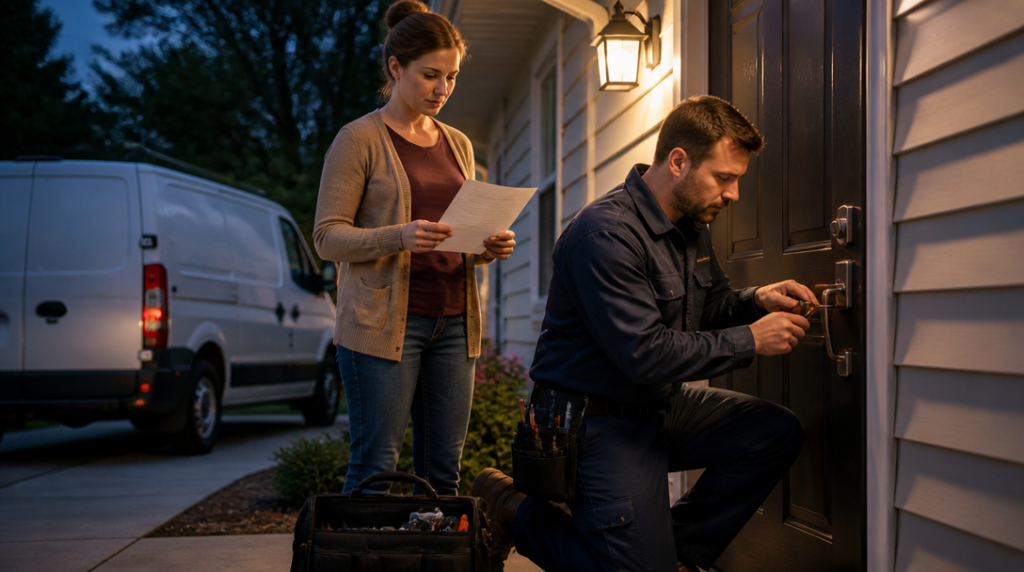
At 10:40 p.m., a homeowner named Daniel searched for a locksmith after locking his keys inside his house. The first result looked local, used a familiar city name, and promised a low service fee. A technician arrived 25 minutes later, drilled the lock, replaced the entire mechanism, and presented a bill several times higher than the phone estimate. By then, the front door was open and the argument had nowhere useful to go.
That scenario is realistic because the hardest part of hiring a locksmith often happens before anyone touches the lock. A professional locksmith is not simply the person who can make a key or open a door. The job also involves identity, licensing, pricing, insurance, workmanship, and the ability to explain what is necessary without turning an emergency into a sales opportunity.
Start with identity, not the advertised price
A low price is useful only if you know what it includes. Many questionable locksmith listings advertise a very small service charge and leave out labor, mileage, emergency fees, replacement parts, or the cost of drilling and installing a new lock. The initial number attracts the call; the real price appears after the technician has control of the situation.
Before booking, ask for the company’s legal or trading name, its physical service area, and the name of the technician who will come to the property. Ask how the technician will identify the company on arrival. A marked vehicle, business card, uniform, and government-issued identification do not prove quality by themselves, but their absence should make you cautious.
A genuine local business should be able to describe where it operates without relying on vague claims such as “serving everywhere.” Multiple phone numbers that all lead to one call center outside the state can be a warning sign that apparently local listings are part of a wider lead-generation operation. The listing may use a city name while the person answering the phone knows little about the neighborhood, the company’s ownership, or the technician being dispatched.
Search results are not a credential. They are advertising space.
State consumer-protection officials in Connecticut warned about bait-and-switch locksmith schemes on July 16, 2026, advising customers to verify registration, confirm the technician’s identity, and establish the price before work begins. Those three checks address the most common weakness in an emergency call: the customer often knows almost nothing about the person standing outside the door.
Verify registration and licensing requirements
Licensing rules vary sharply by state and by the type of work involved. Some jurisdictions regulate locksmiths directly; others impose additional requirements when the job includes construction, electrical work, access-control systems, or a substantial amount of materials and labor. A professional will usually understand which rules apply and will not treat a licensing question as an insult.
California offers a useful example of why the details matter. Locksmith work involving more than $500 in combined materials and labor also requires a contractor’s license. That does not mean every lockout has to be handled by a contractor, but a large installation or security upgrade may fall under a different regulatory category than opening a locked door.
Ask for the relevant registration or license number and verify it through the appropriate state or local authority before approving significant work. Check that the business name matches the license record. If the technician says the company is licensed but refuses to provide any identifying information, choose another provider unless the situation presents an immediate safety risk.
Insurance matters too, especially if the job involves drilling, replacing a door lock, repairing a damaged frame, or modifying a commercial access system. Ask whether the business carries liability insurance and whether employees or subcontractors are covered. You do not need a lengthy legal explanation at the doorstep, but a credible company should be able to answer basic questions without improvising.
Get the complete price in writing
A proper estimate should separate the call-out charge, labor, parts, taxes, and any emergency or after-hours fee. It should also state whether the price is fixed or subject to change after inspection. If the locksmith cannot diagnose the problem remotely, that is understandable. What is not reasonable is refusing to give even a price range or refusing to explain what would cause the bill to rise.
Ask one direct question: “What is the maximum I will pay if the job is limited to opening the lock?” Then ask for a second estimate for likely repairs, such as replacing a cylinder or installing a new deadbolt. These questions distinguish a genuine service call from a vague promise designed to get someone through the door.
California has prohibited advertised service prices from concealing mandatory fees since July 1, 2024. Customers there should request the full price in writing before work starts, rather than accepting a headline figure that excludes charges they cannot avoid. Even where similar rules do not apply, the same habit is sensible.
Do not approve extra work merely because the technician says the lock is “unsafe” or “illegal.” Ask what specific defect was found, whether the lock can be repaired, and what the replacement options cost. A damaged lock may genuinely need replacement, but a professional should be able to show the problem and explain the consequence of leaving it alone.
Watch the payment method
Payment demands can reveal more than a polished website. A request for cash alone, cryptocurrency, gift cards, a bank transfer, or a payment app is a strong scam indicator, particularly if the technician insists on payment before work begins. Federal consumer authorities identify those payment methods as warning signs because they make disputes and recovery much harder.
A credit card payment after the work is completed gives the customer a clearer record and, in some circumstances, additional dispute protections. Ask for an itemized invoice showing the business name, date, address, work performed, parts used, and total charge. Keep the estimate, messages, and payment confirmation. A company that refuses to provide a receipt is not protecting you from paperwork; it is protecting itself from accountability.
One Georgia case shows how large these operations can become. In 2021, a company paid more than $250,000 in penalties and restitution after using over 160 websites with fake local names. The number is revealing: a convincing local identity may be manufactured at scale, across dozens or hundreds of neighborhoods, while the customer believes he or she has found a small nearby business.
Judge the proposed repair, not the confidence
A locksmith may need to pick a lock, decode it, rekey it, or drill it. Drilling is sometimes necessary, but it is not the default solution for every lockout. Ask what technique the technician plans to use and why. If the answer is simply “This is how we do it,” the explanation is too thin.
The same scrutiny applies to security recommendations. A locksmith who immediately proposes replacing every lock in the house may be selling equipment rather than solving the problem. A thoughtful professional will ask about the age and condition of the existing hardware, who needs access, whether keys have been lost, and whether the priority is convenience, burglary resistance, or control over former occupants.
Prices for replacement hardware can vary widely, but the most expensive option is not automatically the safest. A basic rekey may be enough after a tenant moves out. A new deadbolt may be sensible after a forced entry. A commercial building may require a more complex access-control assessment. The recommendation should fit the situation.
Build a shortlist before an emergency
The worst time to compare locksmiths is while standing in the rain beside a locked car or house. Save the contact details of one or two established businesses before you need them. Test the phone number during normal hours. Ask about service boundaries, emergency pricing, licenses, and accepted payment methods. If the answers are clear when there is no crisis, the company is more likely to behave clearly during one.
Personal recommendations remain useful, particularly from property managers, building contractors, and neighbors who have hired the same technician more than once. Reviews can help identify patterns, but they should not replace registration checks. A business with hundreds of glowing reviews may still be difficult to verify, while a small legitimate operator may have a limited online presence.
If a technician arrives in an unmarked vehicle, gives a price far above the estimate, refuses identification, demands an unusual payment method, or starts work without approval, stop the job if it is safe to do so. Pay only for work you authorized, request an invoice, and document the vehicle, business name, and communications. A lockout is urgent; it is not permission for someone else to set the rules.