
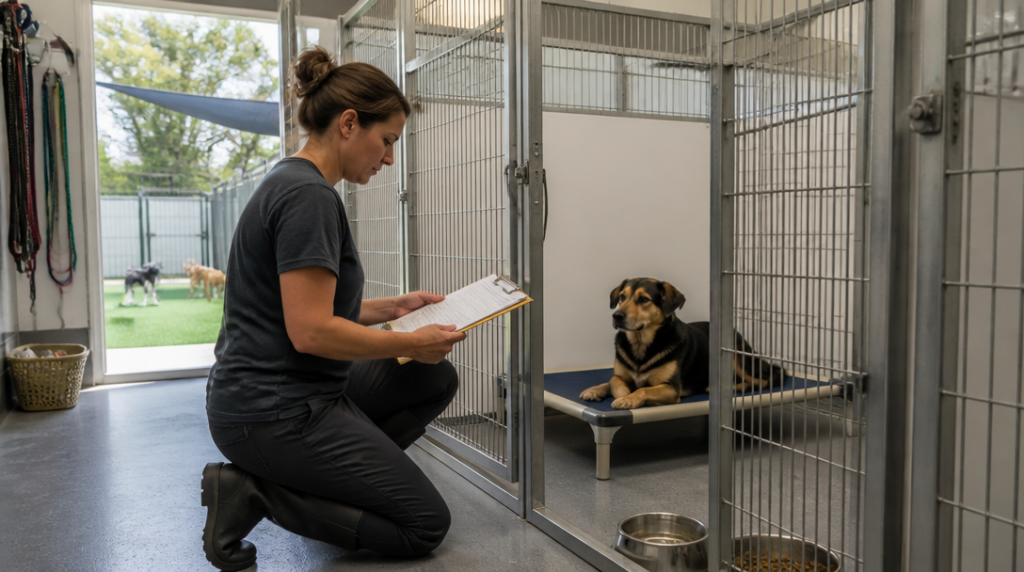
At one kennel, the air smells faintly of disinfectant and warm biscuits. Dogs are sleeping on raised beds while a staff member checks a clipboard. At another, the lobby shines, the receptionist smiles, and the questions about licensing and vaccination records are met with vague answers. Both places may look welcoming. They are not equally prepared to care for your dog.
Choosing a licensed boarding kennel starts before the first overnight stay. You need to know which authority issued the license, what that license covers, and whether the facility is willing to show you how the operation works when the front desk is not performing for visitors.
The rules depend on where you live. A kennel may need a permit or license from the city, county, or state. Ask the operator for the license number and the name of the issuing authority, then confirm that the document is current. A framed certificate near the reception desk is useful, but it should not be the only thing you see.
A USDA license applies only to certain types of commercial animal facilities. It does not automatically cover every boarding kennel, and it is not a guarantee of high-quality care. A federal license can be one piece of the picture, but local licensing, facility standards, staffing, and everyday routines matter just as much.
The numbers from 2025 show why a license should be checked rather than admired from a distance. USDA-licensed facilities recorded 680 violations that year. No operator lost a license or received a fine, which means the existence of a license alone tells you very little about how forcefully problems are handled.
More than 150 operators refused inspections in 2025, and roughly one-third of active facilities were not inspected during the year. That does not prove that every uninspected kennel is unsafe. It does mean that you should not treat a clean-looking website or a license designation as a substitute for your own questions.
Call the relevant local office if the kennel will not provide clear information. Ask whether the license is active, whether complaints or violations are public, and whether the facility is subject to routine inspections. If staff members become defensive at this stage, the conversation has already given you useful information.
Then visit in person. A proper tour should include the areas where dogs sleep, eat, exercise, and are separated when necessary. Listen for the sound of constant barking, notice whether the floors are wet or slippery, and check whether bowls, bedding, gates, and outdoor runs appear clean and intact. The details are mundane, but animal care is built from mundane details.
Pay attention to the smell. A kennel will never smell like a living room, especially during a busy afternoon, but a sharp odor of urine, feces, ammonia, or spoiled food should not be dismissed as normal. Look at the dogs already staying there. Are they alert, reasonably clean, and handled calmly, or do they seem frantic, shut down, or crowded into small spaces?
Ask how many people are physically present during the day and overnight. The answer should be specific. “Someone is always around” is not the same as explaining who is on duty, where that person sleeps or works, and what happens if a dog becomes ill at 2 a.m.
Find out how the kennel handles emergencies. Ask which veterinarian or emergency clinic they use, how they contact owners, and whether staff can administer prescribed medication. The kennel should have your veterinarian’s contact details, an emergency contact, and written permission for treatment when you cannot be reached.
A good intake conversation takes time. Staff should ask about your dog’s feeding schedule, medications, fears, escape habits, interactions with other dogs, and previous boarding experience. If nobody asks what makes your dog nervous, the facility may be relying on a generic routine that does not fit every animal.
Vaccination records deserve close attention. For dogs, request documentation showing current protection against rabies, parvovirus, distemper, and infectious hepatitis. Kennels may also require Bordetella bronchiseptica vaccination, often associated with kennel cough. It is considered a non-core vaccine, so the need for it depends on the dog’s likely exposure and the facility’s policy.
Do not accept a verbal promise that the vaccines are up to date. A vaccination certificate should include the date each vaccine was given, its expiration date, the rabies tag number, the veterinarian’s signature, and the veterinarian’s license number. Check the dates yourself. A record that says only “vaccinated” is not enough to establish current protection.
Ask what the kennel does when a dog arrives without the required documentation or shows signs of illness. Dogs with coughing, vomiting, diarrhea, unusual lethargy, or other symptoms should not simply be placed into a shared area while staff waits to see what happens. The operator should be able to explain its isolation and owner-notification procedures in plain language.
Group play is another point where cheerful marketing can obscure the practical details. Some dogs enjoy supervised play with compatible companions. Others become overwhelmed, injured, or exhausted. Ask how dogs are matched, how staff supervise them, how often groups are interrupted for rest, and whether your dog can be housed without group play.
Watch the staff during a real transition if you can. A dog arriving at the kennel may pull toward the gate, flatten its ears, or bark at unfamiliar smells. Skilled handlers do not need to make a show of affection; they move slowly, secure leashes properly, and give the animal time to understand what is happening. That quiet competence is more convincing than a wall covered with staged pet photos.
Clarify the sleeping arrangement. Will your dog stay in an individual run, a crate, a room, or a shared space? How often will the area be cleaned? What bedding is provided? Are dogs taken outside on a schedule, and who verifies that every dog has returned? The answers should describe an actual routine rather than a vague promise of “plenty of attention.”
Ask how feeding works. You may want the kennel to use your own food to avoid a sudden diet change. Confirm how portions are measured, where food is stored, and how staff prevents one dog from eating another dog’s meal. If your dog takes medication, write down the dose, timing, method, and any warning signs instead of relying on a rushed handover at the front desk.
Security deserves its own inspection. Look for double gates, secure latches, intact fencing, and a clear process for moving dogs from one area to another. Ask what happens during a power failure, severe weather event, fire alarm, or evacuation. A kennel that cannot explain how it would account for every animal during a disruption is not ready for the responsibility.
Read the contract before you book. It should explain fees, cancellation rules, pickup times, late charges, medication costs, emergency veterinary authorization, and what happens if your travel plans change. Pay attention to clauses dealing with illness, injury, escape, and transport. If the language is confusing, ask the operator to explain it before signing rather than assuming the details will work themselves out.
References can help, but they should come after an inspection, not instead of one. A neighbor may have had a pleasant experience during a quiet weekend, while your dog could arrive during a holiday rush with different staff and a full house. Personal recommendations are useful for finding candidates; direct observation is better for judging them.
Try a short daytime stay before booking a long trip. A half-day or single night can reveal whether your dog eats, sleeps, settles, and tolerates the kennel’s noise. Ask for a candid update, not just a photograph. “He spent much of the afternoon pacing and would not eat” is information you can use; a glossy picture says almost nothing about the dog’s actual experience.
The right kennel may not have the newest lobby or the most elaborate package. It will have current local authorization, transparent records, clean and secure spaces, staff who answer precise questions, and a routine that holds up under ordinary pressure. Standing beside the run while a worker checks a dog’s name, food, medication, and vaccination status one more time, you can see whether the system is real or merely advertised.