
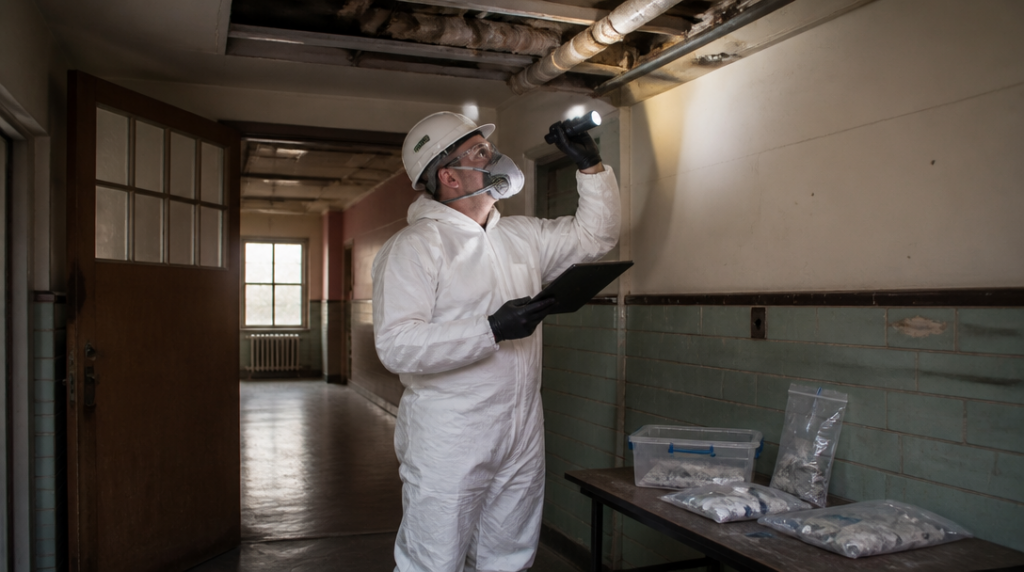
A surveyor can hold an environmental credential and still be unqualified to inspect asbestos. For schools, public buildings, and commercial properties, the decisive question is whether the individual has the right asbestos accreditation for the work, not whether their business card carries an impressive environmental title.
That distinction matters because asbestos surveys are not interchangeable. A person trained to supervise removal work is not automatically qualified to inspect a building, and someone who can collect samples may not be authorized to prepare a management plan or design a project. Hiring the wrong specialist can leave gaps in the survey just when a renovation, demolition, or regulatory review puts the building under scrutiny.
Start by asking for the surveyor’s exact asbestos credential. In the United States, the major accreditation categories include worker, contractor or supervisor, inspector, management planner, and project designer. A building survey requires the inspector qualification. If the project involves a school or another public or commercial building, the inspector should also hold valid accreditation under the applicable AHERA and TSCA requirements. A general “environmental assessor” license is not a substitute.
Ask to see the actual certificate rather than relying on a company website or a verbal assurance. The document should identify the individual, the discipline, the date of issue, and the expiration date. You should also ask which approved training course the inspector completed and whether the required examination was passed. State programs must meet at least the level of rigor set by the EPA Model Accreditation Plan, but the details still vary by jurisdiction. A surveyor who worked legally in one state may need additional approval, registration, or documentation in another.
This is a small administrative check with large practical consequences. An expired certificate, a missing state requirement, or the wrong discipline can undermine the usefulness of an otherwise polished report. Think of it as checking a pilot’s license before boarding a plane: the fact that someone has flown before does not tell you whether they are cleared for this aircraft, this route, or this flight.
The next question is whether the surveyor’s experience matches the building. A small office, a prewar school, an industrial site, and a residential block can contain very different materials and construction histories. A competent inspector should be willing to discuss the building’s age, later alterations, heating and ventilation systems, floor finishes, insulation, roofing materials, fireproofing, pipe runs, electrical equipment, and areas that may be inaccessible during the first visit.
Be wary of a survey that appears to be based mainly on a quick visual walk-through. Asbestos may be hidden beneath flooring, inside walls, around boilers, within pipe insulation, above suspended ceilings, or in materials disturbed only when a wall or ceiling is opened. The inspector should define the scope clearly and explain what was inspected, what could not be accessed, and where limitations remain. “No asbestos observed” is not the same statement as “all suspect materials were investigated and sampled where required.”
A useful proposal should describe the intended survey rather than simply promise an “asbestos inspection.” For a renovation, the survey needs to reflect the areas affected by the planned work, not just the rooms that look accessible. For demolition, the inspection must be sufficiently thorough to identify regulated asbestos-containing material throughout the structure. The surveyor should review available drawings and renovation information when those records exist, but paperwork cannot replace a physical inspection.
Sampling is another point where low-cost offers can become expensive mistakes. The number and location of samples should follow the material’s appearance, use, and distribution across the building. A single sample from one visibly similar surface may not represent every layer, room, or phase of construction. The inspector should explain which materials were treated as homogeneous areas, which samples were collected, and why particular locations were selected.
The final report should record the survey’s scope, inaccessible areas, observed suspect materials, samples taken, laboratory results, and the location of each material. Photographs and floor plans can make the findings far more useful during construction, especially when several contractors will rely on the same document. A report that merely states “asbestos detected” without identifying where the material is located does little to protect workers or control costs.
Pay close attention to the laboratory. Ask for samples to be analyzed by a laboratory accredited through NVLAP, the program used to identify laboratories qualified for asbestos analysis. The report should connect each laboratory result to a sample number and a physical location in the building. You should be able to follow the chain from the suspected material, to the sample, to the analysis, and then to the conclusion in the survey.
Independence is useful here. If the same company performs the survey, recommends removal, and receives the removal contract, its financial incentives are not necessarily aligned with yours. That arrangement is not automatically improper, but it deserves questions. A surveyor who clearly separates inspection findings from removal recommendations is easier to evaluate. The report should describe what was found before discussing what may need to happen next.
Price deserves scrutiny, not automatic trust. A survey that costs less because it covers fewer areas, collects fewer samples, or excludes difficult spaces may not be a bargain. At the same time, a high fee does not prove thoroughness. Compare proposals by scope, credentials, sampling strategy, laboratory arrangements, turnaround time, and the format of the final report. Two quotes that differ by hundreds or thousands of dollars may be describing entirely different services.
For demolition and major renovation, regulatory thresholds make this comparison more concrete. Federal NESHAP rules require a thorough inspection before demolition or renovation. The federal exemption from removal requirements is tied to quantities below 260 linear feet, 160 square feet, or 35 cubic feet of regulated material. Those figures are thresholds, not shortcuts for guessing whether a building contains asbestos. A survey must establish what is present and how much may be affected by the work.
School projects carry an additional scheduling concern. A demolition notification must be submitted at least 10 days in advance. The same advance notice applies to renovation work that exceeds the 260-linear-foot, 160-square-foot, or 35-cubic-foot thresholds. A late survey can therefore delay the entire project, while an incomplete survey can create safety problems after contractors have already mobilized. Selecting the inspector only after the construction schedule is fixed is a common way to lose time.
Ask prospective surveyors how they handle areas that cannot be accessed, concealed materials, changes in the renovation plan, and unexpected discoveries during construction. Their answers reveal more than a generic statement about compliance. A careful professional will distinguish between what the survey proves, what it reasonably indicates, and what still requires investigation. They should also explain whether a supplemental survey will be needed if the project expands beyond the original work area.
References can help, particularly when they come from clients with comparable buildings and similar project pressures. Ask whether the survey was used for a school renovation, commercial demolition, industrial maintenance project, or another setting relevant to yours. Find out whether the report was accepted by the building owner, contractor, and regulators, but do not treat a list of familiar clients as a replacement for checking the inspector’s current credentials.
The strongest choice is usually not the most prominent firm or the cheapest quote. It is the surveyor who can show the right inspector accreditation, satisfy the state’s specific requirements, define the inspection boundaries, use an appropriately accredited laboratory, and produce a report that a contractor can actually work from. Before signing, ask to see a sample report with confidential details removed. Its structure will quickly show whether the firm documents real fieldwork or simply delivers a template with a reassuring cover page.