
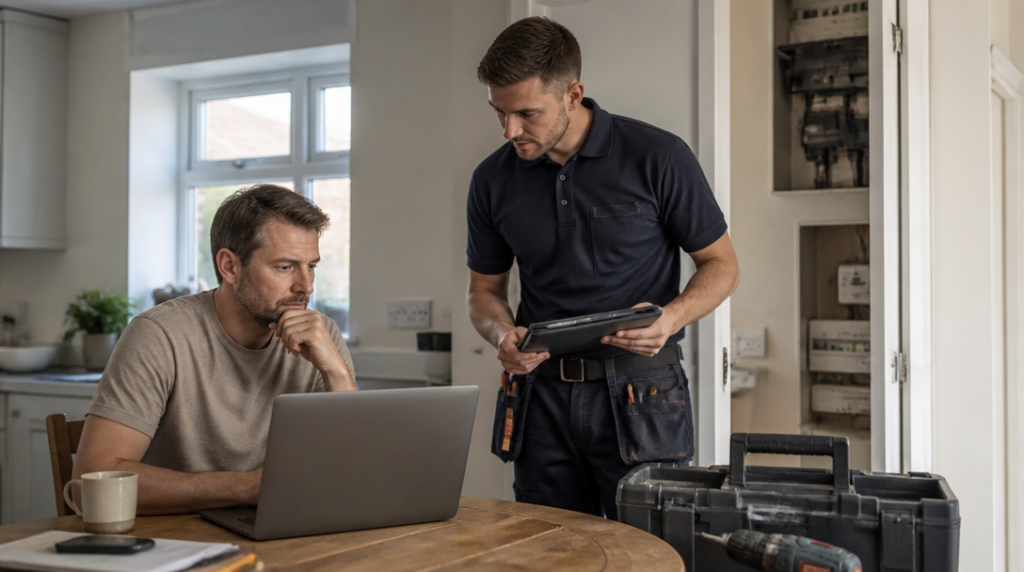
The electrician arrived just after eight, carrying a neat black toolbox and a confident answer for every question. He also had a NICEIC badge printed on his business card. The homeowner glanced at it, nodded, and let him start work.
Two days later, she discovered that the company name on the card did not match the business name on the paperwork. The badge had looked convincing. Checking the registration would have taken less time than making a cup of tea.
Start with the NICEIC search tool
The most direct way to check a business is through NICEIC’s Find a Trusted Tradesperson tool. Search for the electrician’s trading name, company name or, where relevant, the name of the sole trader.
A genuine result should give you more than a green tick or a reassuring label. Check that the registered business address and contact details match the information the electrician has given you. A mismatch does not automatically prove wrongdoing, but it is a reason to pause and ask questions before agreeing to the work.
Business names can be surprisingly similar. “A1 Electrical Services” might sound distinctive until several companies in the same area use almost the same wording. Search carefully, compare telephone numbers and addresses, and avoid selecting the first result simply because the name looks familiar.
The NICEIC database is updated every 24 hours, so the information should be relatively current. That does not remove the need to check the details, especially if the electrician says the registration was obtained or renewed very recently.
What to do if the electrician does not appear
Failure to find a business in the search tool does not necessarily mean that it is unregistered. Some firms do not appear in the online search, so do not treat an empty result as the final answer.
NICEIC can be contacted on 0333 015 6625 for help checking a registration. The telephone service is available Monday to Friday, from 9:00 am to 5:00 pm.
Have the electrician’s full business name, trading name and contact details ready. If the company has supplied a registration number or certificate, keep that nearby as well. The clearer the information you provide, the easier it should be to distinguish the right business from another firm with a similar name.
It is better to make the call before work begins. Once cables are under floors and new consumer-unit equipment is installed, sorting out a registration dispute becomes far more awkward and expensive.
Check what the registration actually covers
NICEIC registration is not a universal licence for every kind of electrical job. You need to check whether the firm holds the appropriate NICEIC scheme for the work you want carried out.
That distinction matters. An electrician may be properly registered for one area of electrical work but not for another. A domestic rewiring project, work involving a particular type of installation, and work subject to specific notification requirements may not all sit under the same scheme.
Ask the electrician which NICEIC scheme covers your project. Then compare that explanation with the information in the official search result or confirm it by telephone. A vague answer such as “we are NICEIC approved, so everything is covered” should not settle the matter.
The wording on paperwork matters too. If a quote describes a job as a full rewire but the registration information refers only to a narrower category of work, ask for clarification before signing anything. A tidy logo cannot fill that gap.
Registration belongs to the business, not every person on the team
One detail often causes confusion: NICEIC certifies the firm, not each individual employee. If a registered electrical company sends two electricians to your home, the registration belongs to the company that employs or engages them.
For a sole trader, the registration applies directly to that individual. The distinction is useful when a business owner says, “I’m registered,” but a different person arrives to carry out the work. Ask which company is responsible for the job and whose registration covers it.
This is also why the name on the quote, invoice and certificate should make sense alongside the name in the NICEIC search result. If the paperwork is issued by an unrelated business, you need to know why. Subcontracting arrangements may exist, but they should be explained rather than left for you to discover later.
A quick check of the person’s name alone can be misleading if the registration is held by a company. Search the business first, then ask how the electrician working at your property is connected to it.
Ask for details before accepting the quote
A registration check is only one part of choosing an electrician, but it gives you a firm starting point. Before accepting a quote, ask for the legal or trading name of the business, its registered contact details and a clear description of the work.
The quote should say what is included. That might cover the replacement of a consumer unit, testing, fault finding, new circuits or repairs to existing wiring. If the description is no more specific than “electrical work,” it leaves too much room for disagreement later.
Ask who will carry out the work and who will issue the electrical certificate. If another company is responsible for the installation, that should be clear before anyone arrives with a drill.
Do not be embarrassed about asking for documents. A reputable electrician should expect customers to check registration, insurance and the scope of the proposed work. In my experience, the awkward question at the start is much easier than the awkward phone call after a problem appears.
Check the insurance position
NICEIC requires public liability insurance of at least £2 million. You can ask the business to confirm that its policy is current and covers the work being proposed.
Insurance is not a substitute for registration, and registration is not a substitute for reading the policy details. The important point is to make sure the business you are hiring is the business named on the insurance documents and the quote.
If the electrician refuses to discuss insurance or says that the NICEIC badge makes the question unnecessary, treat that as a warning sign. A professional relationship should not depend on taking everything on trust.
Watch for mismatched details
Several small inconsistencies can reveal a problem before the work begins. The name on a van may differ from the name on the quote. The telephone number may lead to a different business. The registration result may show an address in another part of the country, while the electrician claims to operate from your town.
None of these details proves that the electrician is dishonest. Businesses move, trade under different names and use shared offices. The sensible response is to ask for an explanation and make sure the answer appears on the paperwork.
Be cautious if someone produces a certificate with a logo but refuses to let you verify the business through the NICEIC search tool. A document can be copied or shown out of context; the registration record is a better place to begin.
Pressure is another useful clue. “Book today or the price changes” is not a registration issue, but it is a poor reason to skip basic checks. Electrical work is too hidden and too costly to commission at speed just because a stranger wants an immediate decision.
What the check can and cannot tell you
A NICEIC search can confirm that a business is registered and help you identify the relevant contact details and scheme. It cannot tell you whether the quote is good value, whether the electrician communicates well or whether the proposed design is suitable for your property.
You still need to discuss the job in plain language. Ask what will be changed, what will remain, whether the power needs to be switched off and what testing will take place afterwards. For larger work, get the scope and price in writing rather than relying on a conversation at the front door.
You should also keep copies of the quote, invoices, certificates and any messages about changes to the work. If the electrician says the job has expanded, ask why and request the revised cost before agreeing to it.
The registration check takes only a few minutes, but it changes the conversation. Instead of asking whether a badge looks genuine, you are checking a business name, an address, contact details, the correct scheme and the insurance position. That is a much stronger place to start before the first cable disappears behind the plasterboard.