
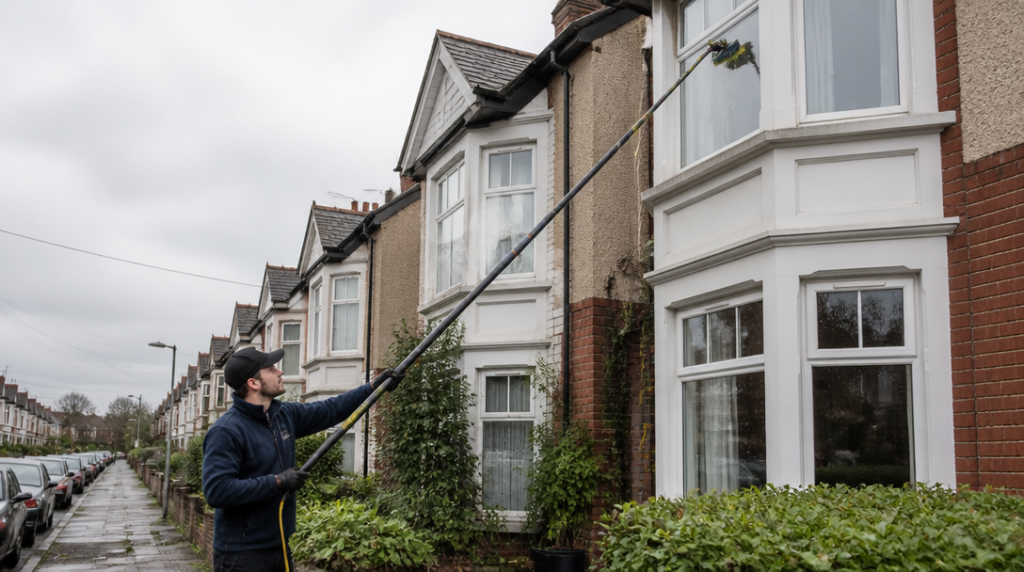
A small terraced house may pay from £30 for a visit, while a large commercial building can receive a bill of £500 or more. Both jobs are described as “window cleaning”, but the comparison ends there: one might take a short visit at ground level, while the other involves difficult access, specialist equipment and far greater liability. So what should a typical UK customer expect to pay in 2026?
For an ordinary house, the answer is usually around £25–£40 per visit. That range sounds straightforward until you ask what “ordinary” means. Does it include the front and back of the property? Are conservatory windows included? Can the cleaner reach every pane from the ground, or will ladders, poles or other equipment be needed? A low headline price can become less attractive once the awkward windows are excluded.
Property type provides a useful starting point. Prices begin at about £30 for a terraced house, £35 for a semi-detached house and £40 for a detached house. These are not fixed national tariffs, and they do not describe every property in those categories. A compact terraced home with easy access may cost less than a sprawling semi-detached house with extensions, roof windows and a conservatory. Still, the figures show how size and access begin to shape the quote before anyone has counted individual panes.
The hourly rate offers another way to test the numbers. A typical window cleaner charges roughly £25–£40 an hour. That does not mean a cleaner will necessarily quote by the hour. Many prefer a price per property or per visit because customers want a clear figure and cleaners need to account for travel, setup and equipment. The hourly rate is more useful as a reality check: if a job is unusually large or difficult, a £30 fixed quote may not be commercially plausible unless the cleaner expects to finish quickly or is already working nearby.
That is where the cheapest quote deserves a closer look. Is the cleaner pricing the whole job, or only the easiest windows? Is the first visit discounted to win the work, with regular cleans priced differently later? Does the quote cover frames and sills, or just the glass? A window may look clean from the pavement while its frames still carry a dark line of grime. Customers often discover the difference only after the work is finished.
A one-off clean tends to cost more than a regular arrangement because the first visit may involve built-up dirt, neglected frames and windows that have not been touched for months. For a small house, a one-time clean can cost anywhere from £30 to £150, depending largely on the number of windows and how easy they are to reach. That is a broad spread, but the work itself can be radically different. A modest home with accessible windows sits at one end; a property with high panes, a conservatory or difficult rear access moves towards the other.
Frequency also changes the economics. Regular customers may receive a lower per-visit price because the cleaner can work faster on maintained windows and schedule nearby properties on the same route. The arrangement benefits both sides, but it can make price comparisons misleading. One household may quote a single deep clean, while another is describing a recurring service every few weeks. They are not buying the same thing, even if both ask for “window cleaning”.
The cleaning method matters too, though it is not always visible in the final invoice. Water-fed poles allow many residential windows to be cleaned from the ground, reducing the need for ladders and making upper-storey work more practical. Traditional methods may still be used for certain windows or interiors. Neither approach automatically guarantees a better result. What matters is whether the equipment suits the building and whether the cleaner can safely reach the glass without leaving missed sections behind.
Interior cleaning can push up the cost, particularly if the customer wants both sides of every window. Cleaners may need to enter each room, move furniture, remove blinds or protect flooring. External-only service is often quicker and easier to price. This distinction should appear clearly in a quote, yet it is exactly the sort of detail that disappears when customers compare two numbers in a text message.
Location adds another layer. London prices are typically about 20% higher than those elsewhere in the UK. That difference is not mysterious: labour, transport and operating costs are higher, and time lost in traffic can affect how many properties a cleaner reaches in a day. But a city address alone should not be treated as a blank cheque. A London customer with a straightforward terraced house may still have an easier job than a rural property with poor access, long travel distances or challenging terrain.
Regional variation exists beyond the capital, although it is harder to reduce to a single neat percentage. Dense urban areas may support efficient routes between nearby homes, while remote areas can involve more driving and fewer appointments per day. Two cleaners with similar hourly rates may therefore produce different property quotes. The distance between jobs is part of the business, even if customers never see it on the invoice.
Commercial window cleaning operates on a different scale. A typical commercial job may cost between £100 and £500, while large sites can exceed £500. The size of the building matters, but so do the number of floors, the amount of glass, operating hours and the equipment required. A small shopfront is not comparable with an office block, school or warehouse. Even within one building, a ground-floor frontage and a high-level glass façade may require entirely different methods.
Commercial clients also pay for coordination. Work may need to happen before opening hours, after staff have left or during a narrow access window. Cleaners may have to manage pedestrians, vehicles, security procedures and other contractors. Where elevated work is involved, the risk is greater and the planning more demanding. A quote that looks expensive beside a domestic visit may reflect the cost of controlling those practical hazards rather than simply charging more for the same number of windows.
This is why the phrase “cost per window” can create a false sense of precision. Ten easily reached panes are not necessarily cheaper to clean than six awkward ones above a conservatory. A glass roof, skylight or upper-floor window can take more time than several accessible panes at ground level. The physical count tells only part of the story; access often determines the rest.
Customers should ask for the details in writing before accepting a quote. The useful questions are simple: how many windows are included, are frames and sills covered, is interior cleaning part of the price, and will difficult or high-level glass cost extra? It is also sensible to ask whether the quoted amount is for a one-off clean or a recurring visit. A vague promise to “sort the windows” leaves too much room for disagreement.
There is a temptation to choose the lowest figure immediately, especially when the job appears routine. But a suspiciously cheap quote may signal limited scope, rushed work or a cleaner who has not properly assessed access. The opposite mistake is assuming that the highest price represents superior workmanship. A more expensive quote can reflect genuine complexity, but it can also be an inflated estimate. The only useful comparison is between clearly defined services.
For most UK households, budgeting around £25–£40 for a standard recurring visit is a reasonable starting point in 2026. A terraced home may begin near £30, a semi-detached property near £35 and a detached house near £40, while one-off work can range much more widely. Once the windows rise above the ground, the property expands, or the job moves into the commercial world, the neat domestic price guide quickly stops being enough. The glass may be the visible part of the job, but access is where the money is made.