
A tree is leaning toward the garage after a storm, one large limb is hanging over the roof, and the first question is simple: how much will removal cost? The answer may be around $750, or it may be several times that amount. Tree removal prices are shaped less by the tree’s name than by the work required to bring it down safely.
In the United States, the average cost of tree removal in 2026 is about $750. Most jobs fall somewhere between $200 and $2,000. That range is wide because a small tree in an open backyard is a completely different job from a tall tree wedged between a house, a fence, and overhead power lines.
A very small tree may cost around $150 to remove. At the other end of the scale, a complicated removal involving a very large tree can reach $10,000. The average is useful as a starting point, but it should never be treated as a fixed price for every property.
The tree itself sets the starting point
Size is the first thing a tree surgeon, also called an arborist in the United States, will assess. A tree’s height affects how much material must be cut and lowered. Its trunk diameter affects the weight of each section. A broad crown may require more climbing, rigging, and cleanup than a narrow one of similar height.
The trunk’s diameter is especially useful when comparing estimates. A public 2026 price schedule listed removal of a 24-inch-diameter tree at roughly $1,300 to $2,335. For a 30-inch tree, the listed range was about $1,500 to $3,598. Those figures show why an apparently small increase in trunk size can push a job into a different price bracket.
The measurement is taken across the trunk, not around it. That distinction matters because people sometimes describe a tree as “24 inches around” when a professional quote is based on diameter. If you are checking an estimate, make sure you know which measurement the contractor used.
Tree species can matter too, although it is rarely the only factor. Some wood is heavier or harder to cut, while a tree with multiple trunks may take longer to dismantle than a single straight trunk. A dead tree can be particularly awkward because its branches may be brittle and unpredictable. A living tree is not automatically easy, either; a tall, healthy tree beside a building may require careful sectional removal rather than a simple cut at the base.
Location can change the price faster than size
Imagine two trees with the same trunk diameter. One stands in the middle of a clear field. The other is beside a house, with branches above a driveway and a narrow passage leading to the street. The second tree is likely to cost more because the crew has fewer safe places to drop the wood.
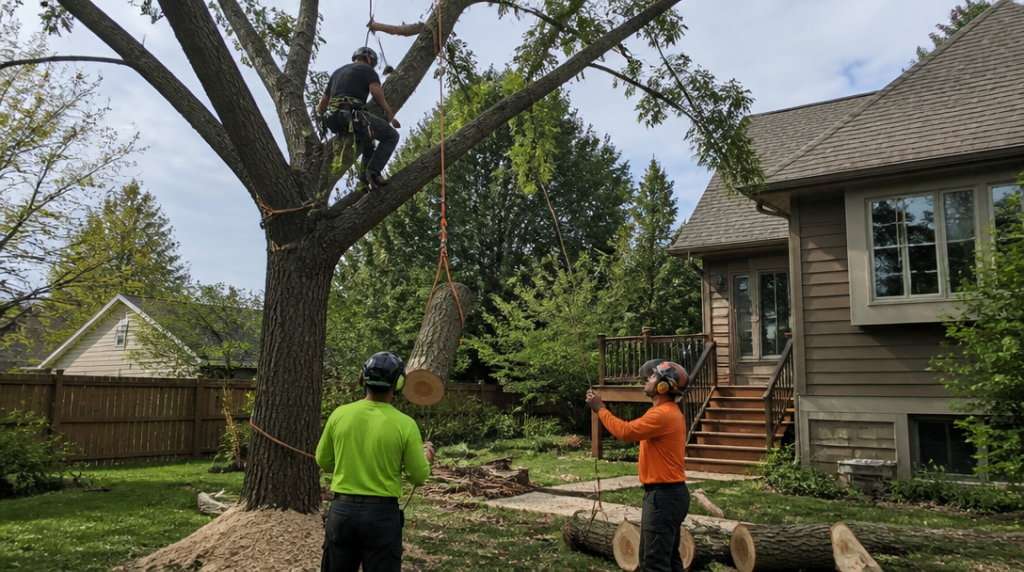
When there is no room for a controlled fall, workers may need to climb the tree, cut it into sections, and lower those sections with ropes or lifting equipment. A bucket truck or crane may be needed in especially restricted spaces. The equipment is not a decorative extra on the invoice; it is what prevents large pieces of wood from landing on the roof, driveway, garden wall, or neighboring property.
Access also affects labor. A truck parked directly beside the tree makes loading easier. A tree at the back of a fenced yard may require every branch and log to be carried out by hand. Soft ground, steep slopes, narrow gates, and landscaping that must be protected all add time.
Power lines deserve particular attention. A contractor may need to coordinate around electrical infrastructure or use specialized methods to keep branches away from live wires. Homeowners should not treat a tree near power lines as a suitable project for a general gardening crew with a chainsaw. The risks are too high, and the insurance consequences can be serious if something goes wrong.
The most expensive tree is often not the tallest one. It is the one with the least room for error.
What the quoted price may include
“Tree removal” does not always mean the same package. One estimate may cover cutting the tree down and leaving the logs on site. Another may include cutting the trunk into manageable pieces, chipping the branches, hauling everything away, and sweeping the work area.
Ask for the quote to separate these services. If branches are chipped and removed, that should be clear. If the trunk will remain in large sections for you to use as firewood, that should be clear too. Some crews include basic cleanup but charge extra for hauling heavy wood or spreading wood chips.
The remaining stump is often priced separately. Stump removal averages about $195 to $609, commonly calculated at roughly $2 to $5 per inch of stump diameter. A wide stump can therefore cost more than a small tree removal customer expects, especially if the stump is close to a wall, patio, or buried utility line.
Stump grinding and complete stump removal are not identical. Grinding reduces the stump below ground level and leaves wood chips behind. Full removal may involve digging out the stump and some of the roots, which can disturb more soil. If you plan to build, pave, or replant in the same spot, ask which method the estimate describes.
The roots usually do not need to be excavated simply because the tree has been cut down. That work is more disruptive and is generally considered only when the site has a particular use planned for it. The important point is to decide before work begins, not after the crew has already loaded the equipment.
Why emergency removal costs more
A storm-damaged tree creates a different kind of job. Branches may be suspended over a roof, the trunk may be partially uprooted, or the tree may have shifted against another tree. Working conditions can be unstable, and the contractor may need to respond quickly while demand is high.
Emergency removal after a storm can cost up to $5,000. The final bill depends on how dangerous the tree is, whether it has damaged a structure, how much debris must be cleared, and whether access is blocked. A fallen tree lying across an open lawn is not the same as a split tree resting on a house.
If a tree has struck a building, stay clear of the area until it has been assessed. A branch that looks motionless can still be under tension, and cutting the wrong section can release that force suddenly. In a storm emergency, the cheapest quote is not necessarily the safest choice; experience with hazardous removals matters more than a polished estimate that leaves out essential work.
How to compare estimates without comparing the wrong things
Start by describing the job consistently to each company. Send the same photographs, identify the tree’s approximate height and trunk diameter, and mention nearby buildings, fences, driveways, and power lines. If one contractor sees a difficult access problem that another has missed, the estimates may not be measuring the same task.
A written quote should explain what will happen to the branches, trunk, and stump. It should also identify extra charges that could appear if the crew finds hidden complications. You do not need a long legal document for a straightforward removal, but you do need enough detail to understand what you are buying.
Insurance and qualifications are worth checking before anyone starts cutting. Ask whether the company carries liability insurance and workers’ compensation coverage where required. You can also ask who will perform the climbing or rigging work. A company that cannot explain its plan clearly is not made more reassuring by offering a very low price.
Do not judge an estimate by the total alone. A $900 quote that leaves the wood, stump, and cleanup to you may be more expensive in practice than a $1,300 quote that includes the full site cleanup. On the other hand, you should not pay for services you do not need. If you want to keep firewood or leave wood chips for garden paths, say so before the quote is written.
A practical way to budget
For a small, accessible tree, begin with the possibility of a few hundred dollars. For a typical removal, the national average of $750 gives you a rough reference point. A large tree near structures may push the price beyond $2,000, and the public 2026 figures for 24-inch and 30-inch trees show how quickly larger removals can climb.
Then add the pieces that are often left out of the first mental calculation: stump work, hauling, difficult access, special equipment, and emergency timing. A homeowner who budgets only for the cutting may be surprised by the cost of making the yard usable again.
The clearest estimate describes the tree, the hazards, the removal method, the cleanup, and the stump in plain language. Once those details are visible, the price becomes much easier to understand than a single number at the bottom of a page.