
What should a homeowner expect to pay for solar in 2026—and how can two companies quote thousands of dollars apart for what appears to be the same system?
In the United States, the answer starts with system size, but it does not end there. A 4-kilowatt installation costs about $11,560 before incentives, while a 6-kilowatt system averages roughly $16,080. A 10-kilowatt system reaches around $25,800, and a 12-kilowatt installation averages about $30,720.
Those figures translate to approximately $2.58 to $2.89 per watt for typical systems. That price includes far more than solar panels on a roof. It covers inverters, mounting equipment, design work, labor, permits, inspections, and the connection to the local electric grid.
The uncomfortable question is whether homeowners are being charged for a genuinely difficult installation—or simply paying for a sales process designed to make solar seem more expensive than it needs to be.
The system size changes the bill faster than most homeowners expect
Solar companies usually price systems by their capacity in kilowatts. A larger system produces more electricity, but it also requires more panels, more racking, a larger inverter, and potentially more complicated electrical work.
The jump from 4 kW to 6 kW adds about $4,520 to the typical price. Moving from 6 kW to 10 kW adds nearly $9,720. That is not a perfectly linear increase, because some costs—such as design, permitting, and administrative work—do not double when the system does.
A 4-kilowatt system may suit a smaller home with modest electricity use. A larger household with electric heating, air conditioning, a heat pump, or an electric vehicle may need 10 kW or more. Roof orientation and shade matter just as much. A south-facing roof with clear sun exposure can produce more electricity from the same number of panels than a roof interrupted by chimneys, trees, or neighboring buildings.
That makes the cheapest quote meaningless if the system is undersized. A low price can simply mean fewer panels and a smaller expected output. Conversely, a large system may look expensive because it is designed to cover electricity use that a smaller installation cannot handle.
The right comparison is not just the total price. Look at the system’s capacity, estimated annual production, equipment specifications, warranty terms, and the assumptions behind the electricity savings. A quote promising an impressive payback period deserves scrutiny if it relies on unusually optimistic production or utility-rate forecasts.
The panels are not the whole installation
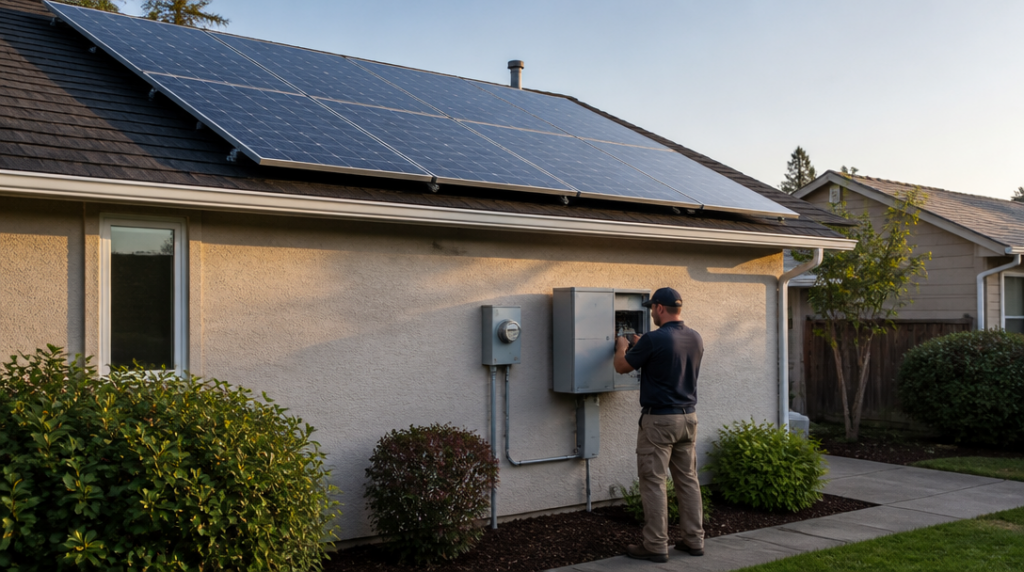
For an average 12-kilowatt system, installation labor, permitting, and grid interconnection account for about $4,670. Labor makes up approximately $2,179, while permits and interconnection account for about $2,491.
That is a substantial slice of a $30,720 project, yet it is easy to overlook because the panels dominate the visual pitch. Homeowners see rows of black modules in a glossy proposal. They do not see the engineering review, municipal paperwork, utility requirements, inspection delays, or the electrician’s work inside the home.
Some roofs make installation slower and riskier. Steep pitches, multiple roof sections, fragile roofing materials, cramped electrical panels, and long cable runs can all raise labor costs. An older home may need an electrical panel upgrade before the solar system can be connected. That work is not always included in the first price a salesperson mentions.
Batteries create another major cost difference. A solar-plus-storage proposal can be far more expensive than a panel-only installation because it adds the battery, control equipment, additional labor, and often more complex electrical work. Storage may be valuable during outages or in areas with time-based electricity rates, but it should not be treated as an automatic part of every solar purchase.
The same caution applies to roof replacement. Installing panels on a roof near the end of its useful life can turn a future repair into a costly removal-and-reinstallation project. Replacing the roof first may be sensible, but it changes the true price of going solar.
Location can move the price by thousands of dollars
Solar pricing varies sharply from state to state. In the second half of 2024, the median residential photovoltaic quote in Massachusetts was 36% higher than the median quote in Arizona.
That gap is not explained by geography alone. The typical system in Massachusetts was smaller, at 10.5 kW, compared with 13.6 kW in Arizona. Local labor rates, permitting practices, market competition, roof styles, weather conditions, utility rules, and installation complexity all affect the final number.
Arizona’s abundant sunshine does not guarantee a cheap project, nor does Massachusetts’ cloudier climate make solar financially pointless. The economics depend on how much electricity the system produces, what the household pays for grid electricity, and how the utility compensates customers for excess generation.
Local rules can also determine how quickly a system becomes operational. A project may be physically complete while waiting for inspection or permission to operate. That delay does not necessarily indicate poor workmanship, but it can postpone the point at which the homeowner starts generating electricity.
This is why national averages are useful only as a rough measuring stick. A quote well above the national range may be reasonable for a difficult roof in a high-cost market. A quote below it may reflect a stripped-down system, missing services, or a contract that leaves important costs for later.
The 2026 tax-credit problem changes the calculation
Many older solar cost estimates assume a 30% federal residential clean-energy tax credit. New residential installations no longer receive that credit for expenditures after December 31, 2025, so it should not be subtracted from a new 2026 quote.
That change makes the headline price more important than it was in previous years. A $25,800 system is not a $18,060 system simply because an old calculator still displays a 30% reduction. Homeowners should ask exactly which incentives remain available in their state, utility territory, or local area and whether the project qualifies under the relevant rules.
The distinction between a tax credit and a rebate also matters. A tax credit reduces tax owed under the applicable rules; it is not the same as an instant discount from the installer. A rebate may have separate eligibility requirements, funding limits, or application deadlines. Treating every incentive as guaranteed cash can produce a dangerously attractive payback calculation.
Financing deserves the same level of suspicion. A loan with a low monthly payment may stretch repayment over many years or include fees that are hidden inside the principal. Some proposals encourage homeowners to make a large early payment based on an expected tax benefit. That strategy becomes especially risky when the assumed federal credit does not apply.
Cash pricing can be confusing, too. In the second half of 2024, the median quoted price for residential solar was $2.65 per watt, while the median price for a system purchased with cash was $3.50 per watt. Those figures are not interchangeable measures of the same thing. They reflect different purchasing and financing arrangements, so a homeowner should ask what the quoted price includes before comparing it with a neighbor’s project or an online estimate.
A fair quote should survive a hostile reading
A serious proposal should show the system size, expected annual production, panel and inverter models, roof areas, estimated timeline, warranty coverage, and every major cost. If the salesperson cannot explain why the system needs a particular capacity, the number may have been chosen to fit a financing target rather than the home’s electricity use.
Get several written quotes, but do not choose by price alone. Compare the cost per watt and the projected production, then examine the assumptions behind those projections. A slightly higher quote may include a better inverter, stronger workmanship coverage, or a necessary electrical upgrade that a cheaper competitor has ignored.
Ask whether the contract includes permitting, utility interconnection, inspection, monitoring equipment, roof repairs, panel removal, and system commissioning. Ask what happens if the utility rejects the proposed design or if the installation reveals a problem with the electrical panel.
Be wary of anyone promising a guaranteed payback period without reviewing your bills and utility rate structure. Solar is not a magic appliance that produces the same financial result in every house. It is a long-lived energy project tied to a roof, a local utility, and a contract that may outlast the salesperson who presented it.
The most revealing part of a solar quote is often the section no one discusses: what happens when something goes wrong. A company willing to spell out responsibility for damaged roofing, failed equipment, delayed interconnection, and future service is offering more than a row of panels. A company that rushes past those details may be offering an expensive lesson in fine print.