
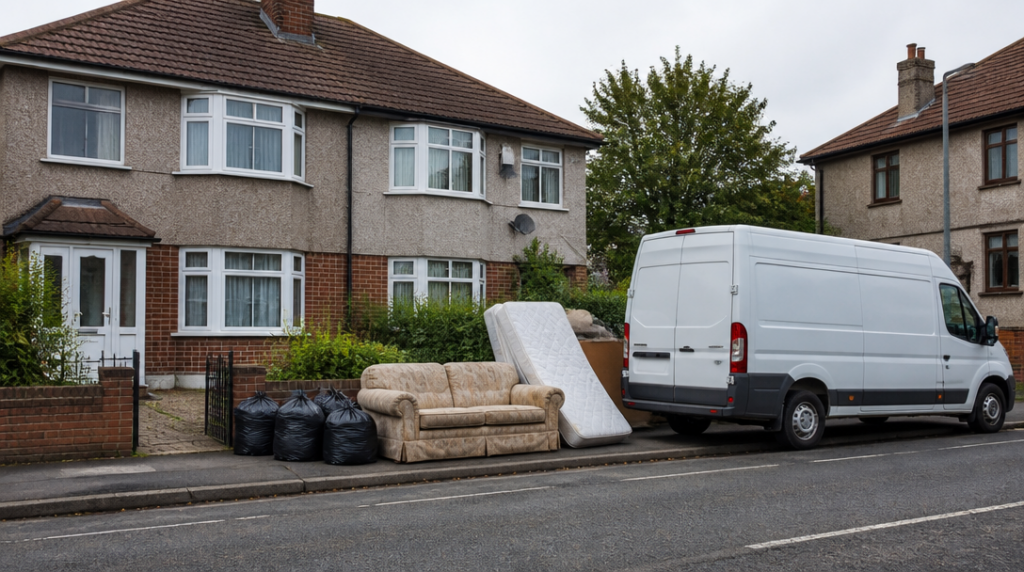
One person may pay £30 to have a few bulky items collected. Someone clearing an entire house could face a bill running into hundreds of pounds. Both jobs are commonly described as “rubbish clearance”, but they are not the same service.
That difference explains why UK prices can look confusing. Council collections are usually designed for a small number of large household items. Private companies may clear rooms, lofts, garages or whole properties, then load, transport and dispose of everything themselves.
Council bulky-waste collection prices
For a sofa, mattress, wardrobe or appliance, the local council is often the cheapest place to start. The catch is that each council sets its own charges, item limits and collection rules. Two neighbouring areas can offer noticeably different prices.
Thanet provides a relatively low-cost example for 2026. From 1 April 2026, the charge is £30 for up to three items or ten black bags. A larger collection of up to five items or fifteen bags costs £39.
Those limits matter. A pile that looks manageable in a garden may exceed the council’s allowance once every bag, chair and broken cupboard is counted. The collection may then need to be split into separate bookings, or you may need another option for the excess.
Test Valley’s 2026/27 rates are higher for a small collection. One item costs £39, while more than one item, up to a limit of four, costs £70. That can still be reasonable for a handful of large objects, especially if they are ready outside and easy for the collection crew to access.
Hart charges £50 for one item during 2026/27. The price rises to £119 for five items and £187 for eight. This is a good illustration of how quickly the bill can grow when the collection moves beyond a single mattress or appliance.
Stratford-on-Avon takes a different approach. Its 2026/27 charge is £51 for one to three items and £62 for four to five items. In that area, adding a couple of extra items makes a relatively small difference to the total.
Bromley has a minimum charge of £43 for a domestic bulky-waste collection. A commercial collection starts at £56, showing that the price can change depending on whether the rubbish comes from a home or a business.
These figures are for local-authority bulky-waste services, not the standard price of a private company clearing an entire property. That distinction is the first thing to check before comparing quotes.
What private rubbish clearance usually costs
Private clearance companies tend to price the job according to volume, labour and disposal requirements. A small collection of a few items may cost around the same as a council service, or more if the company has to carry items down stairs, dismantle furniture or travel a long distance.
A full house clearance is a different calculation. The company may need several workers, a van or multiple vehicle loads, and several hours on site. The cost can rise further if the property contains heavy furniture, large quantities of mixed waste, building materials or items that require special handling.
For that reason, reputable companies often ask for photographs or arrange a visit before giving a fixed quote. A description such as “three rooms of rubbish” leaves too much open to interpretation. A loft packed with lightweight cardboard is not the same job as a garage filled with broken appliances and damp timber.
Access can have a surprisingly large effect on the price. A clear driveway makes loading quicker. A flat with no lift, a narrow passage or a property several streets away from the vehicle can add labour even when the volume of rubbish is modest.
The same applies to sorting. Clean furniture and ordinary household waste are relatively straightforward. Paint, chemicals, asbestos-containing materials, clinical waste and certain electrical items may require separate arrangements. A company that accepts them may charge more, while another may refuse them altogether.
The difference between a few items and a house clearance
A council collection works well when the rubbish is limited and clearly defined. You book a slot, follow the preparation rules and leave the agreed items where the crew can reach them. It is a practical solution for a mattress, sofa, fridge or a small group of bulky objects.
A private clearance is more suitable when the property itself needs emptying. That might happen after a move, a bereavement, a renovation or the end of a tenancy. The company can usually deal with mixed contents in one visit, which saves the owner from arranging several separate collections.
There is also the question of time. Council services may offer a fixed collection date, while a private operator may be able to attend sooner. If a tenancy is ending or a property sale is waiting on clearance, speed can be worth paying for.
Still, “same day” does not automatically mean “best value”. A fast quote may exclude disposal charges, extra labour or additional loads. The cheapest-looking offer can change once the crew arrives if the terms are vague.
What to check before booking
Ask exactly what the quoted price includes. Collection, loading, transport and disposal should be clearly covered, rather than left as separate additions. If VAT applies, the quote should make that clear too.
Describe the rubbish honestly. Mention the number of rooms, large items, bags, stairs, lifts, parking restrictions and anything potentially hazardous. Sending photographs is often the quickest way to prevent a disagreement on the day.
Check whether the company is prepared to leave the area swept and tidy. Some operators remove the waste and leave immediately; others include a basic sweep as part of the service. Neither approach is necessarily wrong, but the difference should be understood before payment.
Waste disposal is another important point. A low price is less attractive if the rubbish is dumped illegally or handled by an operator without the required permissions. Ask how the waste will be disposed of and keep the quote and payment record.
Council services also have conditions. Items may need to be placed outside, separated from other waste or prepared in a particular way. Crews may not enter the property, remove items from upstairs or collect waste that was not included in the booking.
How to keep the bill down
Separate reusable items before booking a clearance. Furniture in good condition, working appliances and usable household goods may be accepted by charities, reuse schemes or local buyers. Removing those items reduces the volume that needs paid disposal.
Do not mix a small council collection with a private house-clearance quote without comparing like for like. The council may be cheaper for three large items, while a private company may offer better value for a full vanload. The right comparison is based on the complete job, not just the headline fee.
If you use a private company, request a written fixed price where possible. Confirm whether the quote covers all labour, loading, travel and disposal. Also ask what happens if the actual volume is greater than expected.
Timing can help as well. A non-urgent collection gives you more room to sort, donate and compare companies. Leaving everything until the final day often turns a manageable job into an expensive emergency.
For a small amount of bulky waste, UK householders may pay roughly £30 to £50 through a council service, with larger council collections reaching well over £100 in some areas. A full private clearance has no single national price because the property, access, waste type and amount of labour shape the quote from the ground up.
The most useful question is not simply “How much does rubbish clearance cost?” It is “How many items need removing, from where, and by whom?” Once those details are clear, the price usually becomes much easier to judge.