
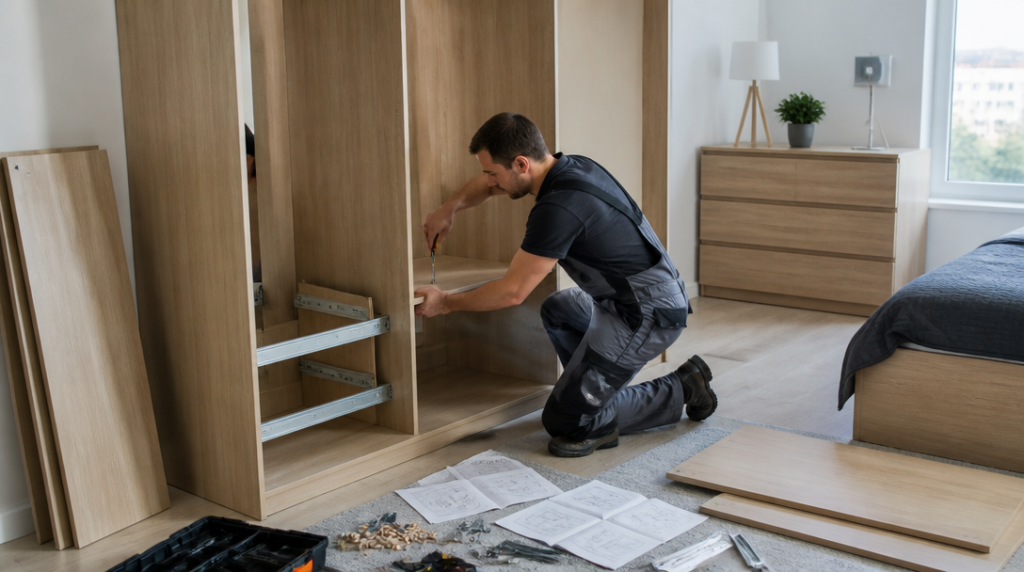
A flat-pack chair can cost about $32 to assemble, while a large piece of outdoor furniture may run close to $150. That contrast explains why professional furniture assembly is easy to underestimate: one person sees a quick afternoon task, while another sees hours of sorting hardware, interpreting instructions, and lifting awkward panels into place.
In the United States, professional assembly generally costs between $50 and $150 per piece in 2026. A commonly cited average is about $150 per item, although that figure can sit well above the price of smaller jobs. The gap is wide because “furniture assembly” covers everything from attaching four legs to a chair to building a tall wardrobe that requires careful alignment and a second pair of hands.
For a straightforward purchase, hiring help may feel excessive. Then there is the moment when the nearly finished cabinet leans slightly to one side, a drawer refuses to close, and three identical screws remain on the floor. That is usually when the value of professional labor becomes easier to understand.
The furniture itself is the first major price signal. Typical average prices are about $32 for a chair, $40 for a dresser, $48 for a table, $64 for a bed, $80 for a wardrobe, and $150 for outdoor furniture. These figures are useful as benchmarks rather than fixed menu prices. A basic dining chair and a large reclining chair may both be classified as chairs, but they do not demand the same effort.
The number of parts, the quality of the instructions, and the need for wall anchoring can all change the amount of work. A dresser with several drawers requires more than simply attaching its frame. Each drawer has to be assembled, fitted, and adjusted so that the fronts line up and the runners move cleanly. A wardrobe can involve tall panels, sliding doors, and limited room to maneuver. Outdoor furniture often includes several pieces sold as one set, which helps explain its higher average cost.
Beds occupy a middle position in many estimates, but size and design matter. A basic platform bed may be relatively manageable, while a storage bed with drawers or a headboard can take considerably longer. Large furniture can also require two workers. In that case, the labor cost may double because the job is no longer priced as a single-person task.
Pricing structure matters almost as much as the item. Some professionals charge by the piece, while handymen often bill by the hour. The average handyman rate is around $90 per hour, with a common range of $40 to $140 per hour. That range reflects differences in local labor markets, experience, insurance, travel, and the complexity of the work.
Hourly billing can be sensible if you have several unrelated tasks in the same home or if the furniture is difficult to assess in advance. It can be less comfortable for a single flat-pack item with unclear instructions, since the final total depends on how long the assembly takes. A fixed price gives more certainty, particularly for a standard product with a known assembly process.
Marketplace services often show a different hourly average. Task-based assembly work averages about $34 per hour, but the total invoice can still be substantial once the job duration and local conditions are considered. Average total bills reported for these services are about $180 in New York, $151 in Los Angeles, $134 in Chicago, and $142 in Miami. The figures show why an hourly rate alone does not tell the whole story. A lower rate does not automatically produce a lower bill if the furniture takes longer to build or the booking includes additional charges.
Location affects the price through more than wages. Dense cities may involve parking difficulties, elevators, longer travel times, and tighter apartments where assembly takes longer. A professional working in a spacious suburban room may complete the same item more quickly than someone working in a narrow city apartment with boxes blocking the only path to the bedroom. The product has not changed, but the job has.
Some retailers offer assembly as an add-on, while others direct customers to an outside service. IKEA’s assembly option through Taskrabbit has a minimum charge of $52, with the final price calculated as a flat fee based on the type and number of items. A minimum fee makes small jobs more expensive on a per-item basis. Paying $52 to assemble one inexpensive chair is a very different calculation from paying the same minimum toward several items in one order.
That is why grouping furniture can improve the economics. A professional may offer a volume discount when assembling multiple pieces, and discounts of roughly 10% to 30% can reduce the combined price. The savings are not guaranteed, but one appointment is often more efficient than several separate visits. Travel, setup, and cleanup happen once, while the worker can move from one item to the next without packing away tools between jobs.
Suppose a home needs a bed, dresser, table, and several chairs. Pricing each piece separately could make the total look intimidating, particularly if the provider applies a minimum charge to every booking. A bundled estimate may be more reasonable, especially when the furniture comes from the same retailer and the instructions are available in advance. Ask for the price of the complete project rather than adding up isolated item rates.
A quote should also make clear what “assembly” includes. Basic construction may not cover moving a heavy box from the delivery area, carrying furniture upstairs, removing packaging, disposing of cardboard, or attaching the finished piece to a wall. Those tasks may be available, but they can alter the invoice. Clarifying them before the appointment prevents the common disagreement that begins with, “I assumed that was included.”
The condition of the room can matter too. A worker needs enough space to lay out panels and hardware, and a crowded room slows the process. Preparing the area does not require anything elaborate: clear the floor, make sure the box is accessible, and keep the instructions and hardware together. If the product arrived damaged or missing parts, assembly may stop before it starts. Professional labor cannot compensate for a broken panel or a missing bag of fasteners.
A do-it-yourself comparison should include more than the advertised assembly fee. The alternative is not always free. It may consume several hours, require tools, involve a trip to replace a missing or damaged component, or result in a mistake that is expensive to correct. Furniture that looks simple in the box can be surprisingly unforgiving once panels are drilled, cam locks are tightened, or hinges are misaligned.
Still, professional assembly does not make sense for every purchase. A small, clearly designed item with few parts may be a reasonable weekend project. The financial case becomes stronger for large wardrobes, multi-drawer dressers, beds with storage, and furniture that must be lifted or positioned carefully. It is also stronger for people who lack the tools, time, or physical ability to handle the work safely.
The most useful budget range is therefore not a single number. For a basic piece, expect the lower end of the $50-to-$150 range. Mid-sized furniture such as beds, tables, or dressers often falls somewhere between a small-item minimum and the typical per-piece average. Large wardrobes, complex designs, outdoor sets, and two-person jobs can push the bill toward or beyond $150.
Before booking, describe the exact furniture, provide the product name or assembly instructions, mention stairs or difficult access, and ask whether the quote is hourly or fixed. Also ask about minimum charges, volume discounts, wall anchoring, packaging removal, and the possibility of a second worker. Those details often matter more than the headline rate, especially when a “quick assembly” job arrives in a box containing dozens of parts and instructions that read like a puzzle designed by someone who has never built the furniture themselves.