
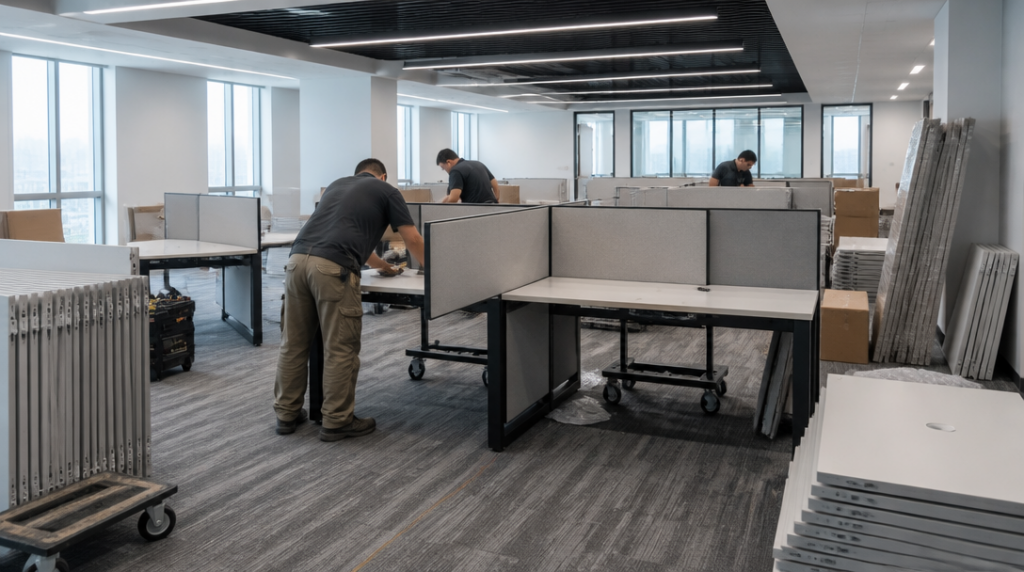
A small office can look deceptively simple: a few desks, some chairs, and perhaps a filing cabinet or two. A large workplace can turn the same job into a carefully staged construction project involving panel systems, wiring, multiple installers, and long hours after the building has emptied. I have always found the gap between those two situations more revealing than any single average price.
For a straightforward setup, office furniture installation may cost only a few hundred dollars per employee. For a complete office installation, the bill can climb into the tens of thousands. Both figures can be reasonable. The difference lies in what is being assembled, how difficult the site is to access, and how much coordination the job requires.
A practical price range per workstation
A useful current benchmark is $200 to $700 per workstation for office furniture installation in Columbus, Ohio, as of April 2026. That range covers a lot of ground. A basic desk and chair arrangement on an open floor will sit closer to the lower end. A workstation with partitions, storage, cable management, or awkward delivery conditions will move upward quickly.
The phrase “per workstation” matters because installers often price commercial furniture by the individual place where someone works. One workstation might include a desk, return, pedestal, overhead storage, modesty panel, and chair. Another might be little more than a freestanding table. Treating both as identical units makes an estimate look precise while hiding the real scope of the job.
For example, ten uncomplicated workstations could produce an installation labor estimate of roughly $2,000 to $7,000 under that benchmark. That is not a universal quote, and it does not automatically include furniture, delivery, electrical work, moving services, or disposal. It is a way to understand the scale before requesting bids.
Panel systems usually cost more. Installation commonly runs $300 to $600 per workstation above the price of the furniture itself. Panels have to be positioned, joined, leveled, and sometimes fitted with power or data connections. A crew may also need to follow a very specific layout so that every workstation lines up with the floor plan and building services.
That extra complexity is easy to underestimate when looking at a catalog image. On paper, a panel-based workstation may look like a desk with walls. In practice, it behaves more like a modular room that has to be assembled in the right order.
Why hourly labor can produce a different answer
Some installers quote a fixed price per station. Others charge by the hour, especially when the furniture list is incomplete or the work includes several unrelated tasks. Published 2026 government schedule rates provide one reference point: an installer is listed at $45 per hour, a furniture technician at $60 per hour, and a supervisor at $50 per hour. The minimum job charge is $150.
Those rates are not a promise that every local contractor will charge the same amount. They do show how a professional crew’s labor can accumulate. A project may involve a lead person directing the work, a technician handling more complicated furniture, and one or more installers doing the physical assembly. The clock runs while they unload, sort components, protect floors, move pieces into position, and clean up packaging, not only while they use tools.
I tend to look at labor estimates in two layers. The first is the visible assembly: attaching legs, mounting panels, installing drawers, and leveling desks. The second is everything that makes assembly possible. If parts arrive mixed together, if an elevator must be reserved, or if the crew cannot park near the entrance, the second layer can consume a surprising amount of time.
A minimum charge of $150 also changes the economics of small jobs. Installing one desk may seem like a quick task, but a contractor still has travel time, loading, insurance, scheduling, and administrative costs. The minimum protects the job from being priced as if the installer simply appeared for fifteen minutes and vanished.
Full office installations can reach $25,000
For a complete office installation, a broad estimate is approximately $10,000 to $25,000 for installation alone. That kind of project may involve dozens of workstations, private offices, conference rooms, reception furniture, storage, and the coordination needed to bring everything together.
The lower end might suit a relatively accessible space with a clear layout and standard furniture. The higher end becomes more plausible when the installation includes extensive panel systems, a large quantity of storage, complicated sequencing, or a tight schedule. The furniture itself is a separate expense, which is why the phrase “installation cost” needs to be kept distinct from the project’s total furnishing budget.
Cubicle installation by itself may run approximately $2,000 to $6,000. That range is narrower because it describes one portion of a broader office setup, but cubicles can still vary considerably. A few basic units in an empty suite are one thing. A dense arrangement with integrated power, overhead bins, work surfaces, and reconfiguration is another.
This is where I would be cautious with unusually low quotes. A low number may reflect a genuinely efficient crew, but it may also exclude disassembly, debris removal, final positioning, or the time needed to fix missing hardware. The cheapest estimate is not necessarily wrong; it simply deserves a close look at what the installer believes the job includes.
A cheap installation can become expensive after the first surprise appears.
Overtime, access, and the details that move the bill
Normal working hours are often the least expensive time to schedule a crew. If the installation has to happen overnight, on a weekend, or under a compressed deadline, labor costs may rise. The same 2026 schedule lists overtime rates of $65 per hour for an installer, $80 for a furniture technician, and $70 for a supervisor.
The difference is noticeable on a large crew. A few extra hours may not matter much for one desk, but overtime across several workers can add hundreds or thousands of dollars. A building that allows furniture work only after tenants leave may therefore have a higher installation bill even if the physical furniture is ordinary.
Access is another quiet cost driver. Installers may need to carry furniture up stairs, navigate narrow corridors, wait for a freight elevator, or work around other trades. A downtown office with strict loading rules can take longer to service than a larger suburban suite with parking directly outside the door. Neither situation is obvious from a furniture list.
The condition of the room matters too. A clear, finished space is easier to work in than one filled with boxes, old furniture, or construction materials. If existing desks must be moved or dismantled, that work should appear separately in the estimate. Mixing it into a vague “installation” line makes it harder to see what is actually driving the cost.
How I would read an installation quote
I would want the quote to describe the furniture by category and quantity rather than offer one unexplained total. Desks, private-office furniture, conference tables, storage, reception pieces, and panel work should be identifiable. The estimate should also say whether delivery, unboxing, assembly, placement, cleanup, removal of packaging, and disposal are included.
For panel systems, I would ask whether electrical or data connections are part of the scope. Furniture installers may handle certain components, while licensed electricians or data technicians deal with building connections. Assuming one crew covers everything can create a scheduling problem and an unexpected second invoice.
I would also check whether the price is fixed or based on estimated hours. Hourly work can be perfectly sensible when the scope is uncertain, but the quote should state the crew size, expected duration, hourly rates, and conditions that could extend the job. A fixed per-workstation price offers more predictability, especially when the layout and furniture count are final.
Photos and a floor plan can make the estimate more accurate before anyone visits the site. Even a simple sketch showing elevators, stairs, doors, and the intended workstation layout can reveal complications that a furniture spreadsheet misses. For a larger project, an on-site walkthrough is usually worth arranging before the contract is signed.
The most useful question is not simply, “What is your price per desk?” It is, “What exactly happens between delivery and the moment the office is ready to use?” That answer tells me whether the quote covers a genuine installation or only the most visible part of the job.