
A UK motorcycle licence can cost well over £1,000 before you have bought a bike, arranged insurance or paid for a single mile of commuting.
That may sound excessive if you have only looked at the government test fees. The theory test costs £23. Module 1 costs £15.50, while Module 2 costs £75 on a weekday or £88.50 in the evening, at weekends or on a public holiday. Add the cheapest compulsory training and the arithmetic appears surprisingly manageable.
The trouble is that the test fees are not the expensive part. Training is where the budget starts to move, and the final figure depends heavily on the route you take, your previous riding experience, the type of motorcycle licence you want and whether everything goes right the first time.
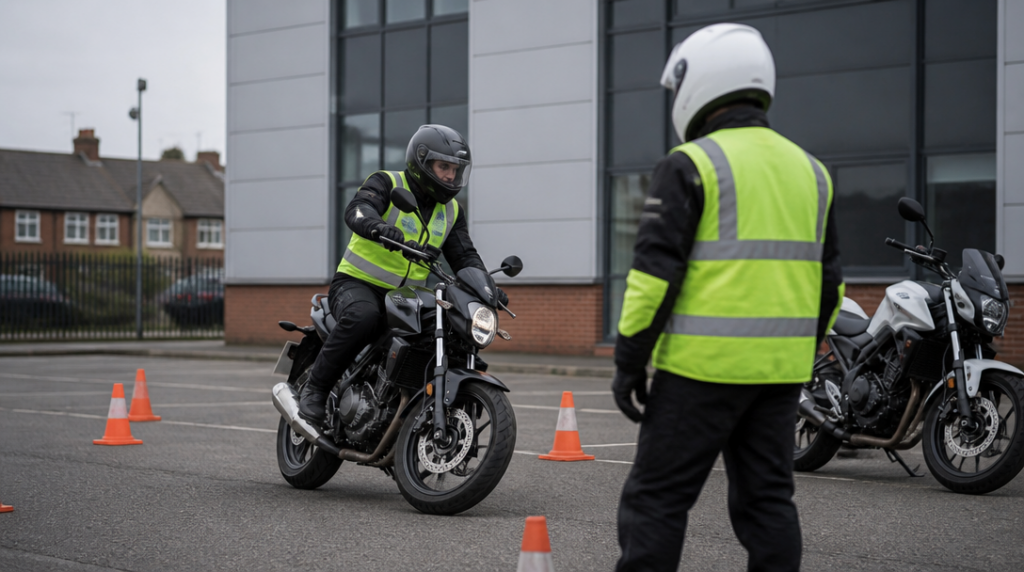
A beginner normally starts with Compulsory Basic Training, usually called CBT. Current prices are roughly £139 to £190, with the exact amount influenced by the motorcycle used and the equipment supplied. A lower-priced course may look attractive, but it is not necessarily the cheapest option if it leaves you needing extra tuition before you feel ready to ride safely or move on to a full licence.
CBT is not the same as passing a motorcycle licence test. It gives a rider the training needed to ride within the rules attached to a provisional licence, but it does not prove the standard required for a full licence. That distinction is easy to miss in adverts that present the course as the main gateway to riding.
The theory test adds another £23. After that come the two practical stages: Module 1, which focuses on controlled manoeuvres, and Module 2, the road-riding test. The fees themselves are fixed at modest levels compared with professional instruction. Module 1 costs £15.50. Module 2 is £75 for a weekday appointment and £88.50 for an evening, weekend or public holiday slot.
Those figures can make a full licence seem like a few hundred pounds away. That estimate assumes a rider already has the necessary ability, access to a suitable motorcycle and enough confidence to pass two different practical tests. Most beginners do not.
The training bill is usually larger than the test bill
Motorcycle schools commonly package training around the licence route rather than charging only for the examinations. A four-day A2 or DAS course, including the tests, currently costs roughly £799 to £840. A five-day DAS course including the tests can cost about £899 to £1,099.
DAS means Direct Access Scheme. It is aimed at riders taking a route to a larger motorcycle licence, subject to the relevant age and licence conditions. A2 training is a different route with its own restrictions. The names are often thrown around casually, but they are not interchangeable packages, so the price of one should not be treated as a universal quote for every learner.
The phrase “including the tests” also needs a little caution. It usually means the advertised package covers the standard test bookings, not that a pass is guaranteed. Fail one part and the replacement booking, additional lessons and possibly a motorcycle hire fee can fall outside the headline price. A package can therefore be excellent value for a prepared rider and a poor bargain for someone who needs more time.
Four or five days may be enough for a rider with experience on scooters, mopeds or off-road bikes. It may not be enough for someone who has never balanced a manual motorcycle, used a clutch in traffic or practised emergency manoeuvres. Motorcycle control is physical and repetitive; knowing what to do is not the same as doing it consistently while tired, watched by an examiner and surrounded by traffic.
This is where online cost comparisons tend to become misleading. They put a CBT fee beside a test fee and quietly leave out the lessons that make passing realistic. It is a bit like pricing a driving holiday by counting only the parking ticket at the destination.
A learner should ask exactly what a training package includes. The useful questions are practical: Is the motorcycle provided for both modules? Are test-day hire and insurance included? Does the package cover the theory test, or only the practical tests? What happens if the instructor decides the rider is not ready? Are extra lessons charged by the hour or sold in another block?
The answers can change the real cost more than a small difference between two advertised course prices. A cheaper package with no test-day bike may become more expensive once hire is added. A higher-priced course with extra preparation and both practical tests included may be the more predictable purchase, although it still carries no guarantee of a pass.
There is another complication: motorcycles are not all equally demanding. A learner using a smaller, lighter machine may find low-speed control easier than someone training on a heavier bike. The equipment supplied by the school, including protective clothing and helmet arrangements, can also affect the price. Some providers include gear; others expect riders to bring their own. Buying everything from scratch can add a substantial amount, even though that spending does not appear anywhere in the licence fee.
The costs that appear after the advertised price
The obvious total for a successful beginner taking CBT, the theory test and a four-day course would be around £976 to £1,058 before any personal riding equipment or other expenses. That combines the £139–£190 CBT range, the £23 theory test and a £799–£840 course. It is a useful illustration, not a guaranteed quote, because course structures differ and the CBT may or may not be included in a wider training plan.
A five-day DAS package produces a higher starting point. Adding CBT and the theory test to the £899–£1,099 course range gives roughly £1,061 to £1,312, again before clothing, transport, insurance or a motorcycle. That is already a serious sum for someone who expected the licence itself to cost only a few dozen pounds.
The calculation can be lower for a rider who needs only limited instruction and books the tests independently. It can be higher for a rider who needs several extra training sessions, fails a module or has to wait for a new test appointment. A failed practical test is not just another fee. It can mean more lessons, another day away from work and another period of paying for transport or bike hire.
Test availability can affect spending too. A rider who chooses an evening or weekend Module 2 appointment pays £88.50 rather than £75. The £13.50 difference is not dramatic by itself, but people often choose less convenient slots because they are available sooner. If a delay means paying for additional refresher training, the booking fee becomes a minor part of the decision.
Insurance is another cost that is easy to ignore until the learner starts comparing motorcycles. Quotes vary according to the rider, location, experience, machine and cover selected, so there is no honest single figure to attach to it. The same applies to fuel, tax, maintenance, security equipment and the motorcycle itself. These are not training costs in the narrow sense, but they are part of the financial commitment created by passing the test.
Protective clothing deserves similar treatment. A helmet, jacket, gloves, boots and riding trousers are not decorative extras for a new rider. The amount spent depends on what the rider already owns and what the training school requires, but a budget that stops at the test booking page is incomplete.
The most defensible answer to the question is therefore a range rather than a neat price tag. The unavoidable official tests total £113.50 for a weekday Module 2 appointment, or £127 for an evening, weekend or public holiday appointment, once the £23 theory test and £15.50 Module 1 are included. CBT brings the basic training-and-test path to roughly £252.50–£317 before further lessons. A structured four-day A2 or DAS course including tests points instead to about £799–£840 for the course alone, while five-day DAS training sits around £899–£1,099.
Those numbers describe different stages of the process, not competing promises. The cheapest route is only cheap if the rider is ready, the bike and equipment are available, and both practical tests are passed without extra tuition. For many beginners, the real cost is decided in the training yard rather than at the test centre.