
A homeowner asking for monocouche rendering in 2026 may hear one figure from a calculator, another from a contractor and a third after the scaffolding has gone up. Which number is real? In the UK, a sensible working range is about £35–£70 per square metre, including labour and materials. That spread is wide enough to turn a modest exterior job into a serious financial decision.
The most common middle figure is around £42 per square metre, although some current estimates sit higher, at roughly £50–£70 per square metre. Those numbers are not necessarily contradictory. They often reflect different assumptions about the building, the access, the condition of the walls and the standard of finish. The problem begins when a low headline rate is treated as a complete quote.
For a typical three-bedroom semi-detached house, complete monocouche rendering is often priced at approximately £3,500–£7,000. At the higher end of the market, estimates can rise to around £6,500–£10,000. That overlap tells its own story: the same broad description of a house can produce dramatically different totals.
A quote that appears to be £3,500 may not be directly comparable with one approaching £10,000. One contractor may be pricing a relatively straightforward application to sound walls. Another may be allowing for difficult access, more preparation and a higher labour rate. Unless the scope is written down, the homeowner is comparing labels rather than jobs.
What the headline price actually includes
The material itself usually accounts for about £10–£18 per square metre. Labour is typically around £25–£45 per square metre. Added together, those figures broadly explain why a complete rate in the region of £35–£70 per square metre is plausible, while also showing where the money goes.
The material is the visible part of the system, but it is not the main cost. Applying monocouche render requires preparation, mixing, spreading and finishing, and the labour rate can shift considerably depending on how accessible and straightforward the walls are. A large, uncomplicated elevation is a different proposition from a house broken up by awkward corners, extensions, narrow passages or multiple levels.
The walls themselves can quietly decide the price. Crumbling surfaces, old coatings, cracks or areas requiring repair may demand additional preparation before the render can be applied. A contractor who ignores that work may offer a very attractive initial figure, but the price can change once the surface is exposed. A contractor who includes it from the start may look expensive by comparison, even when the final bill is more predictable.
This is where homeowners should start asking precise questions. Does the square-metre rate include preparation? Are repairs included, or merely described as an extra if required? Is the quoted finish the one discussed during the visit? Does the price cover all elevations, or only the walls that were easy to measure?
The wording matters. “Monocouche rendering” describes the principal material and application, not every task needed to get a house ready for it. Waste removal, protection around windows and doors, and work at difficult points may be handled differently by different contractors. None of those details should be left to assumption.
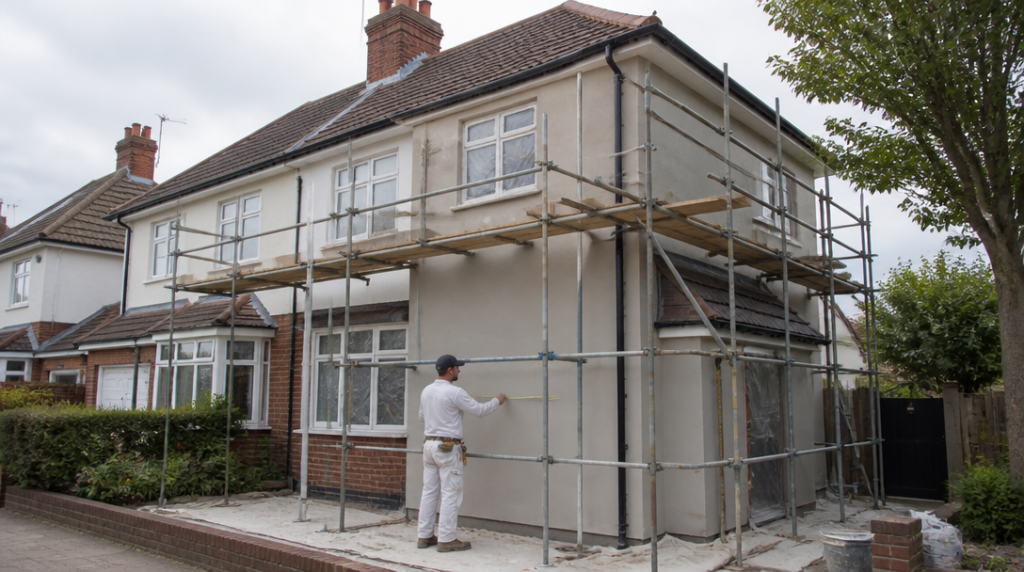
Scaffolding is another common source of confusion. It is often charged separately, at roughly £400–£1,500, while more complicated houses can push the cost towards £2,500. That can make a supposedly affordable rendering quote look very different once safe access is added.
A low per-square-metre figure with scaffolding excluded is not automatically misleading. It becomes misleading when the exclusion is buried or never explained. A homeowner needs the rendering, preparation and access costs shown as separate lines, not folded into a vague total that is impossible to test.
There is a useful practical reason to separate them. Scaffolding is not calculated in exactly the same way as the amount of render. The shape and height of the property, the space around it and the complexity of the access all matter. Two homes with a similar wall area may therefore face different scaffolding bills. That is one reason a square-metre comparison can only take the calculation so far.
Why two quotes can be thousands apart
The £3,500–£7,000 range for a standard three-bedroom semi-detached house is broad, but it is not meaningless. It describes the difference between a relatively uncomplicated project and one priced towards the upper end of the market. Estimates reaching £6,500–£10,000 sit in a different bracket and demand closer scrutiny, particularly if the house is not unusually large or difficult to access.
The first question should be whether the measured area is the same. A contractor quoting on the visible front and side walls is not offering the same service as one measuring every elevation, including additions and less accessible sections. Measurements should be clear enough for the homeowner to understand what has been included and what has been left out.
The second question is preparation. Rendering over a stable, suitable surface is not the same job as dealing with damaged or heavily coated masonry. If one quote allows for extensive preparation and another assumes the walls are ready, the difference may be hidden in the scope rather than the rate.
The third is labour. At £25–£45 per square metre, labour can form the largest part of the bill. That range is substantial. It may reflect the speed and difficulty of the work, the number of people required, access conditions and the finish expected. A contractor charging the upper end should be able to explain what the extra labour involves. “That is our rate” is not much of an explanation.
It is tempting to focus on the material price because it is easy to compare. Yet the difference between £10 and £18 per square metre is only one part of the calculation. A cheaper material allowance does not prove that the whole job is cheaper, just as a premium product does not guarantee careful application. The surface beneath the render and the workmanship on the day will have more immediate consequences for the finished wall than a tidy-looking figure on a spreadsheet.
A useful quote should therefore show at least the measured area, the material allowance, the labour charge, preparation work and scaffolding. It should state whether the figures include VAT if VAT applies, although the supplied price ranges themselves do not establish how individual contractors handle it. That detail alone can distort comparisons if one quote is tax-inclusive and another is not.
The safest way to read the market is to treat £42 per square metre as a rough central reference, not a guaranteed going rate. A quote around that level may be perfectly reasonable for one property and inadequate for another. Prices around £50–£70 per square metre are not automatically excessive either, but they should come with a clear account of the extra complexity.
This is also why calculators can be useful and frustrating in equal measure. They give a quick sense of scale, but they cannot inspect a cracked wall, judge access through a narrow side passage or decide whether an existing finish must be removed. The neat number on the screen is only the beginning of the investigation.
When comparing contractors, ask each one to price the same written scope. Request the rendering rate and the scaffolding cost separately. Ask what happens if the wall needs more preparation than expected. If the answer is vague, the apparent bargain may be resting on work that has simply been pushed outside the quote.
I would be wary of any estimate that makes the project look suspiciously simple. Exterior work rarely stays simple once access equipment arrives and old surfaces are opened up. The most useful quote is not necessarily the lowest one; it is the one that leaves the fewest expensive surprises waiting behind the first figure.