
A single deep scratch can cost more to repair than several small dents combined, with serious panel damage reaching $800 or more.
That price gap surprises many car owners. A light scrape in a parking lot may be inexpensive, while a dent that has cracked the paint can turn into a much larger bodywork job. Mobile repair makes the process easier because the technician comes to your home or workplace, but convenience does not erase the labor, materials, or skill involved.
So, how much should you budget for mobile car scratch and dent repair? For minor damage, expect somewhere between $50 and $300. Larger dents, paint repairs, and damage across several panels can push the bill well beyond $1,000.
Typical mobile repair costs
A surface scratch that has not cut through the paint is usually the simplest problem to deal with. Depending on its length, visibility, and position on the panel, repair may cost around $50 to $300. Some marks can be polished or blended out; others need more careful preparation to make the finish look even under direct sunlight.
That last detail matters. A scratch may look harmless in the shade and suddenly become obvious when the car is parked under bright lights. Paint color also affects the work. Solid black or white paint can be relatively straightforward to blend, while metallic and pearl finishes may require more patience to match the surrounding panel.
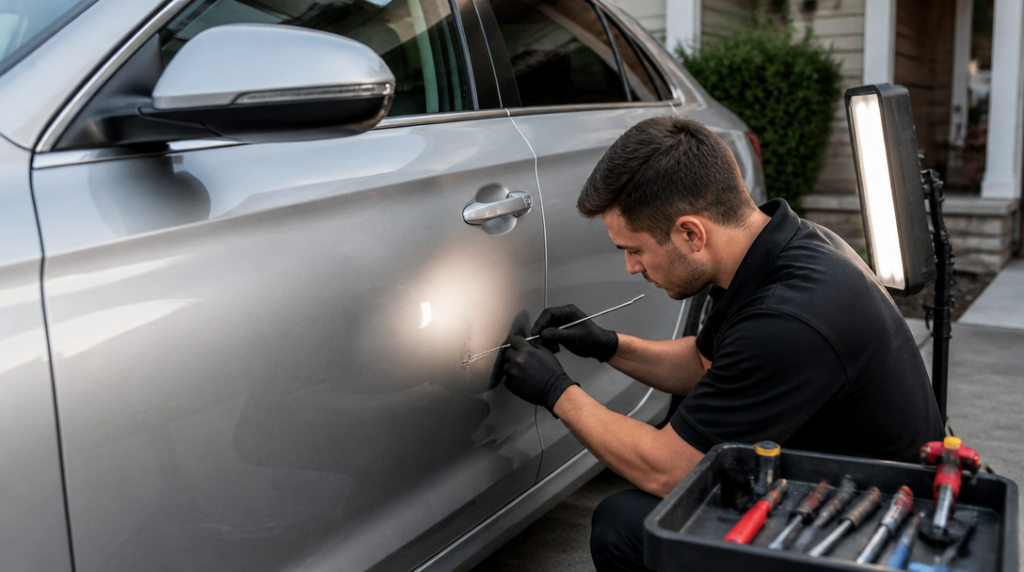
Small dents are often handled through paintless dent repair, commonly called PDR. This technique reshapes the metal from behind the panel without sanding, filling, or repainting it. A small door ding repaired by a mobile PDR technician generally costs about $75 to $150.
That price is typical for a compact dent in an accessible area, especially if the paint is still intact. A shallow ding in the middle of a door is a much friendlier job than a sharp crease beside a body line. The damage may look similar from across a parking lot, but the repair time can be very different.
A medium-sized dent, roughly one to three inches across, often falls in the $125 to $400 range. Size matters, but it is not the only factor. The technician will also consider how deep the dent is, whether the metal has stretched, how close it sits to an edge, and whether there is enough room behind the panel to work safely.
Why the same dent can have different prices
Two vehicles can arrive with dents of almost identical size and receive very different estimates. The shape of the damage is often more important than the measurement alone.
A rounded dent with soft edges may come out cleanly. A sharp crease can leave the metal permanently distorted, particularly if the impact stretched the panel. Dents near a wheel arch, door frame, hood edge, or structural support are also more demanding because access is limited and the metal behaves differently in those areas.
Paint condition changes the calculation, too. PDR works best when the original finish has not cracked or flaked. If the paint is broken, simply pushing the metal back into shape will not restore the appearance or protect the exposed surface. The panel may then need traditional body repair, primer, color matching, and clear coat.
A deep scratch or dent that needs painting typically costs about $400 to $800 or more per panel. That estimate can include removing trim, preparing the damaged area, applying several layers of finish, and blending the color so the repaired section does not stand out from the rest of the car.
This is why a deep key scratch can become expensive even if it is narrow. The visible line may be small, but the technician still has to prepare the surrounding area and recreate a durable finish. Think of it less like erasing a pencil mark and more like repairing a tear in a carefully painted wall.
Mobile repair versus a traditional body shop
The biggest advantage of a mobile service is obvious: you do not have to arrange a ride, leave the car at a shop, or spend your afternoon sitting in a waiting room. For a small dent or cosmetic scratch, that convenience can make mobile repair the sensible choice.
Mobile technicians are especially well suited to PDR, minor bumper scuffs, door dings, and small paint corrections. They can often complete the work at a driveway, office parking lot, or other suitable location. The surface needs to be reasonably clean and accessible, and some paintwork may require shelter from wind, rain, dust, and extreme temperatures.
A traditional body shop still has advantages for serious damage. Shops have enclosed paint booths, larger equipment, replacement parts, and more room to disassemble a vehicle. If a panel is badly creased, the bumper is cracked, or the damage affects sensors and cameras, a mobile technician may need to refer the job elsewhere.
For damage across multiple panels, repair commonly reaches $1,000 to $1,500 or more. A quote in that range may involve several separate dents, paint blending, trim removal, or work on areas that were hit at different angles. At that point, the repair is no longer just a quick cosmetic fix.
Hail damage can add up quickly
Hail is a different kind of problem because one storm can leave dozens of small dents across the hood, roof, trunk, and side panels. Individual dents may be inexpensive, but the total number creates a substantial labor bill.
A complete mobile PDR repair for a vehicle with more than 20 hail dents typically costs around $1,500 to $3,500. The final estimate depends on the number and size of dents, the affected panels, the vehicle’s construction, and how easy each area is to reach.
Hail damage is also a good example of why a quick visual inspection can be misleading. Some dents are visible immediately, while others appear only when light moves across the paint. A technician may use reflections, special lighting, and careful panel inspection to find damage that is easy to miss in a casual look.
What affects the final quote?
The quoted price usually starts with the damage itself, but several practical details shape the final number. Vehicle size matters because a large SUV or truck may have bigger panels and more difficult access than a compact sedan. Aluminum panels can require different techniques from steel, and certain modern body materials cannot be treated exactly like older metal panels.
Location matters as well. A dent on a broad, open door is usually easier than one tucked into a narrow quarter panel. A technician may need to remove an interior trim panel, tail light, headliner, or other component to reach the back of the damaged area. That extra work can increase the labor time even when the dent looks modest.
The condition of the paint is another dividing line. Original factory paint tends to tolerate PDR better than an older repaint or a brittle finish. If the paint is already peeling, cracked, or weakened by previous repairs, pushing the metal may cause additional damage.
Your location can influence pricing, too. Mobile companies may include a travel charge for distant appointments, while busy urban areas often have higher labor rates. Ask whether the estimate includes travel, materials, taxes, and any minimum service fee before booking.
How to avoid paying for the wrong repair
Start by taking clear photos in daylight. Include a close-up, a wider view showing the entire panel, and a side angle that reveals the depth of the dent. This gives the technician a better chance of offering a useful preliminary estimate instead of a vague range.
Describe whether the paint is damaged. Run a clean fingernail lightly across a scratch only if the area is safe and clean; if the mark catches noticeably, it may be deeper than a surface scuff. Do not aggressively polish it before getting advice, since improvised products can make later paint correction more difficult.
Ask what method the technician recommends and why. A professional should be able to explain whether the repair calls for PDR, polishing, touch-up work, or full panel refinishing. Be cautious if someone promises to remove every dent perfectly without seeing the vehicle, particularly for creases, cracked paint, or damage near panel edges.
It is also smart to ask how the result will be inspected. A repair that looks fine under cloudy skies may reveal a visible ripple in direct sun. I have always found that the best cosmetic work is the kind you stop noticing after a few minutes, because the panel simply looks like it was never damaged.
For a light scratch, a small door ding, or an uncomplicated dent, mobile repair can be surprisingly affordable. Once the paint is broken, several panels are involved, or hail has peppered the entire car, the estimate rises quickly. The technician’s inspection is what separates a $100 fix from a $700 panel repair, and a quick photo-based quote is only the starting point.