
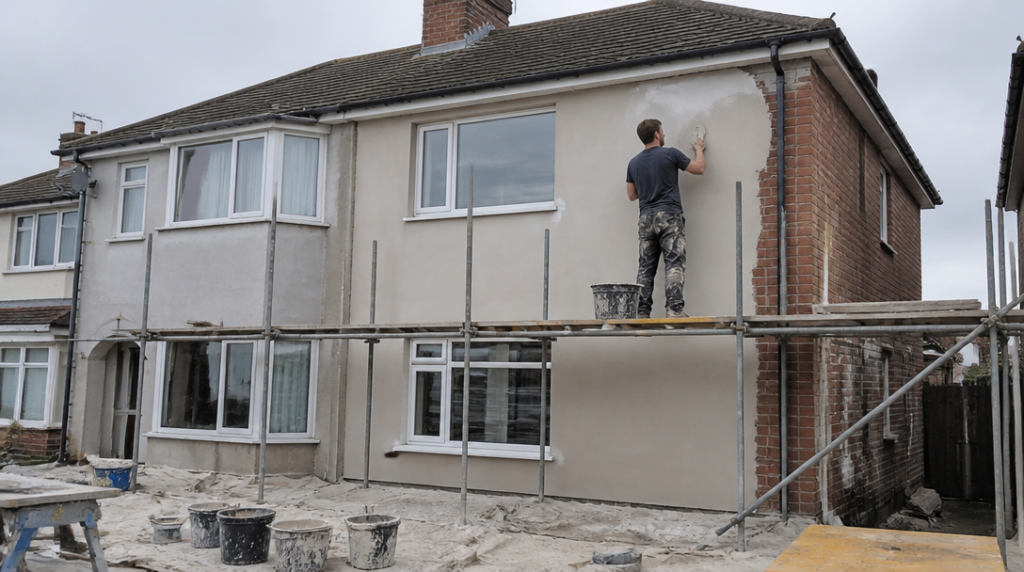
A house can cost anywhere from £30 to £80 per square metre to render in the UK in 2026, including materials and labour. On a typical three-bedroom semi-detached house, that difference can turn a manageable quote into a bill of more than £5,000.
The price becomes tangible when you stand beside the wall itself. Dust gathers along the paving, old paint flakes under the scraper, and a scaffold tower rises above the front door. Every square metre has to be prepared, covered and finished by hand, not simply painted with a thick coat and forgotten.
The basic rendering cost per square metre
For external rendering, the broad UK price range is £30–£80/m². That figure covers the common materials and the labour needed to apply them, although difficult access, repairs and extra preparation can push a project beyond the headline rate.
The measurement normally refers to the external wall area being rendered, not the floor area inside the house. A home with 80 square metres of internal floor space may have considerably more than 80 square metres of outside wall once windows, doors, gables and multiple elevations are considered.
That distinction catches many homeowners off guard. A builder measuring the walls is pricing the surface that must be cleaned, repaired, coated and finished, while a homeowner may be thinking about the size of the house on the estate agent’s floor plan.
A simple wall with clear access sits near the lower end of the range. A tall side elevation, a cracked old surface or a house surrounded by narrow paths takes more time and usually demands more equipment.
Prices by render type
Sand and cement render is usually the least expensive option, at around £30–£45/m². It has a familiar, solid appearance and remains common on houses where the priority is a practical external finish rather than a highly decorative surface.
The mix is applied in coats, and the wall may need time between stages before the finish can be completed. On a breezy building site, the smell of wet cement hangs in the air while the renderers work across the wall in broad, controlled strokes.
Monocouche render generally costs about £40–£55/m². It is supplied as a through-coloured finish, so the colour runs through the material rather than sitting only on the surface as paint would. That can make minor future marks less obvious, although the finished appearance still depends heavily on the skill of the applicator.
Acrylic render falls in a similar band, at roughly £40–£60/m². It is often chosen for its flexibility and range of finishes, but the exact specification matters. Two products described casually as “acrylic render” may not behave or look identical once applied to a real wall exposed to rain, frost and strong sunlight.
Silicone render is usually priced at £45–£65/m². It is a more premium finish and is valued for its water-shedding properties and modern appearance. On a freshly rendered house, the surface can look almost soft from a distance, while the fine texture catches the light differently as clouds move across the elevation.
Lime render is the most expensive of the main options listed here, at approximately £55–£80/m². It is often associated with older or traditionally built properties, where allowing the wall to manage moisture matters more than achieving the cheapest possible coating.
Lime work is not simply a more expensive version of cement rendering. The material, application and drying process require an approach suited to the building. Covering an old wall with an unsuitable hard finish can create problems that only become visible after the contractor has left and winter weather arrives.
What an 80-square-metre house might cost
A typical three-bedroom semi-detached house with around 80m² of renderable area may cost approximately £2,400–£5,200 to render. The lower figure reflects the cheaper end of the market and a relatively straightforward job; the upper figure is consistent with a more expensive finish or a project with greater complexity.
That example is useful because it shows how quickly the per-metre rate accumulates. At £30/m², 80m² produces a £2,400 starting point. At £65/m², the same measured area reaches £5,200 before any additional work outside the core rendering package is considered.
The number of windows can alter the rhythm of the work. Openings interrupt the wall, create corners and require careful finishing around frames. They do not always reduce the price in proportion to the area they occupy, because the edges can take more attention than a broad uninterrupted section of brickwork.
A two-storey side wall can create another complication. The surface may be simple on paper, but the team still has to reach the upper sections safely, protect neighbouring property and keep wet material away from roof tiles, drains and paving.
Why two houses with the same area receive different quotes
The wall itself is only part of the calculation. Before fresh render goes on, the contractor may need to remove loose material, brush away dust, repair cracks or deal with sections that have detached from the background. A clean, stable surface lets the work move quickly. A failing one turns preparation into the main event.
Access also matters. A front elevation beside a wide driveway is a different job from a rear wall reached through a narrow passage with garden furniture, bins and low branches in the way. Scaffold, protective sheeting and moving materials through the property can all affect the final price.
The shape of the building counts too. Dormer windows, bay windows, porches, deep reveals and projecting brickwork create more corners. Corners are where a neat finish is won or lost, and they take longer than a flat run of wall.
Weather can slow the site down as well. Render needs suitable conditions while it is applied and curing. Rain can mark the surface, strong sun can dry it too quickly, and cold conditions may interfere with the setting process. A contractor who allows for delays may produce a higher quote but a less risky programme.
Colour and texture can affect the price even within the same material category. A smooth finish demands a wall that has been prepared carefully because every ripple is visible. A textured finish can create a more forgiving look, but it still needs consistent application across joins and around openings.
What to check in a rendering quote
A useful quote should state the measured area and the chosen material, rather than offering only a single unexplained total. Ask whether the price includes preparation, primer or base coats, corner beads, mesh, protection for windows and doors, scaffolding and waste removal.
The phrase “rendering included” can conceal several exclusions. Small cracks may be covered in the main rate, while extensive repairs, removal of existing render or replacement of damaged masonry may be charged separately. The difference is not necessarily unreasonable, but it needs to be visible before work begins.
Check the finish specification as well. “White render” does not describe the same product as a coloured monocouche or a silicone finish, and the surface texture may be different from what you imagined after seeing a small sample.
Photographs of previous work can reveal more than a polished brochure. Look closely at window corners, junctions with roofs and the line where the new finish meets paving. Those details are where rushed workmanship tends to show first.
It is also sensible to compare the scope of competing quotes, not just their totals. One contractor may include scaffolding and two coats of material, while another may list a lower price that assumes easy access and excludes repairs. The cheaper number can change character once the omissions are added.
Choosing the finish for the building
Sand and cement may suit a straightforward budget-conscious project. Monocouche can offer a coloured finish without relying on a separate coat of paint. Acrylic and silicone products are often considered for more contemporary appearances, while lime is particularly relevant to older construction where the wall’s moisture behaviour cannot be treated as an afterthought.
The right choice is tied to the building beneath it. A modern house and an old solid-wall cottage do not face the same technical conditions, even if both have the same number of square metres. The render should work with the wall, not merely hide it for a few seasons.
Stand close to a finished elevation and the quality becomes easier to judge. The texture should look consistent, the corners should hold a clean line, and the colour should not shift noticeably between one day’s work and the next. From the pavement, those small details often decide whether the house looks newly protected or merely newly coated.