
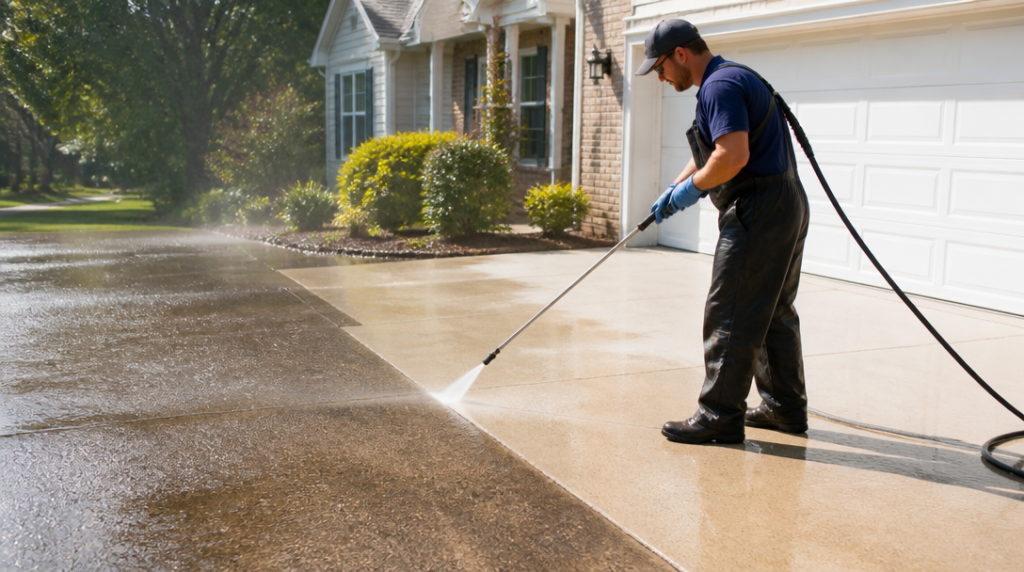
A professional pressure wash for a driveway usually costs between $100 and $350, with an average price of about $210. That is enough money to make the concrete look respectable again, but not enough to justify pretending the driveway is now a luxury renovation project.
Most companies charge around $0.30 to $0.55 per square foot. A typical 576-square-foot driveway therefore lands somewhere between $175 and $320, depending on the surface and the job itself.
The basic driveway pressure-washing cost
Square footage is the first number professionals look at. A larger driveway takes more water, more time, and more effort, so the price generally rises with the area being cleaned.
A small 200-square-foot section may cost only $60 to $110 based on the area alone. That sounds pleasantly manageable until the company adds a minimum service or travel charge. Small jobs can be surprisingly expensive per square foot, much like buying a single cookie at an airport.
For a standard driveway, the $100-to-$350 range is a more useful starting point than a low advertised price. The average cost of roughly $210 gives homeowners a sensible middle estimate, though the actual quote may sit above or below it.
A driveway measuring 576 square feet, for example, typically costs about $175 to $320 to pressure wash. That size is common enough to provide a useful comparison, but every property has its own details. A completely open concrete slab is a different job from a narrow, stained surface with awkward edges and years of accumulated grime.
How surface type changes the price
The material beneath the dirt matters. Pressure washing a driveway is not just a matter of pointing a machine at the ground and waiting for the pavement to confess.
For a 600-square-foot driveway, an approximate price range is $120 to $190 for concrete, $125 to $195 for asphalt, $130 to $200 for brick, and $135 to $210 for pavers or gravel.
Concrete tends to sit at the lower end of these figures, while pavers and gravel can cost slightly more. Brick and paver surfaces may require more careful handling, particularly where joints, uneven sections, or loose material are involved. Gravel presents its own small challenge: the cleaning process must remove dirt without turning the driveway into a shallow archaeological dig.
These ranges overlap heavily, so the material alone will not determine the final bill. A neglected concrete driveway can require more work than a reasonably clean brick one. Surface condition usually matters as much as the name of the material.
Why two similar driveways can receive different quotes
Size provides a useful formula, but it does not tell the whole story. Contractors may also consider how dirty the driveway is, whether stains need extra treatment, and how easily the equipment can reach the area.
Light dust and ordinary outdoor grime are generally simpler to deal with than deep oil marks, algae, tire stains, or discoloration that has settled into porous material. A driveway that has not been cleaned for years may need more time and attention than one washed regularly.
The shape of the driveway can matter, too. A wide, straight surface is easy to work across. Curves, narrow side paths, steps, retaining walls, and landscaping around the edges can slow the process. None of these details necessarily makes the job dramatically more expensive, but they can move a quote away from the most optimistic number.
Access is another practical issue. If a technician can park nearby and work without moving obstacles, the job is more straightforward. If hoses and equipment must be carried around the property, the quote may reflect that extra effort. The driveway may be flat and innocent; the route to it may be the real villain.
Minimum charges for small jobs
The $60-to-$110 estimate for a 200-square-foot area is useful for understanding the basic rate, but it should not be treated as a guaranteed invoice. Many pressure-washing companies apply a minimum service fee, especially when the job is small.
That fee can cover travel, setup, equipment preparation, and the time required to handle the appointment. As a result, washing a small strip of driveway may cost more than multiplying its square footage by the advertised per-square-foot rate.
This is why a quote for a small area can look oddly close to the price of a much larger job. The machine still has to arrive, the hose still has to be connected, and someone still has to avoid spraying the neighbor’s cat. The total work is not measured only by the number of square feet being cleaned.
What a professional quote may include
A basic quote usually relates to cleaning the driveway surface itself. Depending on the company and the condition of the area, the service may include preparing the site, applying water under pressure, and rinsing away loosened dirt.
Extra treatment may affect the price. Stubborn stains, heavy buildup, or particularly delicate materials can require more attention than a routine wash. Homeowners should ask whether stain treatment is included in the quoted price or charged separately.
It is also sensible to clarify whether nearby areas are part of the job. A driveway may connect to a walkway, front steps, or a small patio, but those surfaces are not automatically included just because the equipment happens to be nearby. A quote that defines the work clearly is less likely to produce an unpleasant surprise later.
The same applies to cleanup. Ask what happens to loosened dirt, standing water, or debris around the edges. A driveway can be beautifully clean in the center and still leave a muddy border that looks like the pressure washer stopped just before the interesting part.
Pressure washing versus doing it yourself
Renting equipment can appear cheaper than hiring a professional, particularly for a broad driveway. The calculation becomes less attractive if the project requires extra time, cleaning products, transport, setup, and a careful approach to the surface.
A pressure washer is powerful enough to remove grime quickly, but that power is not automatically friendly to every driveway. Holding the nozzle too close or using excessive pressure can damage a surface, disturb joints, or leave visible cleaning patterns. Concrete is not supposed to resemble a patchwork quilt after its bath.
A professional brings experience with the equipment and the material being cleaned. That does not guarantee a perfect result, and it does not eliminate the need to ask questions, but it can reduce the risk of treating the driveway like a hostile stain-removal experiment.
For homeowners comparing options, the clearest comparison is not just rental cost versus labor cost. It is the full DIY expense and the value of avoiding damaged pavement, wasted time, or a machine that sits in the garage afterward like an expensive metal apology.
How to get a more accurate estimate
Measure the driveway if possible, or provide a rough length and width when requesting a quote. Mention the surface material and point out any visible oil stains, algae, heavy discoloration, cracks, loose pavers, or gravel sections.
Photos can help a company judge the job before visiting. They may not replace an in-person assessment, but they give the contractor a clearer picture than the phrase “it just needs a quick wash,” which has launched many a longer-than-expected afternoon.
Ask for the total price rather than only the rate per square foot. A quote of $0.30 to $0.55 per square foot sounds precise, but the final bill may also involve a minimum charge or additional work. Confirm whether the price includes stain treatment, nearby walkways, setup, and cleanup.
For a typical driveway, planning around $100 to $350 is reasonable. A 576-square-foot surface may fall near $175 to $320, while a 600-square-foot driveway may cost roughly $120 to $210 depending on its material. The most reliable number, however, is the one based on your driveway’s actual size, surface, condition, and access—not the suspiciously cheerful estimate printed in giant letters on a roadside sign.