
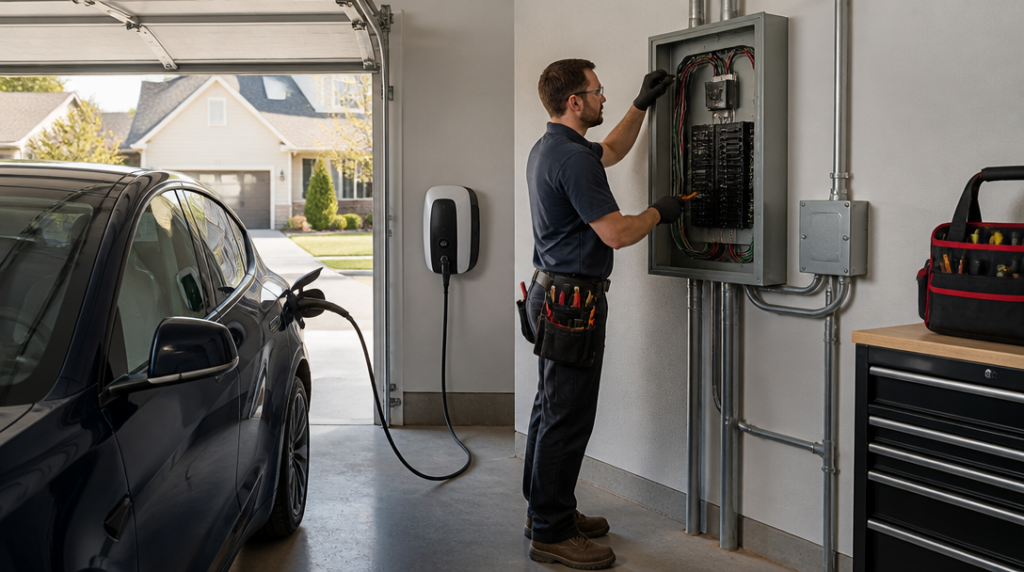
A Level 2 EV charger installed at home can cost anywhere from about $800 to $3,200 in the United States, including the equipment and labor.
That wide range surprises many new EV owners. The charger itself is only part of the bill. The larger question is whether your home’s electrical system can deliver power to the charging location without major changes. A short, simple installation may be relatively affordable. A project that requires a new circuit, a long cable run, permits, or an upgraded electrical panel can quickly move into four-figure territory.
The charger is only one part of the cost
A typical Level 2 home charger costs roughly $300 to $700 on its own. Level 2 equipment uses a 240-volt circuit, similar in voltage to the circuits used by some electric dryers, ovens, and other high-demand appliances. It generally charges an EV much faster than a standard household outlet, which is why many owners choose it for everyday use.
Buying the hardware is the easy part. The electrician must install the correct circuit, connect it safely to the electrical panel, mount or connect the charger, and make sure the installation follows local requirements. The work may be straightforward, but it is not the same as plugging in a small appliance.
A useful way to picture the bill is to separate it into three pieces: the charger, the electrical work, and any permit or infrastructure costs. The charger may account for a few hundred dollars. The electrical work often adds about $400 to $1,300, while permits commonly cost another $50 to $200.
Those figures describe a standard installation, not every possible home. The distance between the panel and the charger matters. So does the location of the panel, the condition of the wiring, the available capacity, and whether the charger will be hardwired or connected through a dedicated outlet.
Why the electrical panel matters so much
The electrical panel is the control center for the home’s power. Before installing a charger, an electrician needs to check whether the panel has enough capacity for another substantial load. A house may have a panel that appears full even if there are a few empty spaces, or it may have enough physical space but not enough electrical capacity.
An installation that uses an existing panel with a reasonably short cable route is usually the least complicated scenario. The electrician adds a dedicated circuit, runs the wiring, and installs the charger or an appropriate outlet near the parking space. A NEMA 14-50 outlet installation without a panel upgrade costs approximately $300 to $600.
That outlet can be convenient for drivers who want to plug in a portable Level 2 charger. A hardwired charger is another option and may suit a permanent setup better. The right choice depends on the equipment and the design of the home, rather than on a universal rule that applies to every garage or driveway.
The expensive scenario appears when the existing panel cannot handle the new demand. Upgrading a panel from roughly 100 amps to 200 amps can add around $1,500 to $3,000. That cost is separate from the charger itself and may involve more extensive electrical work than simply adding one circuit.
This is the part of the project that can turn a seemingly simple purchase into a renovation. It is a bit like buying a powerful new oven and discovering that the kitchen needs a larger gas line before the oven can be used. The appliance is not necessarily the costly problem; the supporting system is.
A panel upgrade is not automatically required for every EV charger installation. An electrician has to assess the home rather than guessing from the charger’s marketing materials or from a neighbor’s experience.
The distance from the panel changes the estimate
A charger installed on the other side of the wall from the electrical panel may require only a short wiring run. A charger placed at the far end of a garage, on an exterior wall, or in a detached garage can require much more cable, conduit, drilling, and labor.
Longer runs can also be more complicated if the wiring must pass through finished walls, crawl spaces, attics, concrete, or outdoor areas. Protecting the cable and routing it neatly may take additional time. In some homes, the charger location is chosen for convenience, but moving it closer to the panel could reduce the installation cost.
The parking arrangement matters, too. A driveway installation may need weather-resistant equipment and outdoor-rated materials. A detached garage may require a separate electrical solution. These details are easy to overlook while comparing charger prices online, where the equipment often appears to be the entire project.
Permits and inspection are part of the process
A permit typically costs about $50 to $200, although the exact amount varies by location and project. The permit is not just an administrative surcharge. It is part of the process used by local authorities to review and inspect electrical work.
The electrician may handle the paperwork, or the homeowner may need to coordinate part of it, depending on local practice. Asking about permits before work begins can prevent an unpleasant surprise in the final invoice. It also makes the quote easier to compare with another electrician’s estimate, since two contractors may describe the same job differently.
A written quote should make clear whether it includes the charger, wiring, breaker, conduit, labor, permit fees, and inspection-related work. If the quote says only “EV charger installation,” ask what that phrase covers.
What a few realistic budgets look like
Suppose the home already has a suitable panel, the parking space is close to it, and the owner chooses a Level 2 charger priced at $500. Add standard electrical labor somewhere within the $400-to-$1,300 range and a permit of perhaps $50 to $200. That project could land near the lower or middle part of the overall $800-to-$3,200 range, depending on the exact labor and materials.
A simpler NEMA 14-50 installation may cost about $300 to $600 before considering the price of the portable charger itself. This can be attractive for a garage where the outlet can be positioned close to the car and the panel has enough capacity.
Now consider a home with a 100-amp panel that cannot support the additional load. A panel upgrade alone may add $1,500 to $3,000. Add the Level 2 charger, installation labor, permit, and the wiring needed to reach the parking space, and the total can rise well beyond the price suggested by the charger box.
These examples are not fixed quotes. They show why two homeowners can buy similar chargers and receive dramatically different installation estimates.
The hardware may be identical; the houses are not.
How to keep the installation from becoming more expensive
Start by deciding where the car will normally be parked. The most convenient charging spot is not always the cheapest one, but placing the charger reasonably close to the electrical panel can reduce the amount of wiring and labor required.
Before choosing a unit, check whether it can be installed on a dedicated 240-volt circuit and whether it requires a plug or hardwiring. The charger should be compatible with the vehicle and installed according to its electrical requirements. A lower-priced unit is not a bargain if it creates complications for the installation or does not suit the intended charging setup.
Get a detailed estimate from a licensed electrician who has inspected the actual property. Photos can help with an initial conversation, but they may not reveal the panel’s capacity, the route behind a wall, or the condition of existing equipment.
It is also sensible to ask whether the quote assumes a panel upgrade. If the electrician cannot determine that without an on-site assessment, the estimate should say so clearly rather than quietly leaving the possibility out.
What happened to the federal installation credit?
A federal tax credit known as 30C provided 30% of eligible costs for certain home charging installations, up to a maximum of $1,000. For home installations, the work had to be completed by June 30, 2026, to qualify under the stated deadline.
As of July 24, 2026, that federal credit is no longer available for newly completed home installations. Anyone preparing a budget now should not subtract $1,000 automatically from the project total. State, local, utility, or other programs may have separate rules, but their availability and requirements can differ by location.
The safest budget is therefore based on the full installation price first. Treat any local incentive as a possible reduction only after checking its current eligibility rules.
For many homes, the final number is determined less by the charger’s brand than by the path electricity must take from the panel to the car. That path is where a few hundred dollars can become several thousand.