
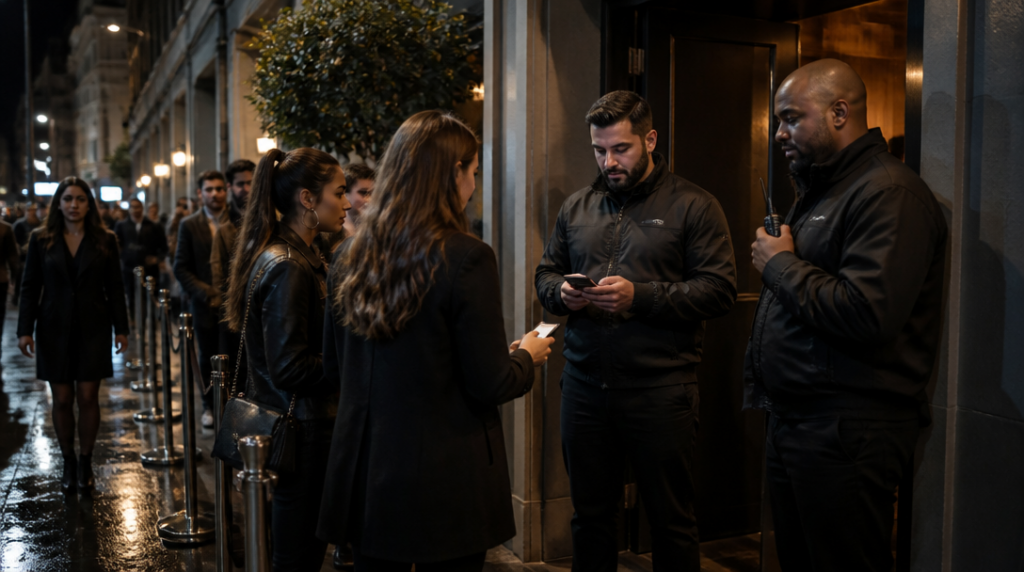
The first guests arrive while the parking lot is still silver with early-evening light. At the entrance, a guard checks a list on a phone, nods to a family carrying folded jackets, and turns away a man whose name is missing. Nearby, another guard watches the line rather than the door, tracking the gaps that open whenever someone stops to search for a ticket.
For the organizer, those quiet movements are part of the event budget. Hiring security in the United States typically costs $25 to $60 per hour for one guard in 2026. Many agencies quote roughly $35 to $75 or more per hour, especially for crowded venues, higher-risk events, expensive neighborhoods, or jobs that demand more experience.
That range is wide enough to make two apparently similar events produce very different invoices. A small daytime gathering with one unarmed guard can sit near the lower end. A late-night concert with several guards, an armed detail, complicated access control, and a minimum booking requirement can climb rapidly.
A useful starting calculation is simple. Four guards working six hours at $35 per hour would cost $840 before any additional fees. The same four-person team at $75 per hour would cost $1,800. The arithmetic takes seconds; deciding which rate applies requires a closer look at the event itself.
The hourly rate is only the first line on the quote
The most common private-agency price for an unarmed guard falls around $20 to $35 per hour. Armed guards generally cost $35 to $60 or more per hour. The difference reflects licensing, training, insurance requirements, equipment, and the level of responsibility attached to the assignment. It is not simply a premium for someone standing in a darker uniform.
An unarmed guard might check tickets, monitor entrances, patrol a parking area, enforce a venue’s rules, or help staff manage a tense interaction. An armed guard may be assigned where the perceived threat is higher or where the client specifically requires armed protection. Local regulations and the agency’s own policies can affect who is legally eligible for each role.
Publicly listed rates show how much local pricing can vary. San José charges $33 per hour for a security guard in 2026 and requires a four-hour minimum. That means one guard costs at least $132, even if the event only needs coverage for a shorter period. A four-hour booking for two guards reaches $264 before anything else is added.
A Los Angeles County contract lists much lower figures: $16.80 per hour for unarmed event staff and $20 per hour for an armed guard. Those numbers should not be treated as a universal private-market price. A government contract may reflect negotiated terms, a defined scope of work, and conditions that differ sharply from a one-off booking arranged by a wedding planner, club owner, or festival organizer.
The same distinction appears in pay rates. As of July 21, 2026, the average wage for an event security guard in the United States was $19.03 per hour, with a median of $16.97. That is the worker’s pay, not necessarily the amount charged to the client. An agency’s bill also has to cover supervision, recruitment, payroll costs, insurance, licensing, uniforms, administration, and business overhead.
That gap often surprises first-time event organizers. A guard earning around $19 an hour does not mean a client should expect to hire one directly for $19. Direct hiring can shift legal and insurance responsibilities onto the organizer, and it may leave the event without a licensed company, a replacement worker, or a supervisor if something goes wrong.
Minimum hours are another quiet source of cost. An agency may accept a four-hour minimum even if the guard is needed only for the final hour of a reception. Some firms also impose minimum staffing levels, particularly for public events or venues with several entrances. Asking for “one guard for the doors” can lead to a different recommendation once the floor plan, parking area, backstage access, and closing procedure are discussed.
The clock matters, too. A security shift usually begins before the first guest arrives. Guards may need time for a briefing, a venue walk-through, a check of emergency exits, or coordination with event staff. If the party ends at 11 p.m. but guests are still leaving in waves at 11:30, the organizer may need coverage beyond the advertised program.
A quote should spell out whether the hourly charge includes those setup and closing periods. Otherwise, the invoice can grow in half-hour pieces while the last cars pull away and staff stack chairs under the hard white light of the venue’s work lamps.
What makes event security more expensive
Risk is the strongest price lever. A quiet corporate meeting in a controlled building usually presents a different assignment from a concert, nightclub event, political gathering, sports celebration, or festival where alcohol and large crowds are involved. The guard may be expected to manage queues, prevent unauthorized entry, watch for fights, respond to medical incidents, protect performers, or control access to restricted areas.
Crowd size does not tell the whole story. A 300-person event with a single entrance can be easier to monitor than a 150-person event spread across a hotel, terrace, parking lot, and service corridor. Visibility, lighting, exits, alcohol service, the guest list, and the venue’s history all shape the staffing plan.
Location pushes rates upward as well. Large metropolitan areas often have higher labor and operating costs, while remote venues may create additional travel time. A guard assigned to a site outside the agency’s normal service area could bring a travel charge or a longer minimum shift. Parking can matter as well; if the guard must pay to park for a six-hour assignment, the contract should say who covers it.
The number of posts is more useful than the number of guests. One post might cover the main entrance. Another could monitor a staff entrance, while a third patrols the parking lot. If the venue has separate public and VIP entrances, each may need continuous coverage rather than occasional checks.
Supervision can add another layer. A larger event may require a field supervisor who checks posts, communicates with the organizer, and handles reassignment when a problem develops. That person may be billed at a different rate, or the agency may include supervision in its general price. Neither arrangement is automatically better; the important detail is whether the supervisor will actually be present and for how long.
Special skills cost more. Close-protection work for a public figure, rapid response teams, licensed investigators, fire-watch duties, and security involving controlled access systems are not interchangeable with standard door coverage. An organizer who asks for “security” without describing the job may receive a vague quote because the agency is pricing uncertainty.
The cleanest way to compare offers is to describe the event in operational terms: date, venue, guest count, opening and closing times, alcohol service, entrances, parking areas, expected trouble spots, and whether weapons are permitted. Include the time needed for setup and departure. A short written brief gives agencies something concrete to price and makes mismatched proposals easier to spot.
Ask whether the quoted figure includes uniforms, radios, travel, supervisor coverage, overtime, cancellation terms, and the required minimum hours. Confirm the guards’ licensing and whether the agency carries liability insurance. A suspiciously low price may reflect missing coverage rather than an unusually efficient company.
For many small events, the largest mistake is hiring too late. By then, the preferred agency may have only one available guard, forcing the organizer to accept a higher rate or a weaker staffing plan. Security works best when it is part of the venue conversation from the beginning, alongside entrances, lighting, alcohol service, and the route guests will take after the music stops.