
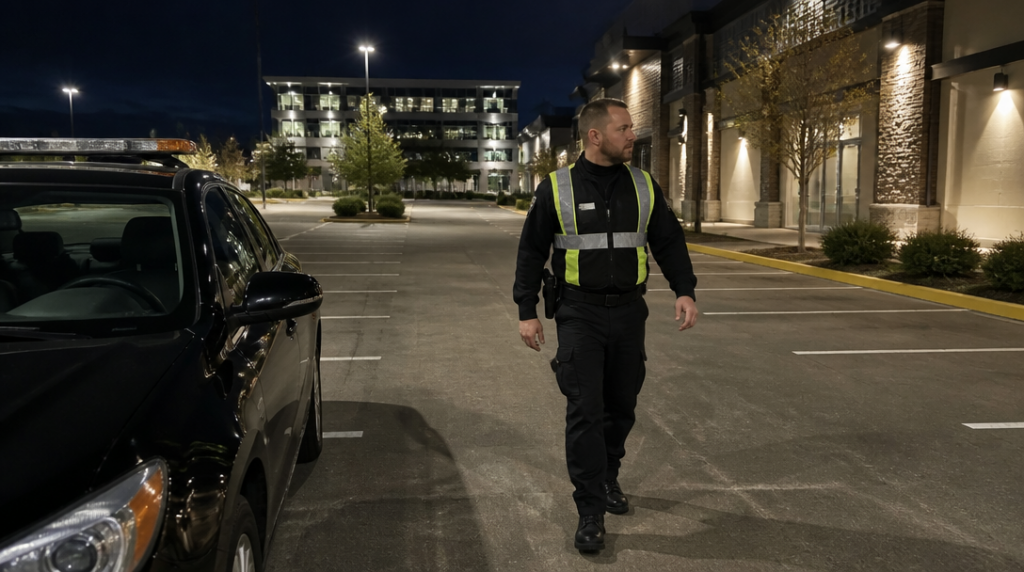
At 10:30 p.m., a shopping center may look quiet from the road: empty storefronts, a few cars under the lamps, and one security guard making a slow circuit through the parking lot. The property manager sees a single person on duty. The invoice reflects something much larger: coverage every night, weekends, holidays, payroll costs, insurance, supervision, and the margin charged by the security company.
That gap between what a guard appears to cost and what continuous protection actually costs is where many commercial security budgets go wrong. In the United States, ordinary commercial security commonly falls around $26 to $32 per hour, but that range is only a starting point. A licensed unarmed guard often costs $30 to $40 or more per hour, while armed coverage commonly reaches $45 to $75 or more per hour.
The final quote depends less on the word “guard” than on the assignment behind it.
The basic hourly calculation
For a straightforward daytime post at an office building, warehouse, retail property, or construction site, a business might receive a quote near the lower end of the commercial range. At $26 to $32 per hour, one guard working a standard eight-hour shift costs roughly $208 to $256 per day before taxes, special equipment, or additional services enter the picture.
That figure is useful, but it can create a false sense of scale. A single post operating around the clock requires 24 hours of coverage every day, not one employee working continuously. At the same hourly range, one uninterrupted 24/7 post comes to approximately $227,760 to $280,320 per year.
That is for one position. A large property with a lobby guard, a patrol officer, and a separate loading-dock post can multiply the annual bill quickly. A security plan that sounds like “just two guards” may actually mean two posts covered across every hour of the week.
Businesses should also check whether the quoted hourly figure is a billable rate or an employee wage. Those are not interchangeable. A security company’s billable rate may cover recruiting, licensing administration, uniforms, training, scheduling, insurance, payroll, management, reporting systems, and replacement staff when someone calls out. A low quote may simply leave more of those responsibilities outside the stated price.
Unarmed does not mean basic
An unarmed guard is usually the most economical option, but the job can vary dramatically. A person checking visitors into a corporate lobby has a different workload from someone patrolling a vacant industrial site at night. Both may be described as unarmed security, yet the risks, training expectations, reporting requirements, and supervision can differ substantially.
Licensed unarmed coverage generally costs about $30 to $40 or more per hour. Rates can rise when the assignment requires a guard with experience in access control, de-escalation, emergency response, loss prevention, healthcare security, or detailed incident documentation. A client may also pay more for officers who must operate access systems, monitor cameras, enforce site rules, or coordinate with police and emergency services.
The cheapest uniformed presence is not automatically the cheapest contract. If guards are poorly matched to the site, turnover and missed procedures can undermine the reason the service was hired in the first place. A guard who spends most of a shift standing at a door may appear interchangeable with any other guard, but the difference becomes obvious when an angry visitor, an alarm, or a disputed delivery arrives at that door.
Armed security carries a different price tag
Armed guards typically cost more because the assignment carries greater liability, stricter qualification requirements, and a higher level of responsibility. Typical pricing often starts around $45 per hour and can exceed $75 per hour, particularly for specialized work or high-risk environments.
The word “armed” can also hide several different services. A stationary armed guard at a financial facility is not the same as an executive protection specialist, a mobile response officer, or a guard assigned to transport valuable goods. The weapon itself is only one part of the cost. The client is paying for the selection process, qualifications, training, equipment, supervision, and risk profile attached to the post.
Some businesses request armed coverage because it sounds more serious, even when the site’s actual problem is poor lighting, uncontrolled access, or a lack of clear closing procedures. A firearm does not repair a broken gate or make an incomplete visitor log useful. In some settings, a well-trained unarmed officer with clear authority and reliable communication may be a more sensible investment.
What local rates reveal
Local government contracts offer a useful reality check, although they should not be treated as universal market prices. In Los Angeles, official rates effective February 20, 2025, list an unarmed guard at $30.65 per hour and a vehicle-equipped unarmed guard at $33.65 per hour. The armed rate is $34.14 per hour, rising to $37.14 per hour with a vehicle.
Those figures show how a vehicle can add a relatively modest hourly amount while changing the service itself. A patrol vehicle allows the officer to cover a wider area, respond to alarms, inspect remote sections of a property, or move between buildings. It also introduces fuel, maintenance, insurance, and vehicle management into the assignment.
The Los Angeles rates also complicate the idea that armed security always costs dramatically more than unarmed security. In a particular contract structure, the difference may be narrower than a business expects. Private commercial quotes can still vary widely because the scope, provider, local labor market, and insurance requirements are different.
Federal-style rates may sit higher
Federal contracting rates provide another benchmark. For 2026, the listed rate is $44.43 per hour for Guard I and $48.99 per hour for Guard II. These categories reflect defined contract standards and should not be read as a universal price list for every private business.
They do, however, illustrate why a quote in the mid-$40s is not necessarily inflated. A commercial client asking for trained personnel, strict reporting, dependable staffing, and formal oversight may be purchasing something closer to a contract-grade service than a basic watchman post.
One short sentence deserves its own paragraph.
The hourly rate is only half the question.
The other half is what the guard is expected to do during those hours.
The details that push a quote upward
Coverage outside normal business hours is usually more expensive than a predictable daytime post, especially if the location has a history of theft, vandalism, trespassing, labor disputes, or confrontations with the public. A remote site may need a vehicle and a guard capable of working alone. A busy retail property may need multiple officers during peak periods and less coverage after closing.
Scheduling can be another hidden complication. A request for a guard every day of the year requires a staffing plan that accounts for days off, vacations, illness, training, and turnover. A provider that promises one named person on every shift may be offering an attractive idea rather than a realistic staffing model.
Clients may also pay extra for supervisors, mobile patrols, canine teams, alarm response, camera monitoring, incident-management software, detailed daily activity reports, or integration with an existing security department. Uniforms and radios may be included, charged separately, or supplied by the client. The same applies to vehicles, body cameras, access-control equipment, and specialized protective gear.
Geography matters as well. Rates in a major metropolitan area can differ sharply from rates in a smaller town, while remote or difficult-to-staff locations may carry their own premium. A warehouse outside a city might avoid urban labor costs but pay more to attract qualified personnel willing to commute or remain on-site overnight.
How to compare quotes without being misled
A serious comparison starts with the post orders, not the headline rate. The proposal should state where the guard will be stationed, what patrols are required, which hours are covered, how breaks are handled, what reports are produced, and who responds when the assigned officer is unavailable.
It should also make clear whether the rate changes for weekends, holidays, overtime, emergency call-outs, or short-notice requests. A contract with a low base rate can become expensive if routine changes are billed as special services.
Ask whether the company guarantees replacement coverage. One absent guard can leave a property exposed, and the business may not discover that weakness until the shift has already started. Clarify how supervisors inspect posts, how incidents are escalated, and whether the client receives records that can be reviewed later.
The most useful question is often not “What is your hourly rate?” but “What exactly is included at that rate?” A provider that answers with a clean scope of work is easier to evaluate than one that relies on a reassuring number and vague promises.
Security is one of those services where the invoice can look excessive on a quiet Tuesday and entirely justified after a single serious incident. That tension makes price comparisons uncomfortable, but it also makes a thinly described bargain especially risky. A guard standing beneath the parking-lot lights is visible; the staffing, training, and contingency planning behind that person usually are not.